Story summary
In the 18th century, Balochistan was introduced to Urdu when Mir Naseer Khan of Kalat supported Ahmed Shah Abdali's military campaigns against the Marathas in India. During this period, about 25,000 soldiers from Balochistan fought alongside Urdu-speaking troops from Delhi and other parts of India. This exposure led some Balochi families to learn Urdu, including the forefathers of Mulla Hasan Brahui, who became Balochistan's first Urdu poet by completing his collection in 1847.
According to Prof Anwer Roomaan’s book "Balochistan Mein Urdu Zaria-i-Ta’leem," another significant phase for Urdu was during the British colonial period. Professor Roomaan highlights that Syed Ahmed Shaheed and his Urdu-speaking fighters traveled through various parts of Balochistan in 1826 en route to Kandahar, Afghanistan, further influencing the region’s cultural landscape.
These historical connections underscore how Urdu literature has been an integral part of Balochistan's cultural heritage for over a century.
Written for “Urdu Literature History” on 2026-10-05,
grounded in this article and the 0 other(s) covering the same event.
PROF ANWER Roomaan (1924-2013) in his book Balochistan Mein Urdu Zaria-i-Ta’leem, or Urdu as medium of instruction in Balochistan, has described the early history of Urdu in Balochistan.
asserted
Roomaan → describe → Balochistan
According to him, Balochistan’s first real and impactful introduction to Urdu occurred in 18th century when Khan of Kalat Mir Naseer Khan (reign 1749-1794) sided with Afghanistan’s Ahmed Shah Abdali during the latter’s military campaigns in India, in particular during the third Battle of Panipat in 1761 against Marathas.
uncertain
Khan → accord → Marathas
From Khan of Kalat’s side, about 25,000 Baloch, Brahui and Pakhtun soldiers fought alongside some Urdu-speaking troops from Delhi and other parts of India.
asserted
soldiers → fight → India
Forefathers of Mulla Hasan Brahui — Balochistan’s first Urdu poet — were also part of Khan of Kalat’s troops and later on Hasan Brahui learnt Urdu from them.
asserted
Brahui → learn → them
In 1826, Syed Ahmed Shaheed and his fighters, most of them Urdu-speaking, travelled through Dhadar, Dasht, Saryab, Quetta and some other parts of Balochistan en route to Kandahar, Afghanistan.
asserted
most → speak → Kandahar
But a more important phase of Urdu’s impact dawned during the British colonial period.
asserted
phase → dawn → period
Dr Shamim Kausar in her book Balochistan Mein Urdu Adab, or Urdu literature in Balochistan, says the British adopted Urdu as official language in Balochistan and Urdu language and literature have been thriving more vigorously in the province since then.
asserted
language → say → province
A large number of poets from Balochistan have been contributing to Urdu literature and some of them wrote in Urdu as early as in 19th century, for instance, Mulla Hasan Brahui (died 1855), who finished writing his collection of Urdu poetry in 1847, and Muhammad Yousuf Khan Popalzai (1863-1936).
asserted
who → contribute → 1847
The latter-day poets from Balochistan carried on the tradition of composing poetry in Urdu, for instance, Taj Muhammad Tajel (died 1944), Khaliq Gul Muhammad Magsi (1884-1954) and Syed Abid Shah (1888-1949), not to mention the hundreds of others writing in Urdu in 20th and 21st centuries.
asserted
poets → carry → centuries
The 2025 Kamal-i-Fan, or prize for lifetime literary achievements, administered by Pakistan Academy of Letters, was awarded to Abdur Rahman Brahui, a scholar from Balochistan, for his outstanding research and critical works.
asserted
Fan → administer → research
One of his books Angrezi Par Urdu Ka Asar, or influence of Urdu on English, makes an interesting reading.
asserted
One → make → reading
The 2018 Kamal-i-Fan was awarded to Munir Ahmed Badini, a prolific writer from Balochistan.
asserted
Fan → award → Balochistan
So, history of Urdu language and literature in Balochistan is quite long and rich, spreading over 175 years and recording it is not an easy task.
asserted
spreading → spread → it
But Syed Khursheed Afroz, a veteran scholar from Loralai, Balochistan, has been doing so for over a decade now.
asserted
Afroz → do → decade
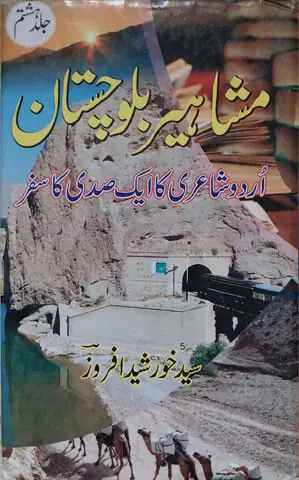
Compiling a compendium of Urdu literature created in Balochistan, Afroz has so far published eight volumes in a series titled Mashaheer-i-Balochistan, recording brief life sketches and describing literary works of prose writers and poets of Urdu hailing from Balochistan.
asserted
Afroz → compile → Balochistan
The first volume (2016) covers Urdu poetry’s 100 years in Balochistan, from 1830 to 1930.
asserted
volume → cover → 1930
The second volume (2017) spans next 30 years, that is, 1930 to 1960.
asserted
volume → span → 1960
In the third volume (2017), Khursheed Afroz chronicles the period of Urdu literature between 1957 and 2016.
asserted
Afroz → chronicle → 1957
The fourth volume (2017) presents the introduction to literary organisations active in Balochistan.
asserted
volume → present → Balochistan
The fifth volume (2018) highlights women poets from Balochistan who composed poetry in Urdu between 1914 and 2014.
asserted
who → highlight → 1914
In the sixth volume (2019), he introduces the prose works in Urdu by women writers from Balochistan, spanning the 50 years from 1915 to 1965.
asserted
he → introduce → 1965
The next 50 years are covered in volume seven (2019).
asserted
years → cover → volume
The eighth volume (2025), titled Mashaheer-i-Balochistan: Urdu Shaeri Ka Aik Sadi Ka Safar is in fact a vastly revised and updated edition
asserted
volume → title → fact
the 400-page first volume now has over 700 pages.
asserted
volume → have → pages
These volumes prove that Urdu has been a medium of literary and creative expression in Balochistan for nearly two centuries and the province has produced some very fine poets and prose writers of Urdu.
asserted
province → prove → Urdu
Syed Khursheed Afroz was born on March 15, 1943 in Loralai, Balochistan.
asserted
Afroz → bear → Loralai
He has taught at different colleges in Balochistan.
asserted
He → teach → Balochistan
A poet, columnist, researcher and critic, Khursheed Afroz has published three collections of his Urdu poetry.
asserted
Afroz → publish → poetry
Khursheed Afroz is working on the ninth volume but lack of support and encouragement has made him sound a bit sulky in the eighth volume’s intro.
asserted
him → work → intro
One hopes that the provincial and federal governments would play their role and the untiring efforts of this octogenarian scholar would be recognised in a befitting manner.
asserted
efforts → hop → manner
 The Aporia