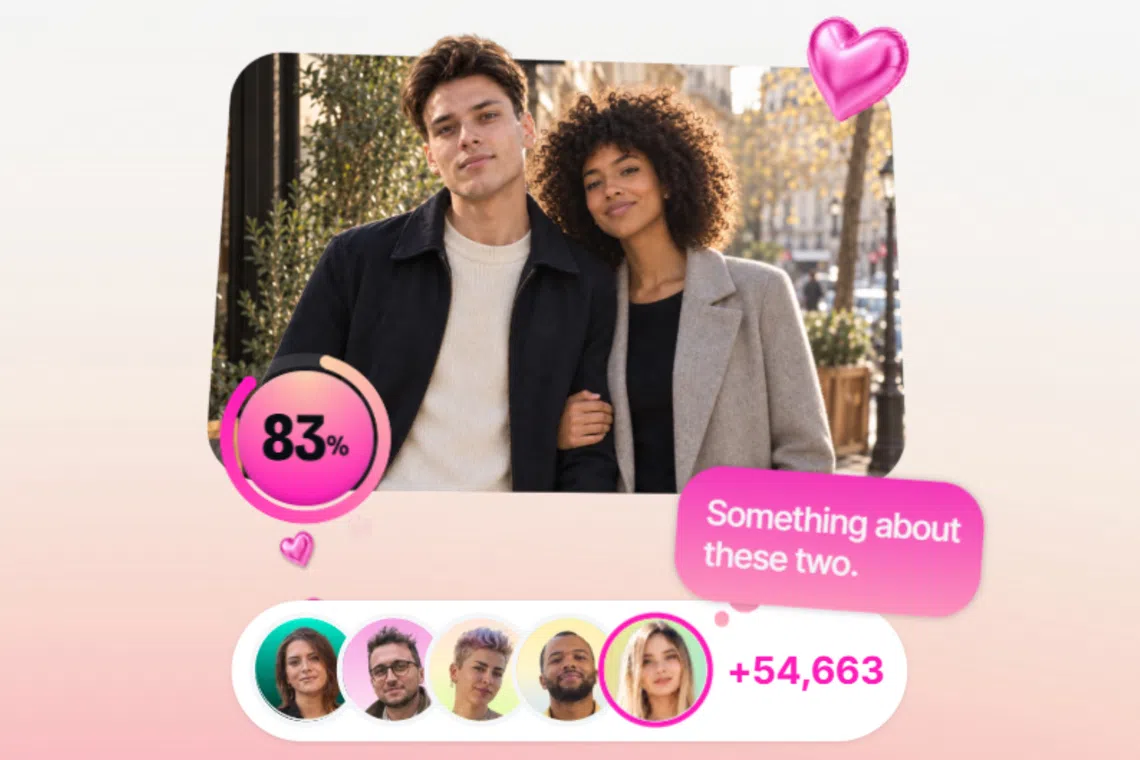
A former Tinder executive named Taru Kapoor has launched a new dating app called Rivet, which allows strangers to vote on the compatibility of potential matches. The app, set to launch in the US on October 8, aims to provide quality connections rather than quantity by having volunteer “matchers” rate pairs’ compatibility before users are shown potential dates. Funded with $10.5 million in seed funding, Rivet uses an algorithm and community input to suggest matches, emphasizing the objectivity of outside perspectives over individual biases.
Written locally by qwen2.5:14b on 2026-10-05,
using this article's own text rather than the other coverage of the
same event (that is the story summary below).
Dating app from ex-Tinder executive lets strangers play matchmaker
AI generated
asserted
strangers → let → AI
A former Tinder executive launched a new dating app that invites the community to vote on strangers’ compatibility, putting a twist on courtship at a time when singles have grown exhausted with swiping.
asserted
singles → launch → swiping
Rivet, which opens to US users on Oct 8, relies on a pool of volunteer “matchers” who rate whether two given people might be compatible.
uncertain
people → open → matchers
The idea is to prioritise quality connections over quantity, giving daters just a few pre-vetted options at a time, founder and chief executive Taru Kapoor said in an interview.
asserted
Kapoor → prioritise → interview
That may include some prospects who fall outside the user’s typical preferences.
uncertain
who → include → preferences
“It surfaces a lot of people that you may otherwise swipe past, especially because when you’re swiping through like 200 people on Bumble or Hinge, and people get faster and faster, more and more transactional and judgmental,” said Kapoor, who spent eight years at Tinder and was a general manager for several Asian markets.
uncertain
who → surface → markets
Dating-app companies have been making major changes to their products in a bid to lure back singles who have reported burnout.
asserted
who → make → burnout
Bumble and Match Group’s Tinder host in-person meet-ups to get people off the app and keep users engaged.
asserted
Bumble → host → users
Bumble has also added an artificial intelligence-powered matchmaking tool as an alternative to swiping, and it gives men a chance to make the first move, not just women.
asserted
it → add → move
New York-based Rivet, which raised US$10.5 million (S$13.4 million) in seed funding and has been testing in select markets, is available on iOS and Android.
asserted
which → base → iOS
Though it is free to join, some features are paywalled, including the ability to message someone without having been matched by the community first.
asserted
features → join → community
The platform is built on the premise that aggregating wisdom from a crowd can help cancel out individual biases for better results.
asserted
aggregating → build → results
Users fill out their profiles with information about what they are looking for, and the algorithm suggests potential pairings.
uncertain
algorithm → fill → pairings
Matchers then review the profiles and cast their vote, resulting in a composite compatibility score.
asserted
Matchers → review → score
High-scoring pairs are matched and can choose to start chatting.
asserted
pairs → score → ?
“It’s very easy for most of us to look at a friend who may be dating the wrong person and ask, ‘Why?’” Kapoor said.
uncertain
Kapoor → ’ → person
“Most humans are actually pretty good at reading other people.”
asserted
humans → read → people
People also tend to be “more objective and rational”, she added, when they are outsiders looking in on someone else’s life.
asserted
they → tend → life
Rivet is not the first dating platform to outsource matchmaking to a community of volunteers.
asserted
Rivet → outsource → volunteers
In 2025, reality star Bethenny Frankel launched the Core, where daters receive curated matches from their peers.
asserted
daters → launch → peers
It is unclear if either of these alternative dating platforms has a chance of pulling in large numbers of users.
uncertain
either → have → users
Kapoor’s app is attempting to stand out with an AI-powered visualisation feature that blends photo pairs together, helping users gauge vibe and height compatibility side by side.
asserted
users → attempt → side
“Humans introducing humans is the oldest technology,” Kapoor said.
asserted
Kapoor → introduce → humans
“A lot of people are turning to matchmaking – human curation – more than before, but it’s very expensive.
asserted
it → turn → matchmaking
If you can afford a US$20,000 matchmaker, great.
asserted
you → afford → matchmaker
But if you can’t, how about I give you several different matches for free?”
asserted
I → give → matches
Rivet tries in different ways to gamify the experience to persuade people to return.
asserted
Rivet → try → people
Matchers can earn “karma currency” when successful matches are made, which can be redeemed for profile perks, direct introductions, cash rewards or gift cards.
asserted
which → earn → perks
(The ability to reach out to someone without having matched costs 1,000 in karma points for one message.
asserted
ability → reach → message
A pack of 3,000 karma costs US$9.99.)
asserted
pack → cost → 9.99
The app also includes features such as weekly top-matcher leaderboards, live events, and promotions that cover half the cost of a first date.
asserted
that → include → date
“People can log onto the app and there are live social match events happening live, with a host and a pair on the screen,” she said.
asserted
she → log → screen
“A lot of people join in and then the audience asks questions.
asserted
audience → join → questions
We are bringing this energy of sort of making the crowd your wingmen.”
asserted
crowd → bring → energy
 The Aporia