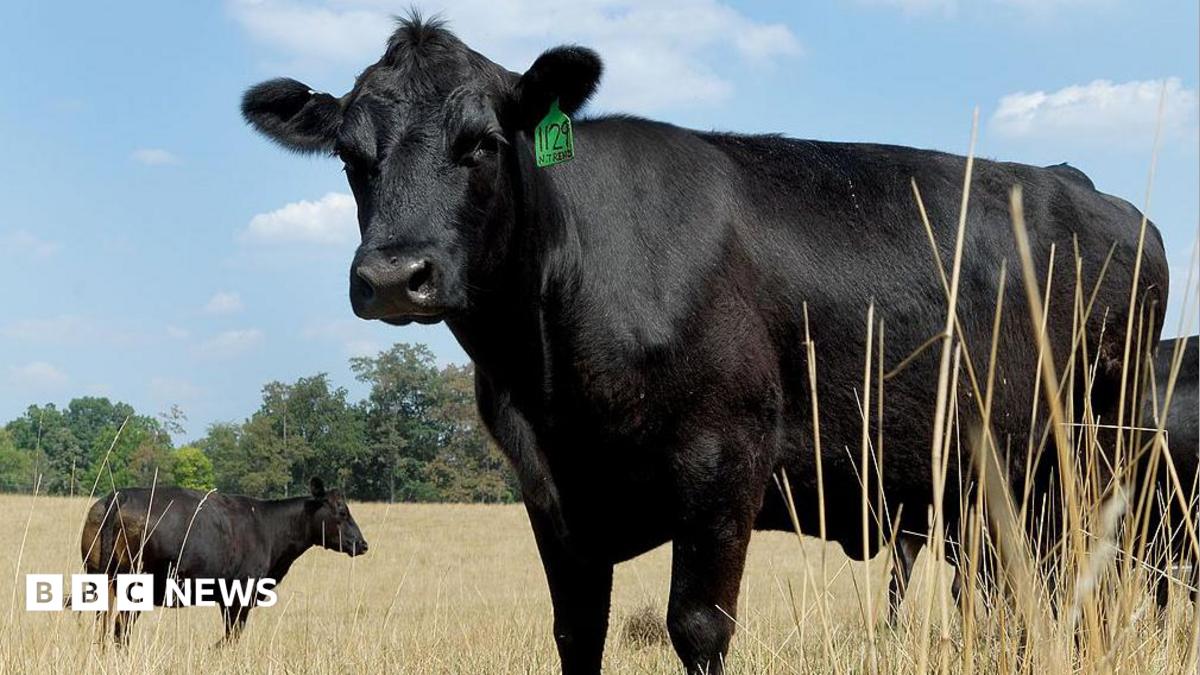
- Published
With US beef prices soaring to record highs, you might think that South Dakota cattle rancher Eric Gropper would be celebrating.
uncertain
Gropper → publish → highs
Yet while the cost of the meat in US supermarkets is now 12% higher, external than it was a year ago, a rise more than three times the rate of general inflation, Gropper says that he and all the other beef farmers aren't making any more profit than usual.
asserted
he → say → profit
The BBC World Service's Follow the Money series spent a week tracing the American beef supply chain to find out what has caused the price jump and discover where all the cash is going.
asserted
cash → follow → jump
The rancher
Eric Gropper has about 350 breeding cows on around 8,000 acres of grassland in south-west South Dakota.
asserted
rancher → have → Dakota
Most of it he leases from the Pine Ridge Indian Reservation.
asserted
he → lease → Reservation
Gropper doesn't set the price for his calves.
asserted
Gropper → set → calves
Instead once a year he takes them to a livestock auction where buyers place bids and the hammer decides.
asserted
hammer → take → bids
Right now the bids are the highest he has ever seen - around $2,500 (£1,883) for a 600lb (272kg) calf, up from $2,000 two years ago.
asserted
he → see → 2,000
These record prices are driven by a simple fact – there are not enough cattle.
asserted
prices → drive → fact
Due to a combination of drought in many states, and disease pressure, at the start of this year the US had fewer cattle than at any point since 1951.
asserted
US → have → 1951
, external
Gropper is experiencing drought first hand, as the 13 natural wells across his land that provide ground water for his cattle have run dry.
asserted
that → experience → cattle
He has to use a water tanker instead.
asserted
He → have → tanker
Due to the national shortage of cattle, Gropper is getting record prices for his.
asserted
Gropper → get → his
But unfortunately his costs have equally climbed to new highs.
asserted
costs → climb → highs
A new pick-up truck that once cost $40,000 now runs to $100,000.
asserted
that → pick → 100,000
A wooden fence post has gone from about $6 to as much as $19.
asserted
post → go → 19
A quarter-mile roll of barbed wire has doubled, from $60 to $130.
asserted
roll → double → 130
Everything he uses day to day, he says, has jumped in price since the Covid pandemic.
asserted
he → use → pandemic
And with little grass on parched fields – well over 60% of US cattle are now grazing on drought-hit land - farms like his are having to buy in hay, silage and other fodder for their cattle.
asserted
farms → graze → cattle
I'm able to pay my bills, but my input costs are so drastically high that if we didn't have these record prices we'd all be broke.
asserted
we → pay → prices
I sit down to do my taxes, and it feels like I made a lot of money.
asserted
I → sit → money
But in the end I really didn't make any more."
asserted
I → make → more
The feedlot
Gropper's calves don't go straight to slaughter.
asserted
calves → go → slaughter
At around six-months-old they are bought by companies that run feedlots – large yards where the animals are fattened on corn and other grains for the final three to six months of their lives.
asserted
animals → buy → lives
The biggest yards hold well over 100,000 cattle at a time.
asserted
yards → hold → time
Around 95% of US cattle are finished this way.
asserted
% → finish → cattle
Brenda Boetel, professor of agricultural economics at the University of Wisconsin–River Falls, watches this part of the chain closely.
asserted
Boetel → watch → chain
She says that while the feedlot companies are currently selling cattle at record prices, they are having to buy them at all-time highs in the first place.
asserted
they → say → place
So they are not making bigger profits.
asserted
they → make → profits
The meatpacker
A meatpacker is the plant that slaughters the animal and breaks the carcass down into the cuts that reach shops or restaurants.
asserted
that → slaughter → shops
Four companies - Tyson, JBS, Cargill and National Beef - control around 85% of American beef processing.
asserted
companies → control → processing
That high level of market concentration has drawn accusations of price-fixing, even from President Trump.
So you might expect that those four firms are currently making huge profits from high beef prices.
uncertain
firms → draw → prices
Yet the opposite is happening.
asserted
opposite → happen → ?
Tyson, the biggest of the four, reported in May that it had lost more than $500m, external on beef in the first half of its financial year.
uncertain
it → report → year
Again, it might be selling its beef for record highs, but it is also buying the cattle at all-time peaks.
uncertain
it → sell → peaks
Jamie Crumley owns one of the remaining smaller meatpackers - Harpley's Meatpacking in central North Carolina.
asserted
Crumley → own → Carolina
She says the price companies like hers have to pay for the live animals has gone up by as much as 60% over the past three years.
asserted
companies → say → years
And while meatpacking companies have increased the prices they charge for their beef, there is a limit.
asserted
they → increase → beef
This is because supermarkets, restaurants – and US consumers – can, and will, simply switch to buying chicken or cheaper imported beef instead.
asserted
supermarkets → switch → chicken
For example, Harpley's is built to handle 425 to 450 cattle a day.
asserted
Harpley → build → cattle
…and 22 more, not listed.
 The Aporia