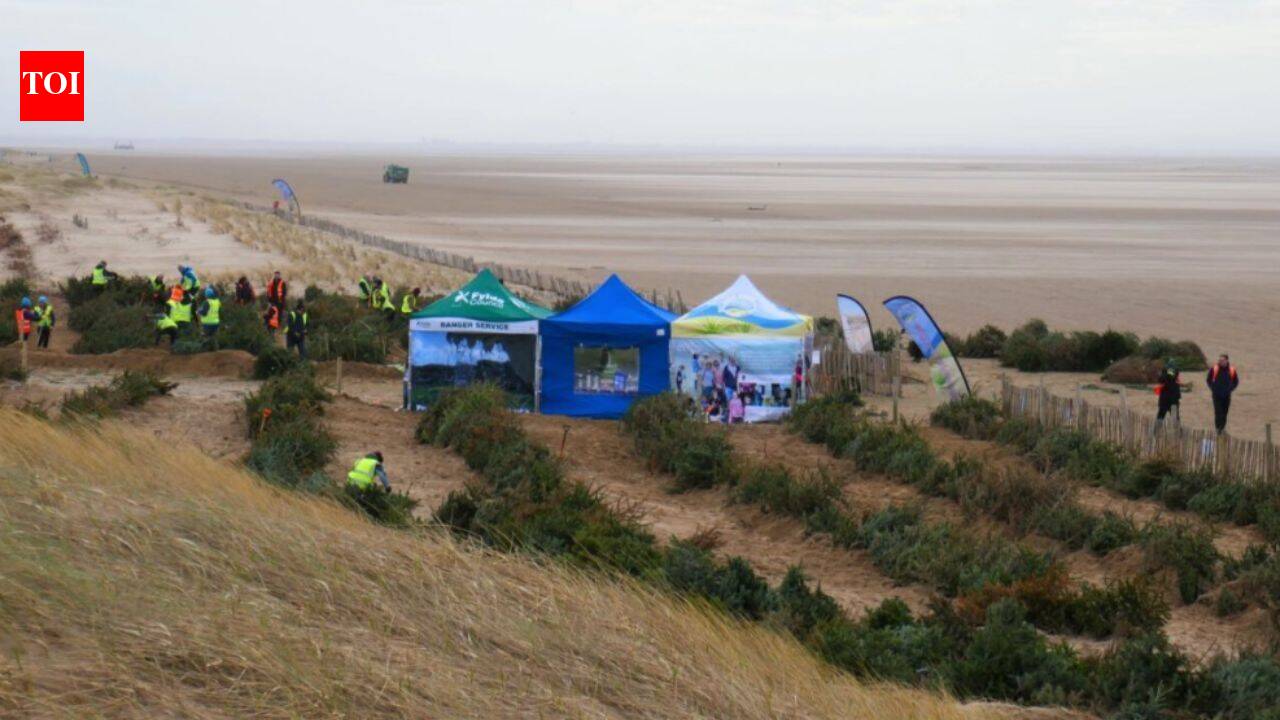
Discarded Christmas trees are being used to help protect homes and businesses along the Fylde Coast in Lancashire, UK.
asserted
trees → discard → Lancashire
Since the project began in 2013, old Christmas trees have been placed on St Annes beach to trap wind-blown sand and help build wider sand dunes.
asserted
trees → begin → dunes
According to Fydle Council, the annual work is part of the Fylde Sand Dunes Project, which aims to restore and conserve the coastal dunes.
uncertain
which → accord → dunes
Fylde Council, Lancashire Wildlife Trust and Blackpool Council work together on the project, which is funded by the Environment Agency.
asserted
which → work → Agency
Trees are placed in front of the existing dunes, where their branches slow down the wind and trap sand.
asserted
branches → place → sand
As more sand collects around the trees, the mound grows and can eventually become part of a new dune.
asserted
mound → collect → dune
The project has already produced a visible change.
asserted
project → produce → change
Last year, more than 2,000 Christmas trees were collected from residents and used in the planting work.
asserted
trees → collect → work
According to the council, this helped create a 90-metre increase in the width of the Fylde Sand Dune system.
uncertain
this → accord → system
Christmas trees build dunes
asserted
trees → build → dunes
Sand dunes naturally develop when wind-blown sand is trapped by an obstruction on the beach.
asserted
sand → develop → beach
At first, the collected sand can be unstable and may collapse.
uncertain
sand → collect → ?
Plants can then begin growing in small pockets of sand and help hold the material in place.
asserted
Plants → begin → place
At St Annes, discarded Christmas trees act as the first obstruction.
asserted
trees → discard → obstruction
Their branches catch sand carried inland by the wind.
asserted
branches → catch → wind
Over time, more sand becomes trapped around the trees, allowing the dune to grow.
asserted
dune → trap → trees
The process then continues naturally.
asserted
process → continue → ?
Pioneer grasses such as sand couch and lyme grass can grow in the dunes.
asserted
grasses → grow → dunes
Marram grass can later become more dominant as sand builds around it.
asserted
sand → become → it
Its growth helps stabilise the new dune, allowing more plants to establish.
asserted
plants → help → dune
As the plants grow and spread, they help hold more sand in place.
asserted
they → grow → place
Eventually, organic matter from plants that die and decay builds up.
asserted
that → die → plants
The dune becomes more stable and develops into a habitat with different plants and animals.
asserted
dune → become → plants
Why dunes matter
asserted
dunes → matter → ?
Dunes act as a natural, or ‘soft’, sea defence.
asserted
Dunes → act → defence
During storms, they absorb some of the energy from the sea.
asserted
they → absorb → sea
Wider dunes are more effective at providing this protection.
asserted
dunes → provide → protection
The dunes help reduce the risk of erosion caused by storm surges, which happen when strong winds combine with high tides.
asserted
winds → help → tides
According to the Fylde Council, more than 80% of the dunes have been lost over the past 150 years because of coastal development.
uncertain
% → accord → development
The remaining dunes are now squeezed between the sea and nearby towns.
asserted
dunes → remain → sea
This makes protecting and extending them important for both coastal communities and wildlife.
asserted
protecting → make → communities
Amy Pennington, Lancashire Wildlife Trust’s Fylde Sand Dunes Project Senior Engagement Officer, said the dunes provide habitat for a wide range of plants and animals and also act as a soft sea defence.
asserted
dunes → say → defence
“The sand dunes along the Fylde Coast are home to a diverse and specialised ecosystem, hosting a variety of unique plants and animals,” she said.
asserted
she → host → plants
A habitat for plants and wildlife
The dunes have been designated as a Biological Heritage Site and are also a Site of Special Scientific Interest (SSSI).
asserted
dunes → designate → Interest
They support specialised plants and animals that are adapted to the dry and shifting conditions of a sand dune environment.
asserted
that → support → environment
Species found in the dunes include dune helleborine orchids, Isle of Man cabbage, dune pansies, sea holly and round-leaved wintergreen.
asserted
Species → find → Man
Wildlife includes the grayling butterfly, mining bees, common lizards, skylarks, linnets and reed buntings.
asserted
Wildlife → include → butterfly
The environment changes as the dunes develop.
asserted
dunes → change → ?
Areas closer to the beach can have alkaline conditions because the sand contains pieces of sea shells.
asserted
sand → have → shells
Further inland, the ground can become more acidic as the dune matures, allowing different plants to grow.
asserted
plants → become → ?
…and 9 more, not listed.
 The Aporia