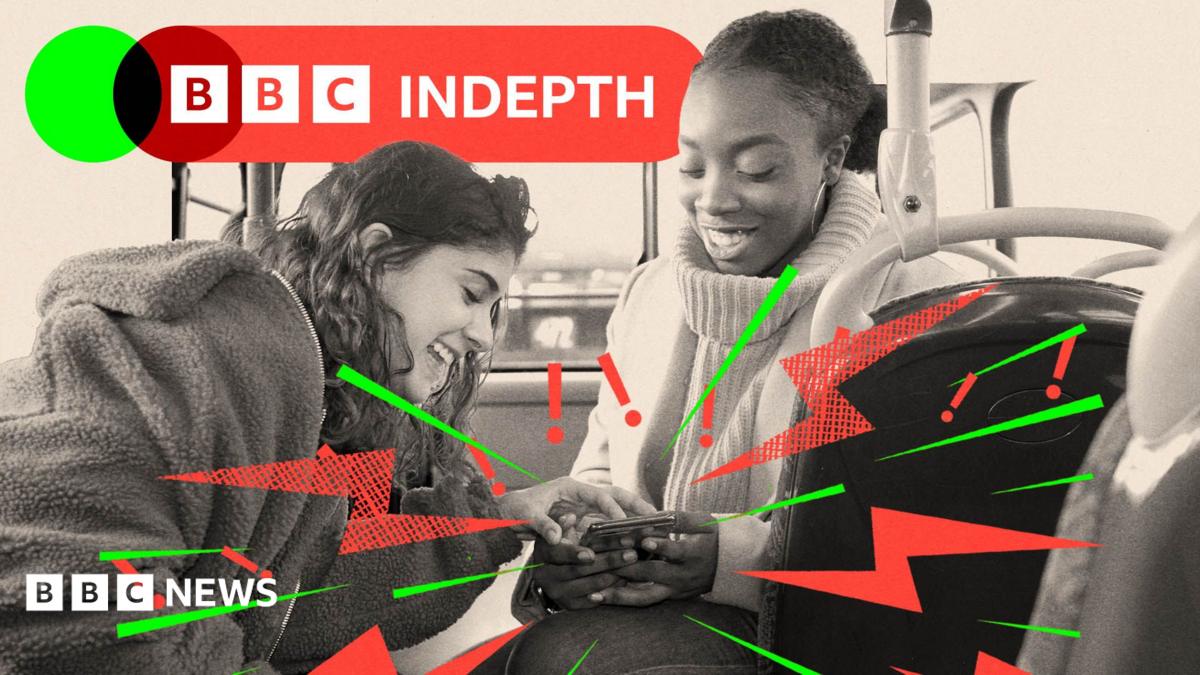
Most days on my commute, I am treated to the contents of strangers' phones.
asserted
I → treat → phones
It could be a teenage boy slouching on a seat on the top deck of the number 29, holding his device inches from his face, either unaware or indifferent that everyone else can hear what he's watching too.
Or a woman taking a phone call on loudspeaker before scrolling at volume through her social feed.
Surveys suggest that many do find this modern phenomenon - known as loudcasting, sodcasting, or headphone dodging - similarly frustrating.
In recent years, Ofcom, YouGov and Transport for London (TfL) have all published polls showing the vast majority of people dislike it.
uncertain
majority → slouch → it
TfL has just relaunched its Travel Kind campaign across the London transport network this summer, reminding people to use headphones.
asserted
TfL → relaunche → headphones
The phenomenon has grown as we become ever more connected.
asserted
we → grow → ?
Figures published in July by Ofcom show that mobile data use has increased by 13% year-on-year in the UK.
asserted
use → publish → UK
5G is being rolled out across the country, meaning that more people can get faster connectivity while travelling.
asserted
people → roll → connectivity
And research has found that many data packages have become cheaper, meaning customers are less likely to have to ration their data use when out and about.
asserted
customers → find → use
So as we become ever more online in public, will we see increasing attempts to clamp down on loudcasting?
asserted
we → become → loudcasting
Or will it end up becoming as normal a part of our soundscape as the hum of passing traffic or the roar of a plane's engine thousands of feet above us?
asserted
it → end → us
Boomboxes in the 1980s and 1990s, for example, caused a stir.
asserted
Boomboxes → cause → stir
Bath University professor David Ellis points out that each new technological trend - including the very use of mobile phones - has often prompted odd looks when deployed in public.
asserted
trend → point → public
"I remember when my mother was mortified that I was walking down the street with a phone to my ear," he says.
asserted
he → remember → ear
Loudcasting has piqued the interest of experts who study how technology shapes our behaviours, and they agree there's a strong generational factor.
asserted
they → pique → behaviours
In an Ofcom survey of 1,010 people in August 2022, of the 13-to-17-year-olds questioned, 69% said it was acceptable to make video calls, 73% to listen to music and 83% to watch videos without headphones.
asserted
it → question → headphones
University of Sussex physiology professor Harry Witchel, who has a long-running interest in soundscapes, argues that it makes sense in the context of young people's brain development.
asserted
it → have → development
He notes that adolescence is when young people move from their parents to their peers, and loudcasting is a way of expressing this.
asserted
loudcasting → note → this
"That's what they're doing, they're saying 'I'm here'," he says.
asserted
he → do → what
"I would say it is," says Dr Rachael Kent, a senior lecturer in digital economy and society at King's College, London.
asserted
Kent → say → College
She adds that it's not wholly borne out of a lack of consideration for others - loudcasting can be a tool for connection.
asserted
loudcasting → add → connection
"Travelling to and from school on public transport with friends, they're experiencing their devices together."
asserted
they → travel → devices
She also argues it's "performative… a way to rebel.
asserted
it → argue → ?
'I'm going to play music, watch stuff', that's a way to express who you are, what your tastes are."
asserted
tastes → go → stuff
Witchel says he began observing loudcasting around 2011, a few years after the release of the iPhone.
asserted
he → say → iPhone
That year he spoke to the BBC about young people playing music aloud from their phones in public, in what he described as a "fascinating human phenomenon of marking social territory".
asserted
he → speak → territory
Fast-forward to 2026, and - alongside tech advances such as improved audio quality - he posits the idea that loudcasting is thriving with the help of a decline in social policing of public spaces and a loss of etiquette in the wake of Covid-19 lockdowns.
asserted
loudcasting → forward → lockdowns
"People were just used to walking around their homes in their bunny slippers, and when they came back into the commons and the social space they forgot there were rules they had to follow," he says.
asserted
he → use → commons
But what is it about the sound of someone scrolling on loud that I find so abrasive when any city or bus is already a cacophony of competing sounds?
asserted
city → scroll → sounds
"Noise is like weeds," Witchel says.
asserted
Witchel → say → weeds
If we think that the railway sounds are supposed to be on the railway, then we don't think of it as inappropriate.
asserted
we → think → it
"The issue isn't so much just pure decibels… the issue is actually attention and how we deal with certain soundscapes, and how that sound environment relates to us.
asserted
environment → deal → us
It has a contextual meaning."
asserted
It → have → meaning
Witchel says we can "habituate" to a train noise, which becomes "much easier to put up with than if someone has a loud conversation".
asserted
someone → say → conversation
Transport for London (TfL), which operates the capital's trains and buses, last year launched a public awareness campaign calling for passengers to be considerate after the results of a survey of 1,000 people said 70% of respondents found loud music and phone calls without headphones a nuisance.
asserted
music → operate → headphones
The Liberal Democrats say such behaviour should be punishable with fines of up to £1,000.
asserted
behaviour → say → 1,000
The party's transport spokesman Olly Glover puts the trend down to a growing lack of social awareness.
asserted
spokesman → put → awareness
"Since the pandemic a lot of people live in their own head more than ever before," he says, adding, "they don't necessarily think about their impact on other people".
asserted
they → live → people
Glover says technology companies should bear some responsibility, suggesting they should provide headphones at railway stations or return to automatically selling them with phones.
asserted
they → say → phones
The BBC contacted tech companies including Apple, Samsung, Meta, and TikTok about their awareness of loudcasting and whether they were responding to it in any way.
asserted
they → contact → way
None of the companies commented.
asserted
None → comment → companies
The Lib Dems' push has also garnered some Tory support.
asserted
push → garner → support
…and 40 more, not listed.
 The Aporia