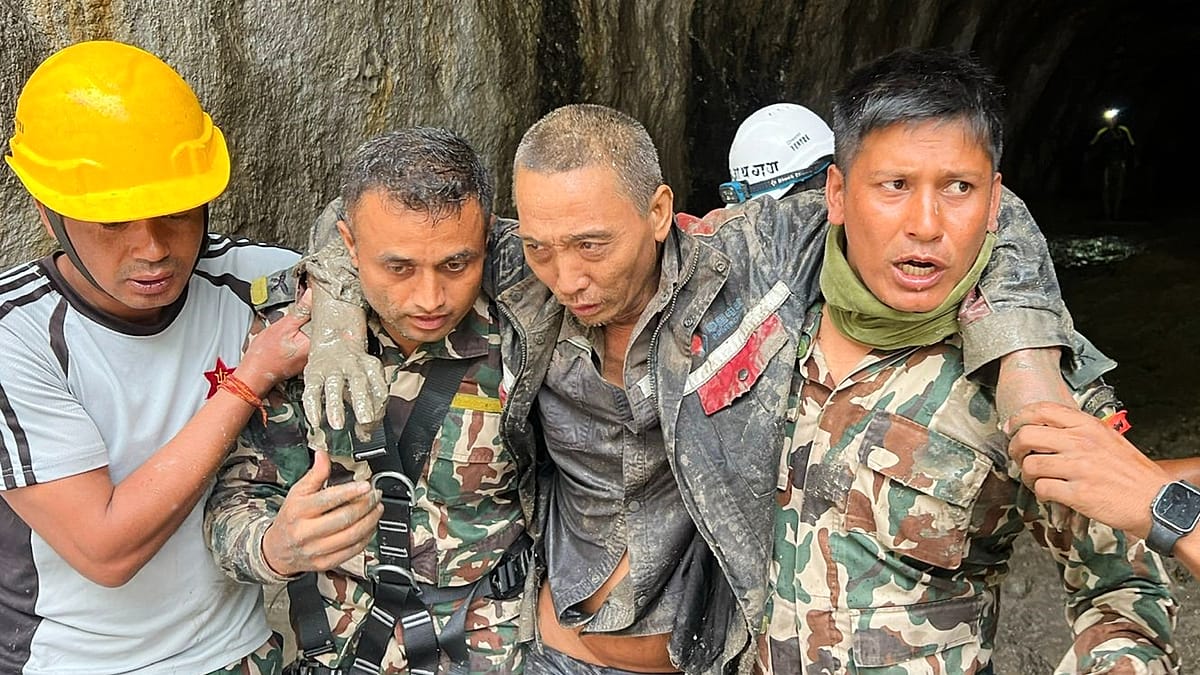
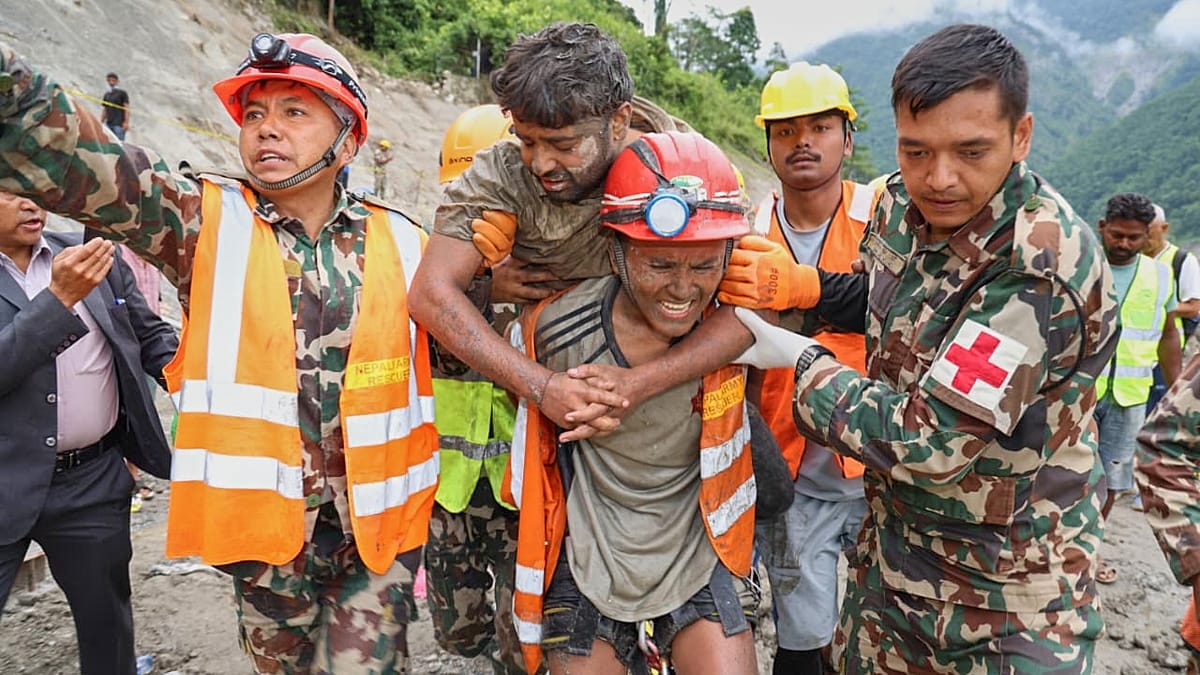
Watch: Moment 64-year-old Nepali woman is found alive in mud-buried home

BBC News · collected 2026-09-06
Read the original at BBC News ↗

Summary

A video shows a rescue team from Nepal's Armed Police Force discovering a 64-year-old Nepali woman named Chandika Shrestha alive in her partially buried home on September 5th. The incident occurred over 10 days after a natural disaster caused by ice, rock, and mud tore through a Himalayan valley in the Nuwakot district of Nepal. Details about Shrestha's condition are not provided in this report, but she was airlifted to a hospital in Kathmandu for treatment.
Written by the local model on 2026-09-06, using this article's own text rather than the other coverage of the same event (that is the story summary below).

Signals How these are calculated →

Claims extracted
4
claim-shaped sentences
Uncertain
25%
1 of 4 hedged
Leaning
not political
takes no side on a contested political question
Publisher trust
95.5
red-flag proxy, not a credibility rating
Outlets on this story
47
World
Narrative spread
1
articles carrying this framing
Analyzed 2026-09-06 · how these are computed

AI analysis (generated at analysis time, not now)

Story summary

A devastating flood and mudslide occurred on August 26 in the Himalayan region, particularly affecting areas along the Nepal-China border. The disaster was triggered by a massive glacial collapse that sent a tsunami-like wall of water, ice, and debris sweeping over the area, killing at least 1,362 people and leaving more than 5,500 missing across both countries.

In Nepal, rescuers have been working tirelessly to locate survivors, with some remarkable stories of rescue emerging. A 64-year-old Nepali woman, Chandika Shrestha, was found alive on the fourth floor of her partially buried house in the Nuwakot district after being trapped for more than 10 days. Another survivor, a man from China, was rescued from a hydropower tunnel.

The disaster has also had a significant impact on nearby villages and towns. The town's market and most residents were affected by the floodwaters, leaving many without homes or livelihoods. Rescuers have been using excavators, shovels, and ground-penetrating radar to scour the affected areas for survivors.

Pakistan has dispatched 100 tonnes of humanitarian assistance to Nepal to support relief efforts, including tents, blankets, mats, hygiene kits, and medicines. The aid is part of a broader international response to the disaster, with many countries offering support to Nepal and China.

In related news, Australia's Prime Minister Anthony Albanese expressed his condolences to Nepal's government and people, saying that 36 Australians remain missing after the disaster. He also emphasized the importance of finding long-term solutions to address the impact of AI datacentres on local communities, rather than just hosting them for short-term benefits.

Written for “Nepal Flood and Rescue Efforts” on 2026-09-07, grounded in this article and the 46 other(s) covering the same event.
Why this leaning score
This article does not take a side on a contested political question, so it has no leaning score. That is an answer rather than a gap: a match report or a rescue can be warmly or critically written without being left or right, and scoring it anyway is how approval of a subject gets recorded as a political position.
No political leaning scored for article 5252 · logged 2026-09-06

Story

📰 Nepal Flood and Rescue Efforts
World · 47 article(s) covering the same event.

How this is being covered How these are calculated →

Article leaning vs. publisher reliability
Source leaning vs. consistency

Compared with similar articles

This article reads unscored and hedges 25% of its claims. Each row says how that neighbour differs.
BBC News
⚖️ leaning not scored 🔴 0% hedged 0 of 3 📰 publisher trust 96
“Article A mentions two people rescued from a tunnel, while Article B describes a single person found alive in their partially buried house”
News | Euronews RSS
⚖️ leaning not scored 🔴 25% hedged 3 of 12 📰 publisher trust 95
“Both articles report on the same specific incident: the rescue of a 64-year-old Nepali woman named Chandika Shrestha from her partially buried house in Nuwakot district, with matching location, date, and outcome.”
National Post
⚖️ leaning not scored 🔴 12% hedged 2 of 17 📰 publisher trust 96
“Article A describes finding a Chinese national alive in a tunnel, while Article B describes finding a Nepali woman alive in her mud-buried home at different locations and with different details”
BBC News
⚖️ leaning not scored 🔴 21% hedged 6 of 28 📰 publisher trust 96
“Article A mentions flash floods and rescue efforts after 9 days, while Article B describes a single survivor found alive in her home on day 10”
Dawn - Home
⚖️ leaning not scored 🔴 11% hedged 2 of 19 📰 publisher trust 95
“Article A describes the rescue of a Chinese national from a tunnel, while Article B describes the rescue of a Nepali woman from her mud-buried home in a different location.”
News - South China Morning Post
⚖️ leaning not scored 🔴 0% hedged 0 of 9 📰 publisher trust 94
“Both articles describe the rescue of Chandrika Shrestha, a 64-year-old Nepali woman, who was found alive in her mud-buried home on September 5.”
World News Today: International News Headlines - The Hindu | The Hindu
⚖️ leaning not scored 🔴 0% hedged 0 of 13 📰 publisher trust 96
“Both articles describe the rescue of survivors from flash floods in Nepal on September 5, 2026, mentioning the same locations and people (Luhaitao and Chandika Shrestha).”
World news | The Guardian
⚖️ leaning not scored 🔴 16% hedged 7 of 44 📰 publisher trust 93
“The articles describe two separate incidents: one about a 64-year-old Nepali woman found alive in her mud-buried home, and another about trapped hydropower tunnel workers who may still be alive after flash floods.”
CBC | World News
⚖️ leaning not scored 🔴 0% hedged 0 of 17 📰 publisher trust 95
“Both articles describe the same woman, Chandika Kumari Shrestha, being found alive in her partially buried home in Nepal after floods, with matching details on date and location”
globalnews.ca
⚖️ leaning not scored 🔴 33% hedged 6 of 18 📰 publisher trust 52
“Article A describes rescue of workers from an underground tunnel, while Article B describes finding a woman alive in her mud-buried home”

Publisher

BBC News · 698 article(s) · 0 correction(s) detected
SignalValueWeight
Correction rate 0.000 0.4
Uncertainty density 0.090 0.25
Assertive mismatch rate 0.000 0.35
No corrections detected for this publisher. That may mean careful reporting, or simply that nothing has been checked.

Who wrote this

No reporter is named on this article.

Topics

Himalayan Nepal Nepali Nuwakot Reuters

Subjects

Nepal GPE · 2× Reuters ORG · 2× Armed Police Force ORG · 1× Chandika Shrestha PERSON · 1× Himalayan NORP · 1× Kathmandu GPE · 1× Nepali NORP · 1× Nuwakot GPE · 1×

Narrative

More than 10 days after a wall of ice, rock and mud tore through a Himalayan valley in Nepal, rescuers continue to find survivors.
framing: mixed · carried by 1 article(s) · first seen 2026-09-06

Claims (4 extracted, 1 hedged)

Watch: Moment 64-year-old Nepali woman is found alive in mud-buried home asserted
woman → watch → home
More than 10 days after a wall of ice, rock and mud tore through a Himalayan valley in Nepal, rescuers continue to find survivors. asserted
rescuers → tear → survivors
Chandika Shrestha, a 64-year-old woman, was discovered alive on the fourth floor of her partially buried house in the Nuwakot district by Nepal's Armed Police Force on 5 September, according to Reuters. uncertain
Shrestha → discover → Reuters
She was airlifted to a hospital in Kathmandu for treatment, Reuters reported. asserted
Reuters → airlift → treatment
💬 Give feedback
🕘 History 🎫 Support