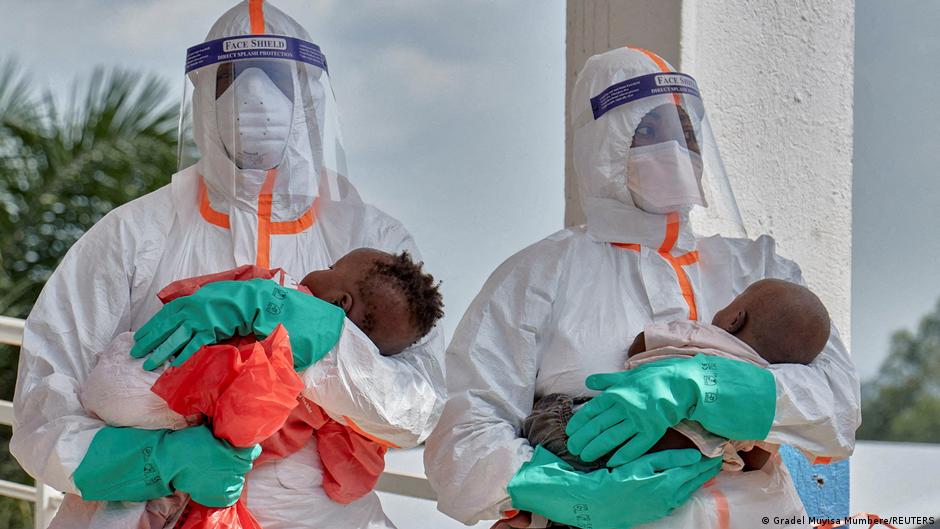
Since the outbreak began in mid-May, more than 3,000 people have died.
uncertain
people → begin → May
Almost half of people infected with Ebola are expected to die, and the mortality rate is particularly high for young children.
asserted
rate → infect → children
According to a commentary by Doctors Without Borders recently published in medical journal The Lancet, the mortality rate for children under the age of 5 is over 60%.
uncertain
rate → accord → 5
But often, it's because of a lack of medication and information on how to use it with young patients, rather than then disease itself.
asserted
it → use → disease
"Children must be centered in Ebola treatment and prevention research," the aid organization wrote in early September.
asserted
organization → center → September
At the heart of the debate is the EBO-PEP study, which began mid-July.
asserted
which → begin → mid
The study looks at an experimental antiviral drug called obeldesivir, which is being studied for its ability to protect people exposed to the Bundibugyo Ebola virus, the strain responsible for the current deadly outbreak.
asserted
which → look → outbreak
But children weighing less than 30 kilograms (about 66 pounds) and around 12 years old or younger, were not included in the original study.
asserted
children → weigh → study
But that could change soon with protocols to include children weighing over 20 kilograms.
uncertain
that → change → kilograms
Children weighing less than 20 kilograms — that is, roughly 6 years old or younger — won't be included in the treatment.
asserted
that → weigh → treatment
But as Doctors Without Borders argued, a 10-day course of infusions is difficult to administer during an outbreak, especially for young children.
asserted
course → argue → children
According to Neal Russell, a pediatric doctor based in London who consults for Doctors Without Borders and who was also the lead author of the Lancet commentary, young children are at particularly high risk from Ebola.
uncertain
children → accord → Ebola
This could be due to their weakened immune systems, underlying health conditions, or the fact that treating them for Ebola is especially challenging in an outbreak.
uncertain
treating → weaken → outbreak
For example, children are often harder to diagnose than adults because early symptoms resemble other illnesses, and young children often find it difficult to describe their symptoms accurately.
asserted
it → diagnose → symptoms
Other issues include the fact that children cannot always be accompanied into an Ebola treatment center by their parents or caregivers, something that is especially important in their recovery.
asserted
that → include → recovery
Younger Ebola patients also require closer monitoring and specially trained staff.
asserted
patients → require → monitoring
In May, an American doctor was treated at Berlin's Charite hospital after contracting the Bundibugyo Ebola virus while caring for patients.
uncertain
doctor → treat → patients
His wife and their four children were also considered at high risk.
asserted
wife → consider → risk
The medical team in Germany decided to treat the family prophylactically with an experimental antibody drug called MBP134.
asserted
team → decide → drug
"Of course, a careful risk benefit assessment had to be carried out," said Han Ngoc Le, a doctor at the hospital who was involved in the treatments.
asserted
who → have → treatments
But at the same time, the children were at high risk of catching Ebola after close contact with their sick father.
asserted
children → catch → father
In the end, all the family remained healthy and no apparent side effects were seen.
asserted
effects → remain → end
It's unclear whether the experimental treatment prevented infection in the children.
uncertain
treatment → prevent → children
Such a small sample can't be mapped onto the larger population either.
asserted
sample → map → population
"The mere fact that the antibody was so well tolerated even in 1-year-olds and children under 12 is a valuable finding upon which future studies can build," Le said.
asserted
Le → tolerate → which
Why do such gaps in knowledge exist?
asserted
gaps → exist → knowledge
Le explained that, from a medical perspective, children cannot simply be thought of as "small adults."
asserted
children → explain → adults
Their metabolisms function differently, they react differently to medications, their pharmacokinetics — what a body does with a drug — are simply different.
asserted
body → function → drug
The same sort of cautions also apply to pregnant women.
asserted
sort → apply → women
That's why dosages of medication can't simply be transferred from adults to children.
asserted
dosages → transfer → children
It's also why any new medications require separate studies so that specific dosages can be determined and potentially special formulations can be developed.
asserted
formulations → require → studies
Children might require kid-friendly syrups instead of adult-size tablets, for example.
uncertain
Children → require → example
"All of this creates extra costs," said Marc Biot, access coordinator for Europe at Doctors Without Borders, who works to ensure people in need can get affordable, good-quality medical products.
asserted
people → create → products
He said research institutions and pharmaceutical companies often see investing extra in pediatric studies as a lower priority.
asserted
institutions → say → priority
"It is faster and it can be cheaper if you only focus on adults," said Biot — which is why treating children and pregnant women usually only becomes part of the research at a later stage of drug development.
asserted
treating → focus → development
"That is our plea — a plea not only to the scientists, to the pharmaceutical companies, but also to those who fund and allow trials to happen — to allow that to happen on the same speed for adults as for children and pregnant women.
asserted
that → fund → children
Biot said it's sad to see that pressure is needed to make it happen.
asserted
it → say → ?
"Whenever you start a clinical trial, you also should include pregnant woman or children," he argued.
asserted
he → start → woman
In 2020, the Global Accelerator for Pediatric Formulations network was founded — supported by the World Health Organization(WHO) — to accelerate the development and availability of child-friendly medicine worldwide.
asserted
network → found → medicine
This isn't an issue limited to Ebola.
asserted
This → limit → Ebola
…and 13 more, not listed.
 The Aporia