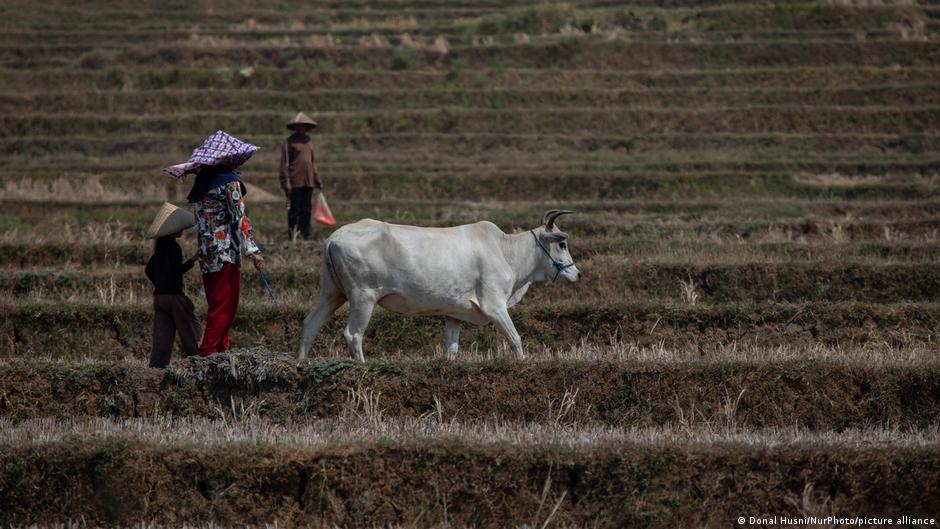
The world's food system is under growing stress, and new research is pointing to areas where this could lead to conflict.
uncertain
this → grow → conflict
Severe droughts and extreme weather are damaging harvests in many regions.
asserted
droughts → damage → regions
A developing El Niño event is even threatening to worsen food shortages for millions of people next year.
asserted
event → develop → people
At the same time, wars and geopolitical tensions are disrupting supply chains that keep food and farm supplies moving.
asserted
food → disrupt → chains
The war in Ukraine has repeatedly shaken grain markets, while the Iran war's impact on the Strait of Hormuz has driven up fuel and fertilizer prices, increasing costs for farmers everywhere.
asserted
impact → shake → farmers
Experts have long warned that rising food insecurity could fuel instability.
uncertain
insecurity → warn → instability
When people can no longer feed their families, they argue over land, water, and other resources — or they move.
asserted
they → feed → land
In fragile countries, these pressures can contribute to social unrest and even armed conflict.
asserted
pressures → contribute → unrest
Now, new research has suggested where some of these risks are greatest.
uncertain
some → suggest → risks
The Climate-Driven Agricultural Decline Index (CADI), developed by Laura Mayoral, Hannes Mueller and colleagues, maps how climate change is reshaping agricultural productivity around the world.
asserted
change → drive → world
"The heaviest losses are in the tropical regions," said Mueller, a researcher at the Institute for Economic Analysis and the Barcelona School of Economics.
asserted
Mueller → say → Economics
Climate change is already reducing food production in many parts of the world.
asserted
change → reduce → world
Hundreds of millions of people live in areas where harvests are smaller than 30 years ago.
asserted
harvests → live → areas
Mueller mentioned Australia, Argentina, Moldova, Nigeria, Romania, the United States, and Sudan as countries where agricultural losses are already being felt.
asserted
losses → mention → countries
"Northern Africa is another region we should pay much more attention to.
asserted
we → pay → attention
If you look at the map, it just looks terrible.
asserted
it → look → map
It really looks horrible," he said.
asserted
he → look → ?
Wars, trade disruptions, export bans, and rising fertilizer costs can magnify food insecurity.
asserted
Wars → rise → insecurity
Within the next 25 years, nearly half of the world's people could be living in areas where farms are producing less food.
uncertain
farms → live → food
New winners, losers, and conflicts
These pressures can undermine governments, help causemigration, and make it easier for armed groups to recruit fighters.
asserted
groups → undermine → fighters
In societies that are already unstable, such factors can push them toward crisis.
asserted
factors → push → crisis
Yet CADI's research points to a surprising reality: Gains in agricultural productivity also appear to increase the risk of violence.
asserted
Gains → point → violence
Mueller said the key issue is not just scarcity, but change.
asserted
issue → say → ?
The climate crisis and other shocks do not simply make some regions poorer.
asserted
regions → make → ?
They also create new opportunities, changing the value of land and resources.
asserted
They → create → land
In some places, land that had been marginal becomes more productive and more valuable.
asserted
that → become → places
And that attracts investors and produces competition for ownership and access.
asserted
that → attract → ownership
So countries that appear to benefit overall may face new tensions.
uncertain
that → appear → tensions
Sudan, for example, is projected to produce more food as the climate changes.
asserted
climate → project → food
But while some areas could become more productive, others may suffer losses, creating new winners and losers within the country and increasing the risk of conflict.
uncertain
others → become → conflict
This looming instability, Mueller said, also applies to areas where the change in productivity hasn't even happened yet.
asserted
change → loom → productivity
"If we know that your land is going to become more productive, maybe I want to grab it from you today.
asserted
I → know → you
That is exactly where negotiations break down and where we will have violence," he said.
asserted
he → break → violence
Even in stable, wealthy regions, the climate crisis is creating future problems.
asserted
crisis → create → problems
It may seem trivial, but the change in grape-growing options in Europe is affecting local farmers.
uncertain
change → seem → farmers
Major producers of sparkling wine have started to buy up land in mountainous regions.
asserted
producers → start → regions
"It is not productive yet, but they already know where future grape harvests will be," Mueller said.
asserted
Mueller → know → ?
"Big agricultural companies are buying land.
asserted
companies → buy → land
This is happening all over the world.
asserted
This → happen → world
Locals are displaced because large producers come in, land prices rise, and you start having fights about something that is still 20 or 30 years in the future.
asserted
that → displace → future
…and 30 more, not listed.
 The Aporia