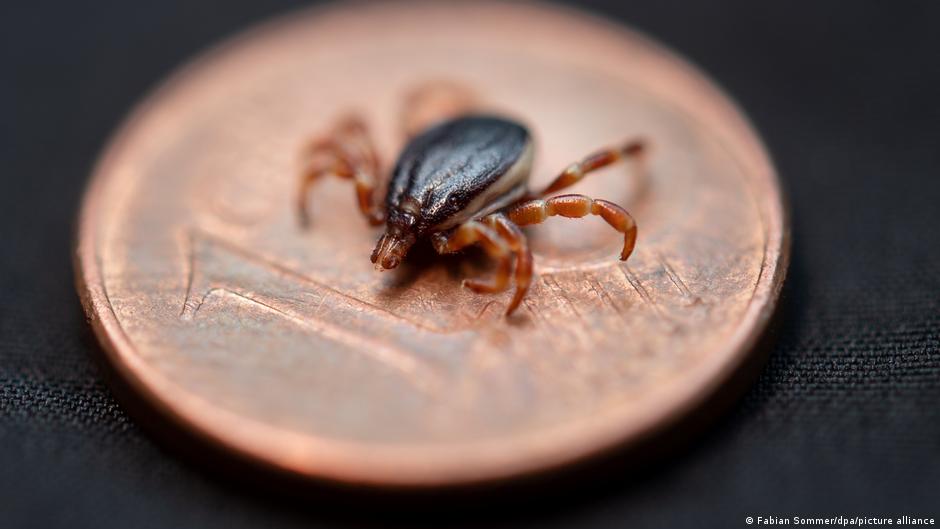
It can spot its prey from up to 200 meters (about 650 feet) away — but unlike many of its fellow species, it doesn't lurk in the grass waiting for its victim to come closer.
asserted
victim → spot → grass
Instead it runs after it, chasing animals and humans alike.
asserted
it → run → animals
The Hyalomma tick, often called "the great hunting tick," was previously found mostly in Africa, Asia, and southern Europe.
asserted
tick → call → Africa
But climate change means it can now survive further north and it has already been spotted in Germany and various Eastern European countries.
asserted
it → mean → Germany
These are capable of destroying blood and lymphatic vessels, which can lead to internal bleeding and death.
asserted
which → destroy → bleeding
Kurtesh Sherifi first read about Crimean-Congo hemorrhagic fever in the newspaper in 2005, when he was completing his studies as a veterinarian in Berlin.
asserted
he → read → Berlin
The article said that 11 people in his homeland, Kosovo, had contracted the disease and five had died.
asserted
five → say → disease
He was already interested in pathogens that can be transmitted between animals and humans, known as zoonoses, and Crimean-Congo fever intrigued him.
asserted
fever → transmit → him
Back home, Sherifi started work with the faculty of agriculture and veterinary medicine at the University of Pristina.
asserted
Sherifi → start → Pristina
Kosovo, a small country with only about 1.6 million citizens, didn't have a high-security laboratory or the equipment necessary for investigating the Crimean-Congo fever virus.
asserted
Kosovo → have → virus
Seeking German cooperation
Sherifi got in touch with Germany's largest institution for study in this area, the Bernhard Nocht Institute for Tropical Medicine in Hamburg.
asserted
Sherifi → seek → Hamburg
One of the researchers was Petra Emmerich, a virologist and expert on what are known as Risk Group 4 viruses — viruses that cause severe, often fatal, diseases and usually have no widely available treatment.
asserted
that → know → treatment
Emmerich also acts as a reservist in the German military, which is especially interested in viruses that could be used as biological weapons.
uncertain
that → act → weapons
She was sent to Kosovo in 2009, which is when she met Sherifi.
asserted
she → send → Sherifi
A lively exchange began between the researchers.
asserted
exchange → begin → researchers
In Kosovo, a structure was established to monitor the spread of the Hyalomma tick and the virus.
asserted
structure → establish → tick
In 2013, the researchers' joint work began to receive funding through the German Biosecurity Program, run by the country's Foreign Ministry and "intended to help partner countries tackle biological threats.
asserted
countries → begin → threats
"
"It's give and take," said Emmerich of the scientific partnership.
asserted
Emmerich → give → partnership
"We have the diagnostic expertise and the necessary resources but we don't have the patients."
asserted
we → have → patients
Doctors from Germany regularly come to Kosovo with Emmerich where they can exchange information with their counterparts there.
asserted
they → come → counterparts
Raising public awareness is another important pillar of the Germany-Kosovo cooperation.
asserted
Raising → raise → cooperation
Farmers in Kosovo are particularly susceptible to infection — and not solely due to ticks biting them, but because they often use their bare hands to remove ticks from animals.
asserted
they → bite → animals
If infected blood from the animals gets into a small wound on the human hand, the virus can be transmitted to the human.
asserted
virus → infect → human
"This is quite likely how a large proportion of the [infected] population in Kosovo got infected," Sherifi explained.
asserted
Sherifi → infect → Kosovo
Patients require intensive care, isolation
He and Emmerich have visited schools to educate students about the dangers of the virus and how to protect against it.
asserted
He → require → it
For example, certain tick repellents help, as do long pants and sturdy shoes.
asserted
pants → help → example
Not all Hyalomma ticks carry the virus, and most people who are bitten by a Hyalomma tick do not become ill.
asserted
who → carry → tick
However, the larger problem is that there is neither a vaccine nor any specific course of treatment for those who do end up suffering from Crimean-Congo fever.
asserted
who → be → fever
"If you do get sick, it's particularly severe," Emmerich explained.
asserted
Emmerich → get → ?
The disease begins with nonspecific, flu-like symptoms including fever, chills, aches and headaches.
asserted
disease → begin → fever
In severe cases, a patient will begin bleeding from the skin, nose and gums and may also experience gastrointestinal bleeding.
uncertain
patient → begin → bleeding
The worst causes can result in organ failure.
asserted
causes → result → failure
Patients require intensive care and isolation because they are highly contagious.
asserted
they → require → care
Much of the treatment in intensive care focuses on maintaining a patient's vital functions, but they are also given the antiviral drug, ribavirin.
asserted
they → focus → drug
But, as Emmerich said, "ribavirin is not all that effective in acutely ill patients."
asserted
ribavirin → say → patients
That is something the scientists have seen firsthand with cases in Kosovo.
asserted
scientists → see → Kosovo
The best answer is prevention, which is why it's also very important for the researchers to monitor the spread of the Hyalomma ticks and for them to recommend avoiding certain areas where the ticks are prevalent, if possible.
asserted
ticks → monitor → areas
Over the years, the researchers have not only collected thousands of the ticks but they have also conducted so-called seroprevalence studies.
asserted
they → collect → studies
These use blood tests to find antibodies from past infections.
asserted
These → use → infections
This allows the scientists to determine whether humans or animals have come in contact with the virus.
asserted
humans → allow → virus
…and 11 more, not listed.
 The Aporia