And it's choking global grain
asserted
it → choke → grain
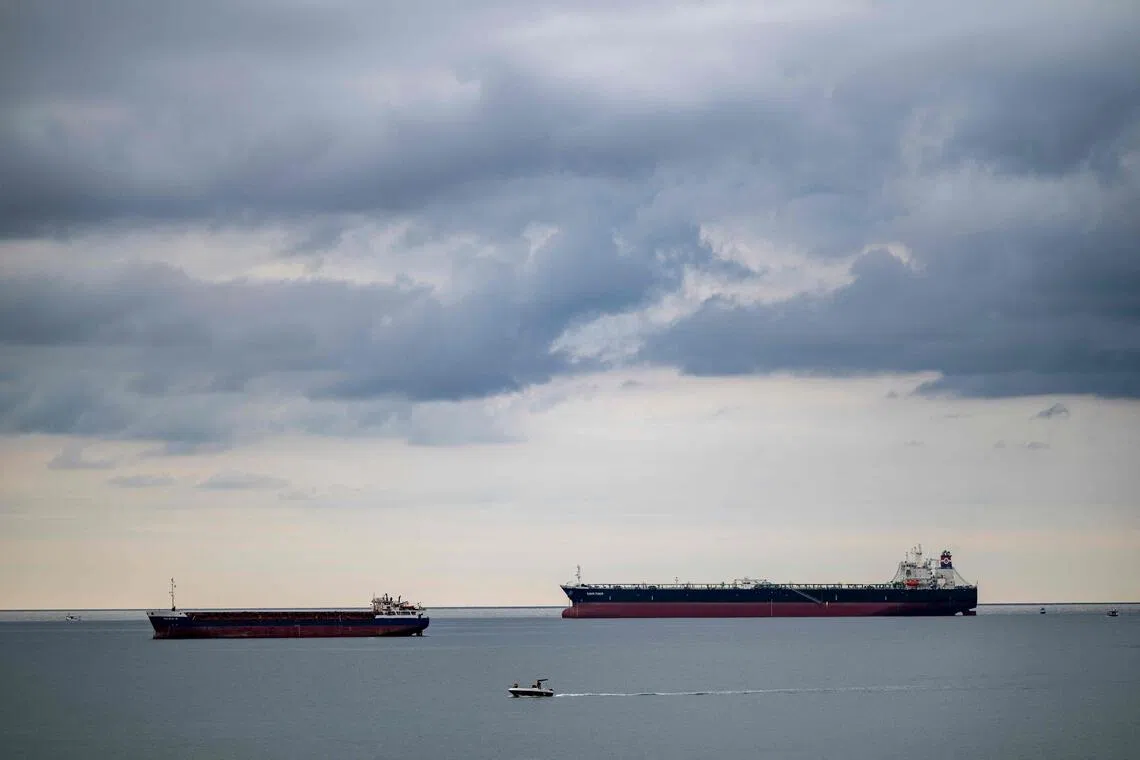
Strikes against ports and vessels have crippled shipping routes, cutting grain exports from Russia and Ukraine
When Mykola Lupar and his crew head out on a navy patrol boat from the Ukrainian Black Sea port of Chornomorsk, the 29-year-old commander can usually count the time they spend on the open water in minutes, before rushing back to shore.
asserted
they → cripple → shore
The heavy machine guns aboard can’t offer much protection from Russian jet-powered drones launched from Crimea, especially when they are trying to board a vessel rocking in the churning waves.
asserted
they → offer → waves
“We are trying to find some windows in time between Russian attacks to patrol, to search for mines and some explosive materials,” Lupar said.
asserted
Lupar → try → mines
“It’s very dangerous.
asserted
It → ’ → ?
For the merchant fleet, I would say there’s almost no chance to stay safe in our waters.”
asserted
I → say → waters
After nearly five years of war, maritime analysts warn that the conflict in the Black Sea is the most intense it has been since the early days of Russia’s full-scale invasion, which began on Feb. 24, 2022.
asserted
which → warn → Feb.
Since mid-July of this year, strikes on commercial vessels have escalated dramatically as Russia seeks to halt Ukraine’s exports and bludgeon its economy, while Kyiv has tried to blunt Russia’s ability to fund its war by striking vessels connected to Moscow’s shadow fleet and some of its port infrastructure.
asserted
Kyiv → escalate → infrastructure
It attributed 125 of those strikes to Ukraine and 88 to Russia.
asserted
It → attribute → Russia
The strikes have not only elevated the risk across the entire Black Sea, but have also eroded the export capacity of both countries, sparking concerns about the global grain supply.
asserted
strikes → elevate → supply
Together, Russia and Ukraine account for roughly a quarter of the world’s wheat exports, and analysts estimate that their combined exports are down 60 per cent from last year.
asserted
exports → account → exports
Efforts, including those led by Turkey, to secure a limited truce in the Black Sea have so far failed.
asserted
Efforts → include → Sea
While both Russia and Ukraine are looking for alternative routes for their exports, the attacks on shipping and ports are already leading to a rise in global wheat prices, which could spike further.
uncertain
which → look → prices
“It’s not only a Ukrainian problem.
asserted
It → ’ → ?
This is a problem for the whole region,” said Dmytro Barinov, president of the Ukrainian Ports Association.
asserted
Barinov → say → Association
“The price jumps at the gas station and everybody feels the lack of fuel.
asserted
everybody → jump → fuel
And here, believe me, very soon — October, November latest — everybody will feel the shortage of food in our region, unfortunately.”
asserted
everybody → believe → region
Throughout its full-scale invasion, Russia has routinely attacked Ukraine’s ports and ships, including the port of Izmail, which lies on the Danube River and borders Romania.
asserted
which → attack → Romania
But since July, Moscow has ratcheted up its attacks.
asserted
Moscow → ratchet → attacks
Russia’s Defence Ministry insists it is targeting only military assets, and after it struck a cargo vessel in the Ukrainian port of Chornomorsk on Thursday, officials accused the ship of supplying the military.
asserted
officials → insist → military
Barinov insists that Russia is hitting purely civilian ships and points to a missile strike on a vessel named the Golden Leo, which was near the port of Odesa in July.
asserted
which → insist → July
Ten people were killed in the strike, which Ukrainian officials said was carrying corn.
asserted
officials → kill → corn
He describes Russia’s attacks as akin to hunting because merchant ships are slow, can’t manoeuvre quickly and don’t have military defences.
“It’s like hunting for an elephant from a helicopter,” he said in an interview with CBC News in Odesa.
asserted
he → describe → Odesa
But Ukraine, too, has been striking Russian ships and infrastructure in the Black Sea and the Sea of Azov, which are connected by the Kerch Strait, east of Crimea.
asserted
which → strike → Crimea
In August, when Ukraine launched a massive missile and drone strike against the Russian port of Novorossiysk, it hit a naval base and damaged two major grain export terminals.
asserted
it → launch → terminals
The strikes by both sides have prompted London-based insurers to expand the area of the Black Sea they consider high risk, as vessels are being hit farther south in the sea.
asserted
vessels → prompt → sea
According to Ambrey, more than 50 were found outside Russian and Ukrainian waters so far this year.
uncertain
50 → accord → waters
Back in 2022, the UN and Turkey worked to secure an agreement known as the Black Sea Grain Initiative to keep commercial vessels transiting to Ukrainian ports.
asserted
UN → work → ports
But after a year, it fell apart when Russia refused to renew it.
asserted
Russia → fall → it
In the wake of that, Ukraine established its own shipping corridor, where vessels would reach its ports by first travelling along the coastlines of Turkey, Bulgaria and Romania before reaching Ukraine.
asserted
vessels → establish → Ukraine
But that route has now also been disrupted by Russia’s widespread attacks.
asserted
route → disrupt → attacks
Caitlin Welsh, director of the Global Food and Water Security Program at the Center for Strategic and International Studies, says that after Russia first launched its full-scale invasion, global food prices reached an all-time high not factoring in inflation.
asserted
prices → say → inflation
Now, she says, the difference is that a significant chunk of Russia’s export capacity is offline as well.
asserted
chunk → say → capacity
“Now it’s not just Russia attacking Ukraine, it’s Ukraine also attacking Russia, and those things are happening at the same time,” she said in a Zoom interview with CBC News.
asserted
she → ’ → News
Recent figures from the United Nations Food and Agriculture Organization say world wheat prices are up 15 per cent from last year, driven in part by disruptions in the Black Sea.
asserted
prices → say → Sea
“Prices are already increasing, and I think we can expect grain prices, especially wheat prices, to continue to increase.”
asserted
prices → increase → ?
Welsh isn’t sure that prices will rise to 2022 levels, but does note that the turmoil in the Black Sea is happening at the same time as other global shocks, including the crisis in the Strait of Hormuz and the compounding effects of El Niño, which brought drought to global wheat-producing regions, creating further food insecurity.
asserted
which → rise → insecurity
For Ukrainians in Odesa, who took advantage of a relatively drone-free sky on Tuesday afternoon to visit the windswept shore near the port, the absence of ships moored offshore is noticeable.
asserted
absence → take → ships
“It is really concerning,” said 20-year-old Iryna Kostina.
asserted
Kostina → say → ?
“Our country has a lot of grain, a lot of agriculture, and it’s basically going to be a bad situation for everyone.”
asserted
it → have → everyone
 The Aporia