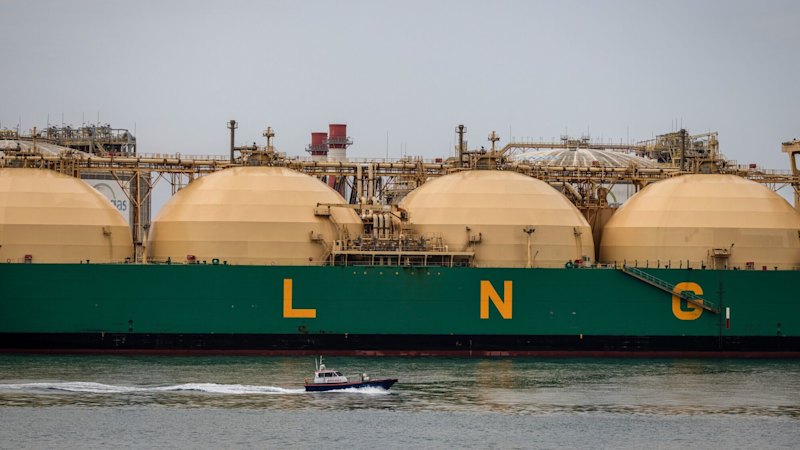
The war in the Middle East is delivering a huge windfall for Australian gas exporters, as new figures suggest soaring prices could add $23 billion to their combined revenue this year and reverse what was expected to be a period of decline.
uncertain
what → deliver → decline
One-off cargoes of liquefied natural gas (LNG) – one of the nation’s most lucrative exports – are fetching more than double their pre-war prices, boosting earnings for producers that operate outside the Persian Gulf and can reliably dispatch shipments to customers.
asserted
that → liquefy → customers
The surge follows Iranian missile strikes on a key Qatari LNG hub and the continued disruption of shipping through the Strait of Hormuz, a vital oil and gas shipping route, which has crippled up to 20 per cent of the world’s LNG supply.
asserted
which → follow → supply
Gas-dependent countries in Asia and Europe are scrambling to secure replacement cargoes to power their homes, factories and electricity grids, sending commodity prices sharply higher.
asserted
countries → scramble → prices
For the local and international operators of Australian LNG terminals, such as Woodside Energy, Santos and Shell, the price spikes have dramatically altered their near-term fortunes.
asserted
spikes → alter → fortunes
Before the war began on February 28, federal government forecasts suggested export earnings from LNG terminals in Queensland, Western Australia and the Northern Territory would slip from more than $50 billion to $47 billion this financial year, dragged down by an impending wave of new LNG projects in the United States and Qatar that threatened to drive the market into oversupply.
uncertain
that → begin → oversupply
Instead, updated figures from the Department of Industry, Science and Resources, released on Friday, reveal LNG revenue is now expected to climb to as high as $70 billion this financial year – a potential $23 billion increase on the government’s earlier forecast.
asserted
revenue → update → forecast
“The closure of the Strait of Hormuz has stymied a long-anticipated shift towards surplus supply,” the report from the Department of Energy Science and Resources said.
asserted
report → stymie → Science
“LNG cargo movements through the Strait of Hormuz remain intermittent and rising US output has largely played a substituting role, with global net LNG supply set to fall in 2026.”
asserted
supply → remain → 2026
Department analysts say LNG prices have been higher for months and could remain elevated well into the future.
uncertain
prices → say → future
The Japan Korea Marker – the benchmark price for one-off LNG prices in North Asia, where the bulk of Australian exports are sold – has pushed above historical averages of $US10-11 per million British thermal units to reach more than $US25 last month.
asserted
bulk → sell → US25
“Going forward, the prices of oil and LNG are likely to be higher than they otherwise might have been before the Middle East conflict,” the report said.
uncertain
report → go → conflict
The prospect of Iran or Oman imposing a toll on shipping through the Strait of Hormuz in the future, and the increased use of alternative pipeline infrastructure to bypass the strait, would also add to the cost of oil and LNG, keeping upward pressure on prices.
asserted
Iran → impose → prices
The forecast of higher revenue for Australia’s LNG producers lands as the prospect of mega-profits in the gas industry continues driving political debate in Canberra.
asserted
prospect → land → Canberra
Climate groups, crossbench MPs and unions are pushing for higher taxes on multinational energy giants, arguing that the current federal offshore oil and gas tax – the Petroleum Resource Rent Tax (PRRT) – fails to deliver a fair public return.
asserted
tax → push → return
The Albanese government has previously rejected independent senator David Pocock’s popular campaign to impose a 25 per cent tax on gas export revenue.
asserted
government → reject → revenue
Despite the short-term market surge, the longer-term outlook for LNG shippers carries distinct risks, according to the report.
uncertain
outlook → carry → report
Government projections suggest Australia’s LNG earnings will begin to normalise, easing from $70 billion this year back to $42 billion by 2031.
asserted
earnings → suggest → 2031
This year’s extreme prices have also had immediate implications for demand, forcing price-sensitive buyers in Asia to seek to shield themselves from soaring costs by lowering their consumption, including by pivoting back to dirtier sources of energy, such as coal-fired power stations.
asserted
prices → have → stations
South Korea, one of Australia’s top LNG buyers, lifted its thermal coal imports by around 40 per cent in the June quarter compared to a year earlier, while LNG imports fell 13 per cent, the report said.
asserted
report → lift → quarter
Some experts warn that this year’s upheaval in the LNG market may have even longer-lasting consequences for demand if it drives countries to step up their investments in renewables and other sources of power.
uncertain
it → warn → power
For the second time in four years, Asian nations have been reminded of the risks of their heavy exposure to LNG, including price shocks and shortages amid geopolitical turmoil.
asserted
nations → remind → turmoil
In 2022, LNG prices hit unprecedented highs following Russia’s invasion of Ukraine.
asserted
prices → hit → Ukraine
“In the long run, the disruption of strategic Middle East shipping lanes (and worries over future disruptions) seems likely to accelerate the push away from oil/gas/LNG to clean energy technologies and slow the fall in thermal coal usage,” the departmental report said.
asserted
report → seem → usage
Woodside Energy, the largest Australian LNG producer, said it did not expect a long-term LNG demand reduction.
asserted
it → say → reduction
Woodside chief Liz Westcott said in July that Australian LNG suppliers could stand to benefit further in future if Asian LNG buyers reconsidered their heavy reliance on Middle Eastern suppliers and pivoted towards trade partners perceived as more geopolitically stable.
uncertain
buyers → say → partners
 The Aporia