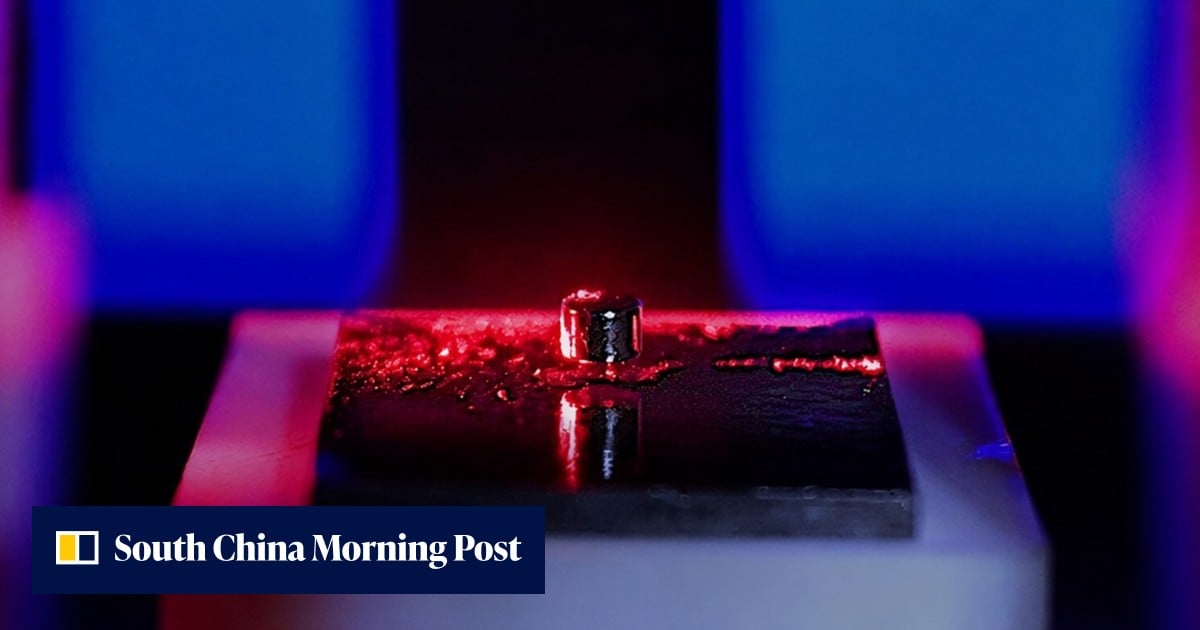
Chinese-German team builds ultra-sensitive ‘floating compass’ to hunt dark matter

News - South China Morning Post · collected 2026-09-05 · by Zhang Tong
Read the original at News - South China Morning Post ↗

Summary

A Chinese-German team of researchers has developed a new "floating compass" called LeMaMa that can detect extremely faint magnetic signals. The device operates at room temperature and is capable of measuring magnetic fields down to the femtotesla level, which is one quadrillionth of a tesla. This sensitivity could be useful for detecting dark matter particles or monitoring brain signals. The researchers' work was published in the journal Science on August 6.
Written by the local model on 2026-09-06, using this article's own text rather than the other coverage of the same event (that is the story summary below).

Signals How these are calculated →

Claims extracted
10
claim-shaped sentences
Uncertain
10%
1 of 10 hedged
Leaning
not political
takes no side on a contested political question
Publisher trust
94.0
red-flag proxy, not a credibility rating
Outlets on this story
1
Science
Narrative spread
1
articles carrying this framing
Analyzed 2026-09-06 · how these are computed

AI analysis (generated at analysis time, not now)

Story summary

A team of researchers from Peking University in China and Johannes Gutenberg University Mainz in Germany have developed an ultra-sensitive "floating compass" called LeMaMa. This device, which operates at room temperature, can detect magnetic signals that are a billion times fainter than the Earth's own magnetic field. The Levitated Magnet Magnetometer (LeMaMa) works by tracking a tiny needle that floats in mid-air with minimal friction, allowing it to measure magnetic fields down to the femtotesla level, an incredibly small unit of measurement. This advancement could have significant implications for the search for dark matter particles and monitoring brain signals. The device's combination of room-temperature operation, tiny components, and high sensitivity make it promising for fundamental physics experiments, according to Ji Wei, an assistant professor at Peking University and corresponding author of the study.

Written for “Dark Matter Detector” on 2026-09-07, grounded in this article and the 0 other(s) covering the same event.
Why this leaning score
This article does not take a side on a contested political question, so it has no leaning score. That is an answer rather than a gap: a match report or a rescue can be warmly or critically written without being left or right, and scoring it anyway is how approval of a subject gets recorded as a political position.
No political leaning scored for article 5091 · logged 2026-09-06

Story

📰 Dark Matter Detector
Science · 1 article(s) covering the same event. This is the one the site leads with.

How this is being covered How these are calculated →

Article leaning vs. publisher reliability
Source leaning vs. consistency

Compared with similar articles

Nothing to compare against. No article is close enough to this one for the pipeline to have linked or judged the pair.

Publisher

News - South China Morning Post · 156 article(s) · 0 correction(s) detected
SignalValueWeight
Correction rate 0.000 0.4
Uncertainty density 0.120 0.25
Assertive mismatch rate 0.000 0.35
No corrections detected for this publisher. That may mean careful reporting, or simply that nothing has been checked.

Who wrote this

Zhang Tong
4 article(s) here · 1 carrying a prediction
🔮 State broadcaster CCTV reported that the technology could fundamentally strengthen China’s ability to secure its own iron resources and reduce its heavy dependence on imports of the strategic commodity.
🔮 The Fengyun-4C’s storm-tracking abilities could provide vital early warnings about extreme weather events during the rescue operation China is using the world’s most powerful geostationary weather satellite to track severe thunderstorms over Nepal and deliver real-time intelligence as the two countries continue search and rescue operations following last month’s devastating glacier collapse.
🔮 By tracking the needle’s tiny deflections, the team can measure magnetic fields down to the femtotesla level – an advance that could widen the hunt for elusive dark matter particles or monitor brain signals.
Also by Zhang Tong
Nothing else under this byline is closely related to this article, so these are simply their most recent.

Topics

Chinese Guangming Daily LeMaMa Peking University’s The Levitated Magnet

Subjects

China GPE · 1× Chinese NORP · 1× Germany GPE · 1× Guangming Daily ORG · 1× Ji Wei PERSON · 1× Johannes Gutenberg University ORG · 1× Peking University ORG · 1× Peking University’s ORG · 1×

Narrative

“The combination of room-temperature operation, tiny components and high sensitivity makes LeMaMa promising for fundamental physics experiments,” Ji Wei, assistant professor at Peking University’s school of physics and corresponding author of the study, told Guangming Daily on August 17.
framing: assertive · carried by 1 article(s) · first seen 2026-09-06
🔮 By tracking the needle’s tiny deflections, the team can measure magnetic fields down to the femtotesla level – an advance that could widen the hunt for elusive dark matter particles or monitor brain signals.
2026-09-06 · News - South China Morning Post
Chinese-German team builds ultra-sensitive ‘floating compass’ to hunt dark matter · assertive framing

Claims (10 extracted, 1 hedged)

Chinese researchers have developed a table-top magnetic sensor that operates at room temperature and can spot magnetic signals a billion times fainter than the Earth’s own field. asserted
that → develop → field
The Levitated Magnet Magnetometer (LeMaMa) functions like a compass with a needle that floats in mid-air with virtually no friction. asserted
that → function → friction
By tracking the needle’s tiny deflections, the team can measure magnetic fields down to the femtotesla level – an advance that could widen the hunt for elusive dark matter particles or monitor brain signals. uncertain
that → track → signals
“The combination of room-temperature operation, tiny components and high sensitivity makes LeMaMa promising for fundamental physics experiments,” Ji Wei, assistant professor at Peking University’s school of physics and corresponding author of the study, told Guangming Daily on August 17. asserted
Wei → make → August
Magnetic fields are everywhere, ranging in strength from about 1.5 tesla for a hospital magnetic resonance imaging machine to the vanishingly weak femtotesla, or a quadrillionth of a tesla, generated by human brain activity. asserted
fields → range → activity
Measuring the tiniest magnetic fields has long been a challenge. asserted
Measuring → measure → fields
Now, scientists from China’s Peking University and Johannes Gutenberg University Mainz in Germany have built the world’s first room-temperature ultraprecise magnetometer based on a levitated magnet. asserted
University → build → magnet
Their work was published in the journal Science on August 6. asserted
work → publish → August
Until now, femtotesla-level measurements have mainly relied on two approaches. asserted
measurements → rely → approaches
One is the superconducting quantum interference device (Squid) magnetometer, which offers excellent sensitivity but must operate at cryogenic temperatures near absolute zero, requiring bulky and expensive liquid-helium cooling. asserted
which → offer → cooling
💬 Give feedback
🕘 History 🎫 Support