How can future doctors blend clinical rigour with AI fluency and empathy?

Read the original at South China Morning Post ↗
Cite

Kwan, C. (2026, September 5). How can future doctors blend clinical rigour with AI fluency and empathy? South China Morning Post. https://www.scmp.com/news/hong-kong/education/article/3366492/how-can-future-doctors-blend-clinical-rigour-ai-fluency-and-empathy?utm_source=rss_feed

Dated when The Aporia collected the article, usually within hours of publication. Check the original for its exact date and byline.

South China Morning Post · collected 2026-09-05 · by Charlotte Kwan

Quick Summary

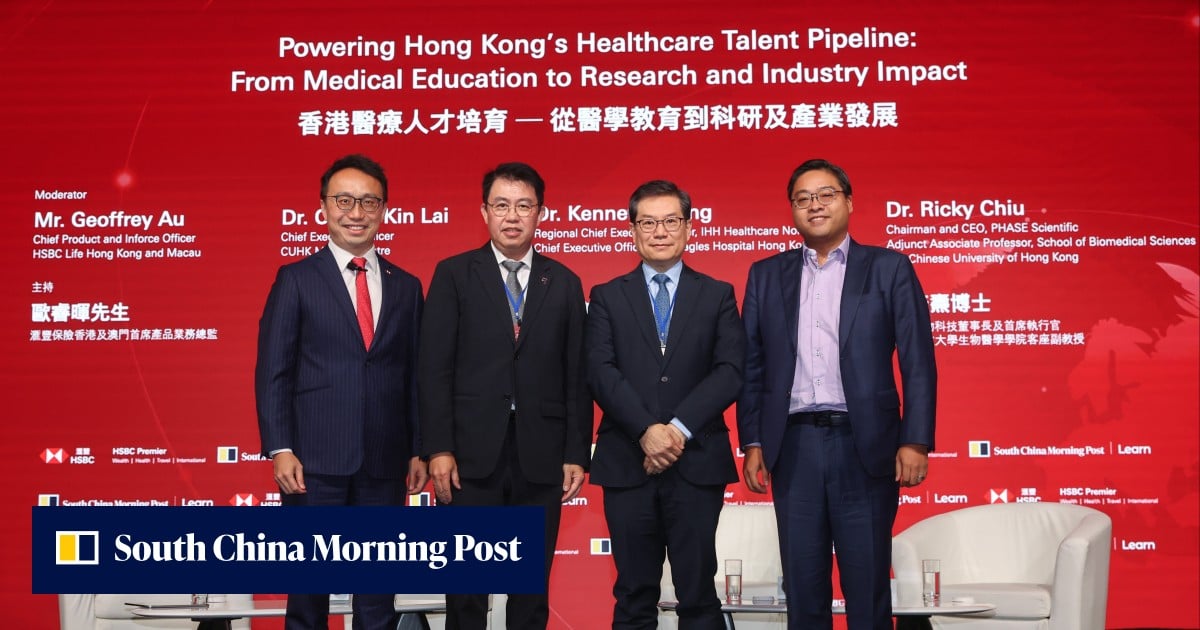
Medical experts at the Global Education Summit in Hong Kong emphasized the need for future doctors to combine clinical rigor with emotional resilience and an open-minded approach to artificial intelligence (AI). The summit, co-organized by the South China Morning Post and HSBC Premier, brought together around 5,000 policymakers, educators, and parents from around the world. According to Dr. Chung Kin-lai, chief executive officer of CUHK Medical Centre, future doctors will be responsible for a larger population than currently in Hong Kong, specifically 18 million people. The discussion highlighted the importance of soft skills as traditional metrics for evaluating future doctors change due to AI's impact on clinical workflows.
Written locally by qwen2.5:14b on 2026-09-06, using this article's own text rather than the other coverage of the same event (that is the story summary below).

AI analysis runs on qwen2.5:14b, locally

Story summary

Hong Kong's next generation of doctors must combine clinical skills with emotional intelligence and a willingness to adapt to artificial intelligence, say medical leaders. During the Global Education Summit, Dr. Chung Kin-lai, CEO of CUHK Medical Centre, stated that being a doctor in Hong Kong will mean serving not just 7 million people, but 18 million. This shift was discussed as part of a panel on how to prepare young doctors and healthcare professionals for an increasingly complex landscape, one where AI is becoming more integrated into medical practice. The experts emphasized the need for emotional resilience, an open-minded approach to AI, and a commitment to transforming the sector. They also stressed that AI will not replace doctors, but rather reward those who can ask better questions and think critically.
Written for “Future Doctors and AI Integration” on 2026-10-21, grounded in this article and the 0 other(s) covering the same event.

Story

📰 Future Doctors and AI Integration
Technology · 1 article(s) covering the same event.

Compared with similar articles

This article reads centre and hedges 0% of its claims. Each row says how that neighbour differs.
We Need a Cure for AI Health Hype different event · 80%
TIME
⚖️ leaning not scored 🔴 7% hedged 2 of 27 📰 publisher trust 59
“Article A discusses AI's potential to cure diseases, while Article B is about a panel discussion on the future of healthcare professionals and their relationship with AI”
How this article was measured signals, leaning charts, publisher record, byline, topics and claims

Signals How these are calculated →

Claims extracted
11
sentences that state something as happening or true
Uncertain
0%
0 of 11 hedged ("reportedly", "may", "according to")
Leaning
Centre
of the writing, not the subject · beta estimate
Publisher signals
64/100
South China Morning Post's corrections and hedging, across everything collected from it. Not a measure of accuracy.
Outlets on this story
1
Technology
Same framing elsewhere
1
articles that frame the event the way this one does
Analyzed 2026-09-06 · how these are computed

How this is being covered How these are calculated →

Article leaning vs. publisher reliability
Source leaning vs. consistency

Publisher

South China Morning Post · 2799 article(s) · 6 correction(s) detected
Running correction rate · 6 correction(s)

Who wrote this

Charlotte Kwan
1 article(s) here · 1 carrying a prediction
🔮 During Global Education Summit, medical leaders say AI won’t replace doctors, but will reward those who ask better questions Medical experts have stressed that Hong Kong’s next generation of healthcare professionals must combine clinical rigour with emotional resilience, an open-minded approach to artificial intelligence (AI) and the drive to transform the sector.
The only article under this byline in the corpus.

Topics

Global Education Summit HSBC Hong Kong’s Shenzhen the South China Morning Post

Subjects

Hong Kong’s GPE · 2× CUHK Medical Centre ORG · 1× Chung PERSON · 1× Chung Kin-lai PERSON · 1× HSBC ORG · 1× Shenzhen GPE · 1× the South China Morning Post ORG · 1×

Narrative

During Global Education Summit, medical leaders say AI won’t replace doctors, but will reward those who ask better questions Medical experts have stressed that Hong Kong’s next generation of healthcare professionals must combine clinical rigour with emotional resilience, an open-minded approach to artificial intelligence (AI) and the drive to transform the sector.
framing: assertive · carried by 1 article(s) · first seen 2026-09-06
🔮 During Global Education Summit, medical leaders say AI won’t replace doctors, but will reward those who ask better questions Medical experts have stressed that Hong Kong’s next generation of healthcare professionals must combine clinical rigour with emotional resilience, an open-minded approach to artificial intelligence (AI) and the drive to transform the sector.
2026-09-06 · South China Morning Post
How can future doctors blend clinical rigour with AI fluency and empathy? · assertive framing

Claims (11 extracted, 0 hedged)

How can future doctors blend clinical rigour with AI fluency and empathy? asserted
doctors → blend → fluency
During Global Education Summit, medical leaders say AI won’t replace doctors, but will reward those who ask better questions Medical experts have stressed that Hong Kong’s next generation of healthcare professionals must combine clinical rigour with emotional resilience, an open-minded approach to artificial intelligence (AI) and the drive to transform the sector. asserted
generation → say → sector
The remarks came during a panel discussion on the first day of the inaugural Global Education Summit, co-organised by the South China Morning Post and HSBC Premier. asserted
remarks → come → Post
“We always talk about people going north, going to Shenzhen … for medical services. asserted
people → talk → services
But I would say that it’s a good thing for a future doctor. asserted
it → say → doctor
You’re going to be a doctor not just for 7 million people. asserted
You → go → people
You’re going to be a doctor for 18 million people,” Dr Chung Kin-lai, chief executive officer of CUHK Medical Centre, said on Saturday. asserted
lai → go → Saturday
The discussion, titled “Powering Hong Kong’s healthcare talent pipeline: from medical education to research and industry impact”, explored how the sector was preparing young doctors and healthcare talent for this changing landscape. asserted
sector → title → landscape
The summit, which runs for two days, brought together about 5,000 policymakers, educators and parents from around the world to discuss regional talent development, AI integration and evolving academic pathways. asserted
which → run → development
With AI reshaping clinical workflows, medical leaders warned that traditional metrics for evaluating future doctors were changing. asserted
metrics → reshape → doctors
Chung noted that soft skills had become increasingly vital. asserted
skills → note → ?
💬Give feedback
🕘History 🎫Support