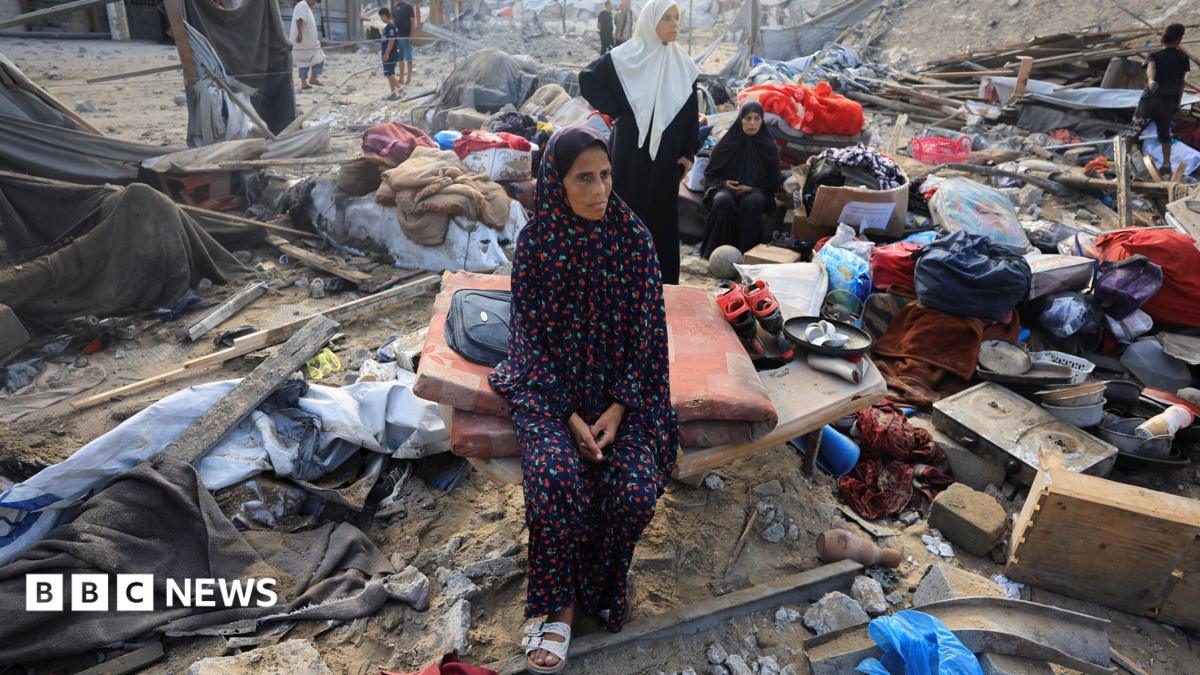
Return of goods to markets in Gaza doesn’t mean people can afford them

Al Jazeera – Breaking News, World News and Video from Al Jazeera · collected 2026-08-05 · by Lina Ghassan Abu Zayed
Read the original at Al Jazeera – Breaking News, World News and Video from Al Jazeera ↗

Summary

Ghadeer Nassar, a mother of seven living in Gaza City, struggles to provide for her family despite some goods returning to markets after months of shortages caused by Israel's blockade and war. Nassar's husband lacks stable income, earning only around $2-$3 per day from temporary work, forcing Ghadeer to resort to selling personal belongings or bartering for food. Shop owner Maher al-Khudari notes that while larger quantities of goods are available, prices remain high due to shortages and transportation costs, with many residents unable to afford necessities, even on credit. According to the United Nations, food insecurity remains a significant issue in Gaza, despite some improvements in supply availability.
Written by the local model on 2026-08-21, using this article's own text rather than the other coverage of the same event (that is the story summary below).

Signals How these are calculated →

Claims extracted
40
claim-shaped sentences
Uncertain
10%
4 of 40 hedged
Leaning
not scored
needs a local LLM pass
Publisher trust
96.5
red-flag proxy, not a credibility rating
Outlets on this story
1
World
Narrative spread
1
articles carrying this framing
Analyzed 2026-08-05 · how these are computed

AI analysis (generated at analysis time, not now)

Story summary

Ghadeer Nassar, a mother of seven children, lives in a small classroom at the Remal Model School in Gaza City, Gaza Strip with her family, as they are displaced Palestinians. Her husband's lack of stable income makes it difficult for them to afford basic goods, even though some have returned to markets after months of shortages due to Israel's blockade and war. He often takes on temporary work, earning only $2.27 or $3.25 per day, which is not enough to provide for his family. Despite the return of goods to markets, Nassar struggles to buy them, highlighting the ongoing financial difficulties faced by families like hers in Gaza. The World Food Programme notes that while supplies have increased, so has the number of households struggling to afford basic goods.

Written for “Gaza Goods Return Delayed” on 2026-08-31, grounded in this article and the 0 other(s) covering the same event.
Why this leaning score
The article uses phrases such as 'genocidal war' and 'economic collapse', which are strong condemnations of Israel's actions, but also presents a nuanced view by highlighting the struggles of Gazan residents to afford basic necessities despite some goods returning to markets. The tone is critical of Israel's blockade, but sympathetic towards the plight of those affected.
Written under an earlier scoring contract, which gave a paragraph rather than checkable quotes. Re-analysing this article replaces it.
Leaning score -0.50 for article 500 · logged 2026-08-05

Story

📰 Gaza Goods Return Delayed
World · 1 article(s) covering the same event. This is the one the site leads with.

How this is being covered How these are calculated →

Article leaning vs. publisher reliability
Source leaning vs. consistency

Compared with similar articles

This article reads unscored and hedges 10% of its claims. Each row says how that neighbour differs.
Assignment different event · 100%
BBC News
⚖️ leaning not scored 🔴 7% hedged 1 of 15 📰 publisher trust 96
“Article A discusses the development of a tech hub in Gaza before and after the 2023 attack, while Article B focuses on economic struggles and shortages in Gaza's markets”
BBC News
⚖️ leaning not scored 🔴 9% hedged 1 of 11 📰 publisher trust 96
“Article A describes a new development in Hamas disarmament talks, while Article B discusses the return of goods to Gaza's markets and struggles faced by residents, mentioning no direct relation to Hamas disarmament”
Al Jazeera – Breaking News, World News and Video from Al Jazeera
⚖️ leaning not scored 🔴 4% hedged 8 of 200 📰 publisher trust 96
“Article B mentions a mass funeral for 112 people killed in Israel's 2023 Sabra attack, which is not mentioned or implied in Article A”
Al Jazeera – Breaking News, World News and Video from Al Jazeera
⚖️ leaning not scored 🔴 0% hedged 0 of 2 📰 publisher trust 96
“Article A mentions medical evacuation and treatment abroad, while Article B focuses on economic struggles and returning goods to markets”
Al Jazeera – Breaking News, World News and Video from Al Jazeera
⚖️ leaning not scored 🔴 6% hedged 3 of 51 📰 publisher trust 96
“Article A mentions an event that occurred on July 30, while Article B does not mention this date and seems to focus on ongoing struggles in Gaza”

Publisher

Al Jazeera – Breaking News, World News and Video from Al Jazeera · 173 article(s) · 0 correction(s) detected
SignalValueWeight
Correction rate 0.000 0.4
Uncertainty density 0.070 0.25
Assertive mismatch rate 0.000 0.35
No corrections detected for this publisher. That may mean careful reporting, or simply that nothing has been checked.

Who wrote this

Lina Ghassan Abu Zayed
1 article(s) here · 1 carrying a prediction
🔮 “On some days he would earn no more than seven or 10 shekels ($2.27 or $3.25).”
The only article under this byline in the corpus.

Topics

Gaza Gaza City Gaza Strip Israel Remal Model School

Subjects

Gaza GPE · 7× Israel GPE · 4× Nassar PERSON · 4× Al-Khudari PERSON · 2× Gaza City GPE · 2× Gaza Strip GPE · 1× Ghadeer Nassar PERSON · 1× Palantir ORG · 1× Palestinians NORP · 1× Remal Model School ORG · 1×

Narrative

The World Food Programme notes that while the entry of commercial and humanitarian supplies has increased in the last two months, the number of households reporting that they were finding it difficult to buy goods from markets because of unaffordability had also increased.
framing: assertive · carried by 1 article(s) · first seen 2026-08-05
🔮 “On some days he would earn no more than seven or 10 shekels ($2.27 or $3.25).”
2026-08-05 · Al Jazeera – Breaking News, World News and Video from Al Jazeera
Return of goods to markets in Gaza doesn’t mean people can afford them · assertive framing

Claims (40 extracted, 4 hedged)

Every day is a struggle for Ghadeer Nassar, as she struggles to provide for her seven children. asserted
she → struggle → children
They live together in a small classroom in Remal Model School, alongside other displaced Palestinians. asserted
They → live → Palestinians
3Seventh round of Israel-Lebanon talks begins – what’s on the agenda? asserted
what → begin → agenda
Some goods have returned to Gaza’s markets, after months of shortages driven by Israel’s blockade on the territory, running alongside its genocidal war. asserted
goods → return → war
But the challenge now for families like Nassar’s is finding the money to buy those goods. asserted
challenge → find → goods
Nassar’s husband has no stable source of income, even before the war, which began in October 2023. asserted
which → have → October
Instead, he depends on temporary work opportunities that provide the family – their children range in age from 14 years to nine months – with little financial stability. asserted
children → depend → stability
“He used to do whatever work was available,” said Nassar. asserted
Nassar → use → ?
“On some days he would earn no more than seven or 10 shekels ($2.27 or $3.25).” asserted
he → earn → shekels
Ghadeer has been forced to turn to options she never thought imaginable, like selling her wedding ring and her husband’s phone so she could provide for her children. uncertain
she → force → children
And when money is simply unavailable, she turns to bartering. asserted
she → turn → bartering
Once, Nassar said, she exchanged one kilogramme of rice for four kilogrammes of lentils – the latter could feed her family for longer. uncertain
latter → say → longer
“I try to make whatever food we have last as long as possible,” she said. asserted
she → try → food
“I don’t buy what I want, I buy what I can afford.” asserted
I → buy → what
Only the necessities Maher al-Khudari, a shop owner in Gaza City, says that purchasing patterns have changed dramatically compared with before the war. asserted
patterns → say → war
Although larger quantities of goods are now available, prices remain high due to shortages and the cost of bringing in and transporting products, while most residents have exhausted their savings and lost their jobs. asserted
residents → remain → jobs
Shop owners themselves face a daily dilemma: customers need food, but many can no longer afford to pay for it. asserted
many → face → it
Al-Khudari says some people ask to buy necessities on credit, but that puts him in a predicament. asserted
that → say → predicament
“People come wanting to buy on credit, but their circumstances are difficult. asserted
circumstances → come → credit
I am also someone trying to make a living, and if I give everyone who needs help credit, I will lose everything, because all of Gaza is in need,” he explained. asserted
he → try → need
Al-Khudari has noticed that those who are buying from him aren’t buying what they used to: the person who would buy a kilogramme of vegetables now purchases a few pieces, while things like sweets have become luxuries. asserted
things → notice → sweets
“The problem is that people do not even have the minimum amount of money to secure a piece of bread,” he said. asserted
he → have → bread
According to the United Nations, food insecurity remains high in Gaza. uncertain
insecurity → accord → Gaza
The World Food Programme notes that while the entry of commercial and humanitarian supplies has increased in the last two months, the number of households reporting that they were finding it difficult to buy goods from markets because of unaffordability had also increased. asserted
it → note → unaffordability
With Israel unwilling to allow reconstruction to properly commence in Gaza, and the Palestinian enclave’s economy to rebound, the current situation is likely to continue. asserted
situation → allow → Gaza
That forces the territory’s population, the majority of them displaced, to be reliant on food aid. asserted
majority → force → aid
The scale of the economic collapse caused by the war is reflected in the numbers. asserted
scale → cause → numbers
The latest UN market data indicates that the food consumer price index is 102 percent higher than pre-war levels. asserted
index → indicate → levels
Palestinian economic expert Mohammed Abu Jiab said that one of the biggest challenges facing the Gaza economy was a shortage of cash liquidity. asserted
one → say → liquidity
Abu Jiab explained that the availability of goods in markets in Gaza is not evidence of genuine economic activity, because purchasing power has sharply declined in the wake of thousands of families losing their jobs and savings as a result of the war. asserted
thousands → explain → war
Instead, they have become dependent on aid or temporary sources of income. asserted
they → become → income
The expert added that simply populating the markets with goods is not enough for the economy to recover. asserted
economy → add → goods
Instead, more income and job opportunities need to be created, allowing people to earn money that they can then spend on purchasing goods. asserted
they → need → goods
That is unlikely to happen without real long-term stability in Gaza, something that Israel appears unwilling to allow. asserted
Israel → happen → that
And so, for Palestinians like Ghadeer, every decision at the store is a difficult one, and she is forced to only buy what she urgently needs. asserted
she → force → what
Her three-year-old daughter, Sham, newly out of hospital after being treated for a broken leg, wanted an orange recently. asserted
daughter → treat → orange
Nassar’s husband couldn’t afford to buy one, but taking pity on Sham after hearing her pleading, the shopkeeper gave her one for free. asserted
shopkeeper → afford → one
“There are many times when I cannot find anything to feed my children,” Nassar said. asserted
Nassar → be → children
“I boil water with vegetable powder and they drink it without any vegetables or meat.” asserted
they → boil → vegetables
“My biggest fear is that these may be my best days,” she added, “and that the worst is yet to come.” uncertain
worst → add → ?

💬 Give feedback
🕘 History 🎫 Support