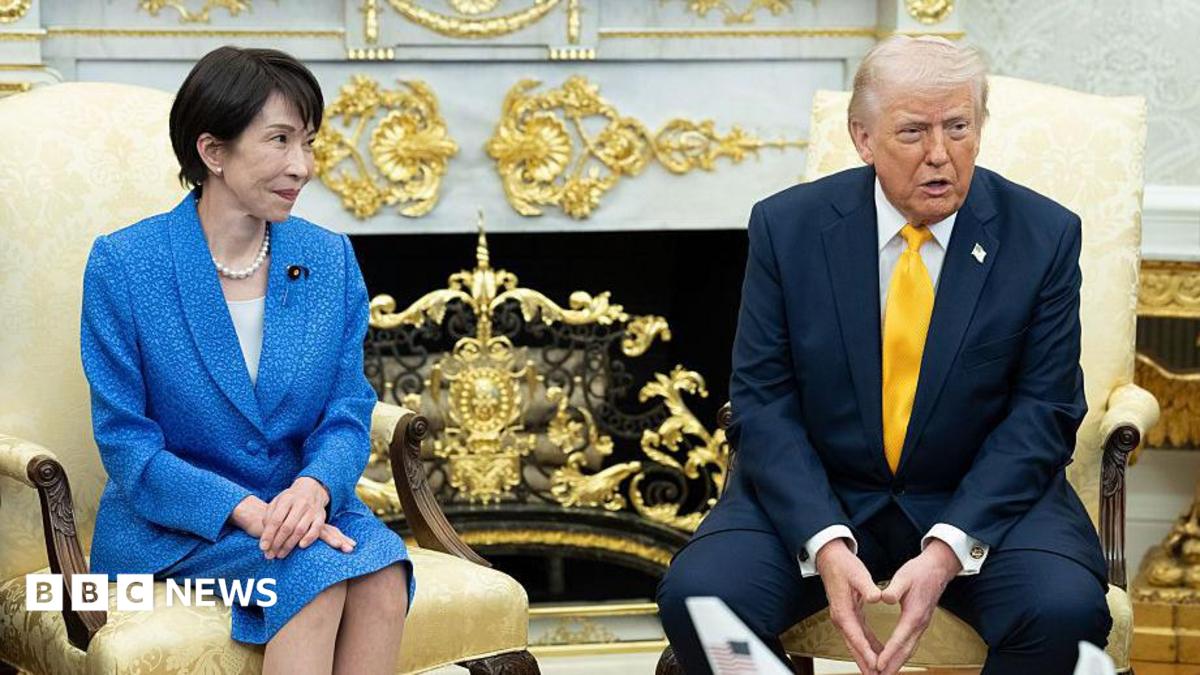
Why the Trump administration is helping support Japan’s weakening yen

Al Jazeera – Breaking News, World News and Video from Al Jazeera · collected 2026-08-05 · by Erin Hale, John Power
Read the original at Al Jazeera – Breaking News, World News and Video from Al Jazeera ↗

Summary

The Trump administration has coordinated with Japan to intervene in the currency market and prop up the yen, which has fallen to a 40-year low against the US dollar. The intervention began on July 31, when the US Treasury sold euros for yen, while Japanese authorities bought yen, resulting in the yen rising from 163 to 157 against the dollar. Japan's economic stagnation since the early 1990s and negative interest rates have contributed to the yen's weakness, with Tokyo spending tens of billions of dollars to defend it since 2022. The US's motivation for helping to support the yen is likely driven by its own interests, as a weaker Japanese currency can benefit US exporters.
Written by the local model on 2026-08-21, using this article's own text rather than the other coverage of the same event (that is the story summary below).

Signals How these are calculated →

Claims extracted
33
claim-shaped sentences
Uncertain
9%
3 of 33 hedged
Leaning
not scored
needs a local LLM pass
Publisher trust
96.5
red-flag proxy, not a credibility rating
Outlets on this story
2
Economy/Business
Narrative spread
1
articles carrying this framing
Analyzed 2026-08-05 · how these are computed

AI analysis (generated at analysis time, not now)

Story summary

The US and Japan have intervened jointly for the first time since 2011 to prop up the yen, which had fallen to a 40-year low. The two countries are expected to continue intervening in a coordinated manner to prevent a sell-off in the yen and Japanese government bonds, which could impact the global economy and push up borrowing costs for the US. According to Bank of Japan data, Tokyo may have sold almost $59 billion of US dollars to buy yen when it intervened on Thursday, before Friday's confirmed joint intervention with Washington. The size of the US intervention is unclear, but a notepad in front of US Treasury Secretary Scott Bessent during a cabinet meeting had notes suggesting that the US might have bought or sold between $5-10 billion in yen. This move highlights both countries' efforts to prevent economic instability and maintain global financial stability.

Written for “Japan Yen Support Efforts” on 2026-08-31, grounded in this article and the 1 other(s) covering the same event.
Why this leaning score
The article's tone is generally neutral, but the use of quotes from experts like Chris Turner and Masahiko Loo, who offer a somewhat critical assessment of Japan's economic policies and their impact on the yen's value, suggests a mildly right-leaning bias. Additionally, the explanation of why the US intervened to support the yen, citing its own benefits, implies a slight preference for US interests.
Written under an earlier scoring contract, which gave a paragraph rather than checkable quotes. Re-analysing this article replaces it.
Leaning score +0.65 for article 494 · logged 2026-08-05

Story

📰 Japan Yen Support Efforts
Economy/Business · 2 article(s) covering the same event. This is the one the site leads with.

How this is being covered How these are calculated →

Article leaning vs. publisher reliability
Source leaning vs. consistency

Compared with similar articles

This article reads unscored and hedges 9% of its claims. Each row says how that neighbour differs.
BBC News
⚖️ leaning not scored 🔴 6% hedged 2 of 34 📰 publisher trust 96
“Both articles describe a single joint intervention by US and Japan to prop up the yen, which occurred last week”

Publisher

Al Jazeera – Breaking News, World News and Video from Al Jazeera · 173 article(s) · 0 correction(s) detected
SignalValueWeight
Correction rate 0.000 0.4
Uncertainty density 0.070 0.25
Assertive mismatch rate 0.000 0.35
No corrections detected for this publisher. That may mean careful reporting, or simply that nothing has been checked.

Who wrote this

John Power
5 article(s) here · 1 carrying a prediction
🔮 US President Donald Trump’s administration has said it aims to sever “every” economic lifeline sustaining Iran in what officials have warned will be the toughest sanctions campaign ever seen.
🔮 It’s trying to prevent a disorderly decline that could spill over into Treasury markets, global funding conditions, and broader financial stability,” Loo told Al Jazeera.
🔮 “Gaining a clear picture of Claude’s understanding of its situation – by examining its reasoning transcripts and running our own analyses – will help us identify the causes of its behavior,” the AI company said in a post on X, referring to its flagship series of large language models.
🔮 Baghaei said Iranian officials were currently engaged in negotiations with Oman on allowing ships to transit the Strait of Hormuz and that issues between the US and Iran would need to be addressed in the “next stages”.
More on this subject from John Power
US threat of ‘economic D-Day’ for Iran tests Trump’s China detente
2026-08-24 · Al Jazeera – Breaking News, World News and Video from Al Jazeera · 51% similar
All 5 articles by John Power →
Erin Hale
1 article(s) here · 1 carrying a prediction
🔮 It’s trying to prevent a disorderly decline that could spill over into Treasury markets, global funding conditions, and broader financial stability,” Loo told Al Jazeera.
The only article under this byline in the corpus.

Topics

Israel Japan Japanese Tokyo Washington

Subjects

Japan GPE · 11× Washington GPE · 5× Japanese NORP · 4× Tokyo GPE · 4× Al Jazeera ORG · 2× Israel GPE · 2× 4Colombia GPE · 1× Petro ORG · 1× Spokane GPE · 1× The United States GPE · 1×

Narrative

That would put upward pressure on interest rates in the US, raising the cost of servicing the country’s rapidly growing national debt, which already exceeds $39 trillion. “The financial cost of intervention for the US is low and, given that President Donald Trump favours a weaker US dollar, the domestic political cost is minimal,” Shigeto Nagai, head of Japan economics at Oxford Economics, wrote in a research briefing on Monday. “Coordinated intervention is a cost-effective method as it allows the US to do a significant favour for Japan, a precious loyal ally in Asia, and take some pressure off US interest rates.
framing: assertive · carried by 1 article(s) · first seen 2026-08-05
🔮 It’s trying to prevent a disorderly decline that could spill over into Treasury markets, global funding conditions, and broader financial stability,” Loo told Al Jazeera.
2026-08-05 · Al Jazeera – Breaking News, World News and Video from Al Jazeera
Why the Trump administration is helping support Japan’s weakening yen · assertive framing

Claims (33 extracted, 3 hedged)

The United States and Japan last week staged a coordinated intervention to halt the slide of the yen after the Japanese currency fell to a 40-year low against the US dollar. asserted
currency → stag → dollar
While it is unusual for authorities to intervene to help prop up another country’s currency, the yen has an important role in international finance as the world’s third-most-traded currency, meaning its depreciation has repercussions far beyond Japan. asserted
depreciation → intervene → Japan
Recommended Stories list of 4 items- list 1 of 4Colombia’s Petro repeats asserted
Petro → repeat → items-
- list 2 of 4Bodycam video shows firefighters battling blaze in Spokane, US - list 3 of 4Why are the Washington wildfires so severe? - list 4 of 4Palestine weekly: Israel kills dozens in Gaza after Hamas disarmament deal Here is everything you need to know about the currency intervention: What is a currency intervention and how did the US and Japan coordinate? A currency intervention occurs when a government or central bank buys or sells large quantities of foreign currency to help stabilise the value of its own currency. asserted
government → show → currency
In this case, the US and Japan coordinated an intervention to lift the value of the yen after it slid to 163 against the dollar for the first time since 1986. asserted
it → coordinate → 1986
The intervention began on July 31 when the US Treasury began selling euros for yen, while Japanese authorities also bought yen. asserted
authorities → begin → yen
In the days after the intervention, the yen began to rise and reached 157 to the dollar on Wednesday. asserted
yen → begin → Wednesday
The US last staged a currency intervention with Japan in 2011 when the yen began appreciating rapidly following the Tohoku earthquake and tsunami. asserted
yen → stag → earthquake
It also stepped in to support the Japanese currency during the Asian Financial Crisis in 1998. asserted
It → step → 1998
How did the yen get so weak? asserted
yen → get → ?
The yen’s collapse is the result of longstanding economic challenges combined with new pressures from the US-Israel war on Iran. asserted
collapse → combine → Iran
Japan has struggled with economic stagnation since the early 1990s. asserted
Japan → struggle → 1990s
The Bank of Japan has for decades attempted to stimulate growth with ultra-low and even negative interest rates, a policy that has exerted downward pressure on the yen. asserted
that → attempt → yen
While Japan’s weak currency has helped draw record numbers of tourists and kept exports cheap, it has also placed a strain on households by raising the cost of imported goods. asserted
it → help → goods
Tokyo has spent tens of billions of dollars since 2022 trying to defend the yen, but the economic policies of successive Japanese leaders, including current Prime Minister Sanae Takaichi, have partly offset these efforts. asserted
policies → spend → efforts
“Takaichi wants it all: Growth, loose fiscal policy, loose monetary policy and a stable yen – but their policy mix is leading to a weak yen, which is causing an inflation problem,” Chris Turner, global head of markets at ING, told Al Jazeera. asserted
Turner → want → Jazeera
Why does the US want a stronger yen? asserted
US → want → yen
While Japan is a close US ally, Washington stepped in for its own benefit as much as Tokyo’s, said Masahiko Loo, a senior fixed income strategist at State Street Investment Management in Tokyo. asserted
Loo → step → Tokyo
“Washington isn’t trying to strengthen the yen for Japan’s sake. asserted
Washington → try → sake
It’s trying to prevent a disorderly decline that could spill over into Treasury markets, global funding conditions, and broader financial stability,” Loo told Al Jazeera. uncertain
Loo → try → Jazeera
“A free-falling yen isn’t just Japan’s problem. asserted
yen → fall → ?
At some point it becomes a global liquidity and financial stability issue, which is why Washington stepped in.” asserted
Washington → become → point
The yen is the most traded currency after the US dollar and the euro, which means dramatic changes in its value can have ripple effects across the global financial system. asserted
changes → trade → system
One of Washington’s biggest concerns is the prospect of Japan selling off its holdings of US Treasury securities, which were valued at $1.114 trillion in May. uncertain
which → sell → May
If the yen continued to fall, Tokyo would be encouraged to sell large quantities of US Treasuries to raise cash it can use to defend the currency. asserted
it → continue → currency
That would put upward pressure on interest rates in the US, raising the cost of servicing the country’s rapidly growing national debt, which already exceeds $39 trillion. “The financial cost of intervention for the US is low and, given that President Donald Trump favours a weaker US dollar, the domestic political cost is minimal,” Shigeto Nagai, head of Japan economics at Oxford Economics, wrote in a research briefing on Monday. “Coordinated intervention is a cost-effective method as it allows the US to do a significant favour for Japan, a precious loyal ally in Asia, and take some pressure off US interest rates. asserted
US → put → rates
Will the intervention work? asserted
intervention → work → ?
While the joint intervention has provided short-term support for the yen, Japan will need to take more fundamental measures, such as raising interest rates, to raise the value of the currency in the long term, according to experts. uncertain
Japan → provide → experts
Japan’s benchmark interest rate currently stands at 1.0 percent, its highest since 1995 but far lower than other advanced economies, including the US. asserted
rate → stand → US
Without a change in Japan’s low-interest-rate environment, the latest currency intervention is just “throwing good money after bad,” said Derek Tang, an economist and CEO of Monetary Policy Analytics, a US research advisory firm. asserted
Tang → throw → Analytics
“Ultimately… the gravitational force of economic fundamentals will overwhelm intervention efforts,” Tang told Al Jazeera. asserted
Tang → overwhelm → Jazeera
“Nevertheless, Japan seems very reluctant to tighten monetary policy to raise its own interest rates and allow the currency to appreciate in that manner,” Tang said. asserted
Tang → seem → manner
“So this situation will persist for the time being.” asserted
situation → persist → time

💬 Give feedback
🕘 History 🎫 Support