The Guardian
· collected 2026-09-30 · by Hannah Ellis-Petersen and Aakash Hassan in Delhi
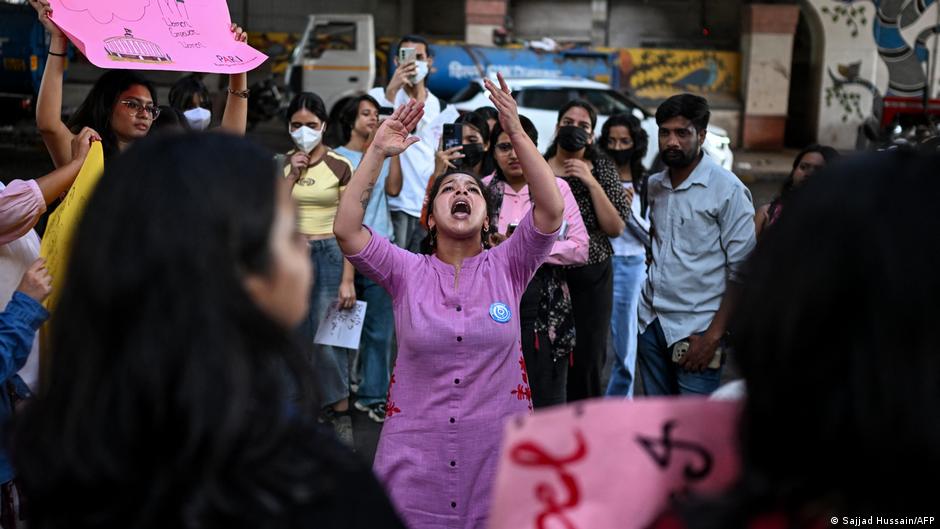
The posters, just like the women holding them, were taking no prisoners.
asserted
posters → hold → prisoners
“Girls don’t need curfews, rapists need consequences,” read one.
asserted
one → need → consequences
“Lock your dicks rather than your women at home,” read another.
asserted
another → lock → home
As hundreds of women walked from the gates of their university campus into the streets of Delhi – where sexual harassment, assault, catcalling and molestation are a constant, daily threat – they shouted together in a chorus of rage and defiance: “We want justice.”
The fury that has erupted on India’s university campuses over the past week has been double-edged.
asserted
that → walk → week
The trigger was a series of brutal rapes that have taken place in Delhi in recent weeks, including the alleged gang-rape of a 17-year-old in a public park close to Delhi University by three men who posed as police officers.
asserted
who → take → officers
Just a week earlier, another 17-year-old was gang-raped and murdered in Delhi’s Swaroop Nagar neighbourhood after she went to meet friends.
asserted
she → rap → friends
The accused allegedly raped her, stabbed her to death and dumped her body in a field, where it was discovered days later half eaten by dogs.
uncertain
it → accuse → dogs
Rapes of an 11-year-old and a six-year-old were reported in the same month.
asserted
Rapes → report → month
Last month, a 16-year-old was allegedly raped by a bus driver and conductor after she boarded a sleeper bus in Delhi.
uncertain
she → rap → Delhi
Women who have taken part in protests on Delhi university campuses have condemned these alleged violent rapes on minors as disgusting and unforgivable – but they have also been at pains to emphasise that they are not out of the ordinary.
asserted
they → take → ordinary
Fourteen years have passed since Delhi’s infamous Nirbhaya rape case, when a woman was gang-raped on a bus and died from her injuries.
asserted
woman → pass → injuries
But while it provoked international outrage and a slew of legislation and government promises, women say nothing has changed; for them, India’s streets, particularly in Delhi, remain as unsafe as ever.
asserted
streets → provoke → Delhi
According to statistics, a women is raped in India every 20 minutes – though the real scale is believed to be far worse due to chronic under-reporting.
uncertain
scale → accord → reporting
This week, the supreme court said the five successive rape cases “starkly underlined a systematic failure” and it could not help but “draw painful parallels to the Nirbhaya incident of 2012”.
uncertain
it → say → 2012
Vaishnavi Dhruw, 21, a history student at Delhi University, was among the female protesters at the “smash the patriarchy” protest march on Wednesday afternoon.
asserted
Dhruw → smash → afternoon
“I don’t know a single woman who lives in this city and feels safe,” she said.
asserted
she → know → city
While some of the key demands of the protest have been better lighting and policing, Dhruw emphasised that for anything to change, the country required a deep societal shift where men no longer felt they had ownership over women’s bodies.
asserted
they → emphasise → bodies
“We are not marching for safety, we are here to protest for our freedom, for the most basic right to walk in our own streets,” she said.
asserted
she → march → streets
“Again and again, women are told to stay indoors, to not go out at night, to cover ourselves, to protect ourselves.
asserted
women → tell → ourselves
When will society tell men in our country not to rape?”
asserted
society → tell → country
Much of the anger driving the protests has also been prompted by the response by the authorities to the rapes, which women say once again has only been to police their freedoms.
asserted
women → drive → freedoms
Women in Delhi were told to stay out of parks at night, and classes were temporarily halted at one of Delhi’s most prestigious female colleges.
asserted
classes → tell → colleges
Many hostels where female students stay impose strict curfews preventing them from going out at night.
asserted
students → stay → night
“Instead of going after criminals, you’re going to tell women to sit at home,” said Aranya Rathore, 25, a student at Delhi University.
asserted
Rathore → go → University
In fact, it’s going to curtail our freedom more.”
asserted
it → go → freedom
Female students say a lot of their time is taken up by safety logistics – from wearing modest clothes to reorganising their days to ensure they do not travel alone or at night and always having a trackable live location on their phones.
asserted
they → say → phones
There is widespread awareness that should anything happen, the onus of blame – both within the family home and more widely in society – tends to fall on women.
asserted
onus → be → women
As one poster at Wednesday’s march pointed out, “no one ever asks what the rapist was wearing”.
asserted
rapist → point → what
Yet despite their best efforts, many women said it was almost impossible to avoid harassment.
asserted
it → say → harassment
Ananya Wig, a 26-year-old graduate of Delhi University and the founder of Her Huq, a gender equality initiative, said she had experienced harassment both around university campuses and in public spaces.
asserted
she → say → spaces
She recounted an incident where a driver rolled down his car window and began masturbating as she and female friends got off a rickshaw and walked through the college gates.
asserted
she → recount → gates
“This wasn’t at night, it was in the middle of the day,” she said.
asserted
she → say → day
“I’ve always lived in Delhi and the city has not changed.”
asserted
city → live → Delhi
The protests have brought into focus a dilemma faced by many Indian women, who are being educated in greater numbers than any time in the country’s history and have better job opportunities than ever before, but still have to navigate the constant debilitating threats to their safety and the conservative pressures from their families.
asserted
who → bring → families
“I know so many girls, not just 10 years ago but even today, who end up choosing educational institutions and jobs and other employment opportunities depending on how close they are from their home,” said Wig.
asserted
Wig → know → home
Many of the Delhi University students who took part in the marches said that sexual harassment had become prevalent on campus, and have demanded better accountability mechanisms for reporting assault.
asserted
harassment → take → assault
The university has not responded.
asserted
university → respond → ?
Devyani Sarkar, 24, who is studying for a master’s in English, said: “Delhi University is one of the most prestigious universities in India right now but there are various cases of women being assaulted by professors, sometimes unfortunately also for grades.
asserted
women → study → grades
It’s despicable, but it’s also a living truth.”
asserted
it → ’ → ?
Many on the marches said it was no coincidence that they were taking place in the aftermath of India’s “cockroach” movement, in which hundreds of thousands of young Gen Z Indians took to the streets over education reform.
asserted
thousands → say → reform
…and 2 more, not listed.
 The Aporia