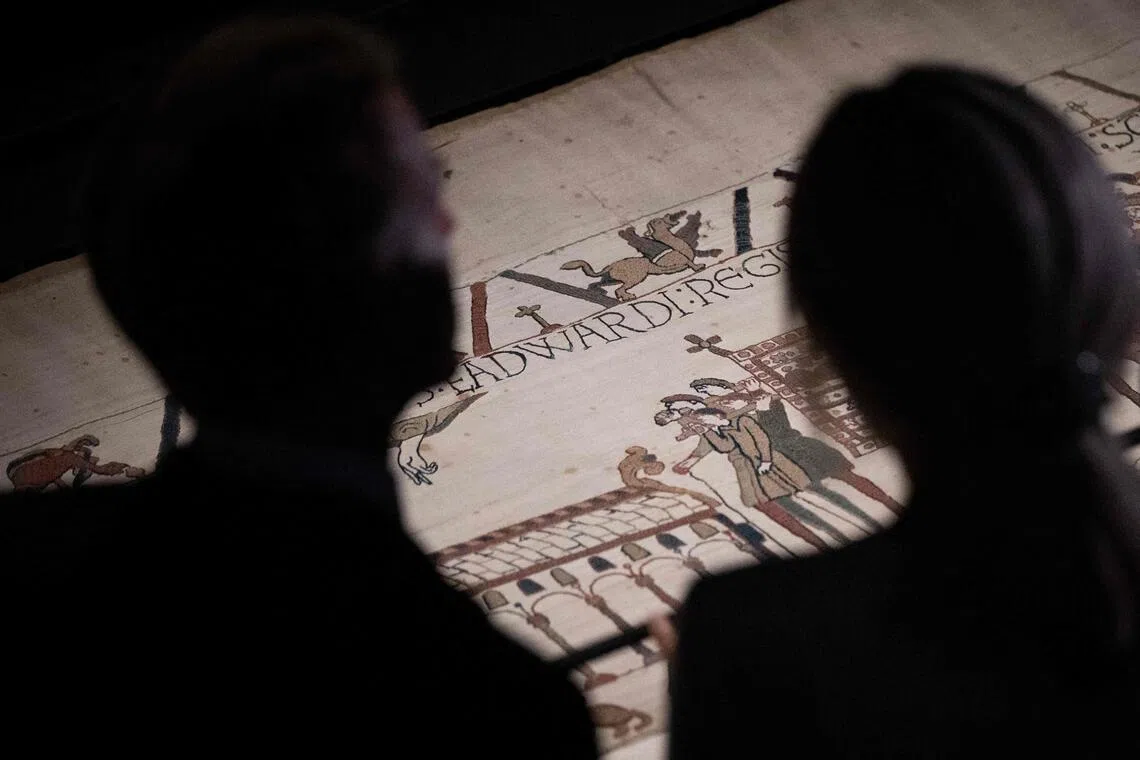
The King of England and the president of France this week visited the British Museum to view the Bayeux Tapestry, which is on display in the UK for the first time since it was embroidered by a team of British needlewomen in Kent nearly 1,000 years ago.
asserted
it → visit → Kent
It tells the story of the Battle of Hastings in a 230ft frieze featuring 626 figures - only six of them women - 190 horses, 37 ships and 33 buildings.
asserted
six → tell → them
The tapestry is a unique account of a battle, the details of which might have been largely forgotten had it not become the subject of such an extraordinary artefact.
uncertain
it → forget → artefact
But many of the events it depicts have been hotly disputed as historians unearthed alternative versions.
asserted
historians → depict → versions
Here the author of Harold The King: The Story Of The Battle Of Hastings presents a blow-by-blow account of 1066, the year that changed Britain for ever.
asserted
that → present → Britain
As the English king Edward the Confessor lies dying, his nearest and dearest flock to his bedside, including his wife Edyth.
asserted
nearest → lie → wife
During the night, Archbishop Stigand of Canterbury asks Edward, who has failed to produce an heir, who he would like to succeed him.
asserted
he → ask → him
As he slips in and out of a coma, Edward indicates the throne should go to his wife's brother Harold Godwinson, the Earl of Wessex's son.
asserted
throne → slip → Wessex
The death of King Harold as depicted on the Bayeux Tapestry
James Norton as King Harold in the BBC drama King and Conqueror
January 6
A meeting of the Witan - the council of nobles and churchmen who advised the Anglo-Saxon kings - is convened at the newly completed Westminster Abbey to rubber stamp Edward's choice.
asserted
who → depict → choice
That afternoon, the abbey hosts a funeral and a coronation, with Edward buried at the church he commissioned and his successor Harold crowned king.
asserted
successor → host → church
King Harald Hardrada of Norway claims that King Magnus I - the man with whom he had shared the Norwegian crown until his death 19 years earlier - had struck a deal with Harthacnut, Edward's half-brother and predecessor as king, that if either died without an heir the other would succeed him.
uncertain
other → claim → him
Over the Channel in France, Duke William of Normandy is stewing, too.
asserted
William → stew → Normandy
He was related to Edward via the English king's mother, Emma of Normandy, and only the previous year had extracted a solemn oath from Harold, sworn over sacred relics, that William's right to the succession would be upheld.
asserted
right → relate → succession
Conscious of the threat from Norway, Harold rides to the north of England to confront the two most powerful noblemen in the region, the brothers Edwin, Earl of Mercia, and Morcar, Earl of Northumbria.
asserted
Harold → rid → Northumbria
Despite the fact that he had at least six children by his common-law wife, Edith Swanneck, Harold secures their loyalty by agreeing to marry their sister, another Edith.
asserted
Harold → secure → sister
With his northern flank secured, Harold turns his attention to recruiting a large army in the south to confront the even more potent threat from Normandy.
asserted
Harold → secure → Normandy
The Bayeux Tapestry on display at the British Museum which opens to the public on September 10
Edward the Confessor as depicted in the Bayeux Tapestry.
asserted
which → open → Tapestry
The King died on January 5 1066
An image on the Bayeux Tapestry which shows William of Normandy rewarding Harold Godwinson Earl of Wessex with arms and knights him
March
Within weeks, Harold has assembled a force of several thousand men on the Isle of Wight.
asserted
Harold → die → Wight
William embarks on a mammoth ship- building programme, aiming to creating a navy of 700 Viking-style longships at the port of Dives-sur-Mer to carry his invading force of 7,000 men and 2,000 horses.
asserted
William → embark → men
His knights are protected by pointed metal helmets with nose guards and the hauberk, a knee-length chainmail shirt weighing about 30lbs.
asserted
knights → protect → 30lbs
They carry formidable weapons, such as axes and broadswords, which can cause catastrophic wounds, scattering brain matter, severed limbs and spilled entrails across the battlefield.
asserted
which → carry → battlefield
As Harold and William ready themselves for war, a 'long-haired star' is sighted in the skies over Europe.
asserted
star → ready → Europe
It shines brightly for more than a week as it passes close to the Earth but prompts very different emotions on each side of the Channel.
asserted
it → shin → Channel
In England, King Harold and his people see the shooting star, now known to be Halley's Comet, as a terrifying omen which signals doom for the ruling regime.
asserted
which → see → regime
But William of Normandy interprets it as a divine endorsement of his upcoming invasion.
asserted
William → interpret → invasion
With William's invasion stymied by bad weather, provisions running out and his militiamen agitating to return home to harvest their crops, Harold disbands his army and returns to London.
asserted
Harold → stymie → London
On the very same day, Harald Hardrada - egged on by Harold's exiled brother Tostig, who is hell-bent on revenge for being exiled to Norway - makes landfall at the mouth of the River Tyne in a fleet of more than 300 ships carrying a massive force of 15,000 men.
asserted
who → egg → men
Harold swears an oath to William of Normandy
James Norton as Harold.
asserted
Harold → swear → Harold
King Harold's coronation took place on January 6 1066
September 12
In a move that represents a nightmare pincer movement for Harold, William, who has been keeping a beady eye on the weathercock on the spire of
the local church, orders his fleet to set sail from Normandy.
asserted
who → represent → Normandy
Fortunately for the Englishman, the Duke of Normandy loses a number of his boats to fierce storms and the rest of his fleet is forced to take shelter at Saint-Valery-sur-Somme, where it waits for the winds to change.
asserted
winds → lose → Somme
September 20
To Harold's horror, Edwin and Morcar lose a hard-fought confrontation with the Viking invaders two miles south of York, now known as the Battle of Fulford.
asserted
Edwin → lose → Fulford
They send an urgent plea for help and Harold leads a forced march north with his elite force, the Housecarls, and calls up ordinary fighting men as they pass through Essex, Leicestershire, Nottinghamshire and Derbyshire.
asserted
they → send → Essex
September 25
By marching night and day, with few stops for rest, Harold's army reaches Yorkshire in four days, taking the Norwegians by surprise.
asserted
army → march → surprise
What follows is a rout which has gone down in history as the Battle of Stamford Bridge.
asserted
which → follow → Bridge
Both Harald and Tostig are killed and the invaders suffer such huge losses only 24 of the original 300 ships are required for survivors.
asserted
24 → kill → survivors
It proves to be the last Viking incursion on to English soil.
asserted
It → prove → soil
September 28
Three days after Stamford Bridge, William makes his belated arrival in his would-be kingdom at Pevensey on the East Sussex coast, 11 miles west of Hastings.
asserted
William → make → Hastings
There, he immediately sets to work building a motte-and-bailey castle - a medieval structure of a wooden keep on a raised earth mound (a motte), with an enclosed courtyard (a bailey) surrounded by a ditch and palisade.
asserted
he → set → ditch
A scene from the Bayeux Tapestry showing the invading Normans on horseback charging the Anglo-Saxon soldiers
King Charles and French Preisdent Emmanuel Macron join others to view the Bayuex Tapestry in London
October 1
King Harold and his men are still in York, and in a pitiful state, when word comes that the Normans have landed.
asserted
Normans → show → state
A third of Harold's men had died at Stamford Bridge.
asserted
third → die → Bridge
…and 58 more, not listed.
 The Aporia