Missile alerts cost Ukraine $45m for every hour they halt businesses

Read the original at The Guardian ↗
The Guardian · collected 2026-09-30 · by Pjotr Sauer in Kyiv

Quick Summary

Ukraine's economy minister estimates missile alerts cost the country $45 million hourly as businesses halt operations during sirens lasting up to ten hours daily. Russia targets economic infrastructure, and while Ukraine introduced a two-tier warning system to mitigate this, recent attacks underscore continued risks even under lower alert levels. Russian strikes have caused over $10 billion in damage this year alone, affecting critical industries and exports.
Written locally by qwen2.5:14b on 2026-09-30, using this article's own text rather than the other coverage of the same event (that is the story summary below).

AI analysis runs on qwen2.5:14b, locally

Story summary

Ukraine's economy minister, Oleksandr Kravchenko, estimates that missile alerts are costing the country $45 million (£34 million) every hour as businesses shut down. This comes amid increased Russian attacks targeting key infrastructure like industrial sites and data centers in an effort to cripple Ukraine’s economic backbone. The rapid deployment of jet-powered drones by Russia has intensified this threat, leading to prolonged sirens that can last up to 10 hours daily, forcing workers into shelters and effectively halting operations. Kravchenko, a former McKinsey executive who joined the government in summer, underscores the urgent need for advanced air-defence systems and the development of drones capable of intercepting these new Russian weapons.

Written for “Ukraine Missile Alerts Cost” on 2026-10-04, grounded in this article and the 0 other(s) covering the same event.

Signals How these are calculated →

Claims extracted
31
claim-shaped sentences
Uncertain
16%
5 of 31 hedged
Leaning
not political
takes no side on a contested political question
Correction & hedging signals
68.3
corrections and hedging in what we collected; not a measure of accuracy
Outlets on this story
1
Economy/Business
Narrative spread
1
articles carrying this framing
Analyzed 2026-09-30 · how these are computed

Story

📰 Ukraine Missile Alerts Cost
Economy/Business · 1 article(s) covering the same event.

How this is being covered How these are calculated →

Article leaning vs. publisher reliability
Source leaning vs. consistency

Compared with similar articles

This article reads unscored and hedges 16% of its claims. Each row says how that neighbour differs.
Al Jazeera
⚖️ leaning not scored 🔴 0% hedged 0 of 13 📰 publisher trust 60
“Article A discusses economic costs due to missile alerts, while Article B reports a specific drone attack on a school in Kyiv.”
Al Jazeera
⚖️ leaning not scored 🔴 0% hedged 0 of 2 📰 publisher trust 60
“The articles describe different events: one about economic costs of missile alerts in Ukraine, and another about Germany's aid announcement during a visit by the German Chancellor.”
New York Post
⚖️ leaning not scored 🔴 0% hedged 0 of 20 📰 publisher trust 64
“The articles describe different incidents occurring at distinct times, one regarding economic costs of missile alerts and the other about air raid sirens and explosions during a visit by German Chancellor.”
Washington Examiner
⚖️ leaning not scored 🔴 11% hedged 4 of 37 📰 publisher trust 72
“The articles describe related military actions but different specific events: one focuses on the economic impact of missile alerts halting businesses, while the other reports on a new air campaign targeting Ukrainian power plants.”
The Hindu
⚖️ leaning not scored 🔴 6% hedged 1 of 16 📰 publisher trust 60
“The articles discuss different aspects of the ongoing conflict; one focuses on the missile and drone attacks on Kyiv, while the other discusses the economic impact of missile alerts.”
The Guardian
⚖️ leaning not scored 🔴 0% hedged 0 of 11 📰 publisher trust 68
“The articles describe different aspects of the ongoing conflict; one focuses on economic costs due to missile alerts, while the other reports on specific overnight drone attacks and damage to infrastructure.”
NPR
⚖️ Leans left 🔴 0% hedged 0 of 3 📰 publisher trust 60
“Article A focuses on the economic impact of missile alerts and Russian attacks on Ukraine's infrastructure, while Article B discusses how Ukrainians are coping with new and more deadly Russian attacks.”
BBC News
⚖️ leaning not scored 🔴 0% hedged 0 of 24 📰 publisher trust 78
“The articles describe different aspects of ongoing Russian strikes on Ukraine; one focuses on economic costs due to missile alerts, while the other discusses the mayor's warning about intensified strikes tearing Kyiv apart.”

Publisher

The Guardian · 1243 article(s) · 4 correction(s) detected
Running correction rate · 4 correction(s)
2026-10-03
Tennessee’s top prison official resigning after botched execution of Christa Pike
2026-10-01
Tennessee governor suspends all executions after Christa Pike’s lethal injections fail
2026-09-28
Extra 1,000 prison beds announced in NSW as union warns against arresting ‘our way out of domestic violence’
2026-09-05
Australia’s housing prices are trending down. See which suburbs have had the biggest falls

Who wrote this

Pjotr Sauer in Kyiv
2 article(s) here · 1 carrying a prediction
🔮 Two people were injured in the strike, said Kyiv’s mayor, Vitali Klitschko.
🔮 “What we had not fully anticipated was how quickly Russia would develop these jet-powered drones and use them to target everything,” he said, referring to Russia’s use of the new weapons that have pounded Kyiv in recent weeks.
Also by Pjotr Sauer in Kyiv
Nothing else under this byline is closely related to this article, so these are simply their most recent.

Topics

Kyiv McKinsey Russia Russian Ukraine

Subjects

Ukraine GPE · 8× Kravchenko PERSON · 6× Kyiv GPE · 5× Russian NORP · 5× Russia GPE · 4× European NORP · 1× Japan GPE · 1× McKinsey ORG · 1× Oleksandr Kravchenko PERSON · 1× Volodymyr Zelenskyy PERSON · 1×

Narrative

“The cost of war is simply increasing,” he said, pointing to the need for more air-defence systems and for Ukraine to accelerate development of drones capable of intercepting Russia’s new jet-powered weapons. But high-profile corruption scandals have also reached Zelenskyy’s inner circle, straining trust in the government both at home and among western donors.
framing: assertive · carried by 1 article(s) · first seen 2026-09-30
🔮 “What we had not fully anticipated was how quickly Russia would develop these jet-powered drones and use them to target everything,” he said, referring to Russia’s use of the new weapons that have pounded Kyiv in recent weeks.
2026-09-30 · The Guardian
Missile alerts cost Ukraine $45m for every hour they halt businesses · assertive framing

Claims (31 extracted, 5 hedged)

Missile alerts are costing Ukraine an estimated $45m (£34m) for every hour they bring business to a halt, according to the country’s economy minister, as Kyiv searches for ways to keep the economy running under an intensifying Russian bombardment. uncertain
Kyiv → cost → bombardment
Russia has increasingly targeted the infrastructure underpinning Ukraine’s economy, striking industrial sites, warehouses, logistics hubs and datacentres in what Oleksandr Kravchenko, the minister for economy and the environment, described as an effort to “destroy pretty much the entire economy”. asserted
Kravchenko → target → economy
“What we had not fully anticipated was how quickly Russia would develop these jet-powered drones and use them to target everything,” he said, referring to Russia’s use of the new weapons that have pounded Kyiv in recent weeks. asserted
that → anticipate → weeks
Speaking from the heavily protected government building in Kyiv, Kravchenko, a former McKinsey executive who joined the government in the summer, said the attacks were forcing large parts of the economy into repeated standstills as workers were sent to shelters, with sirens lasting up to 10 hours a day. asserted
sirens → speak → hours
“If people are in a bunker, business stops,” he said. asserted
he → stop → bunker
To ease the economic costs, the government recently introduced a new two-tier warning system designed to keep businesses operating during prolonged air raid alerts. asserted
government → ease → alerts
A “red” alert warns of a missile threat and requires people to seek shelter, while a “yellow” warning is used for drone threats, allowing many businesses to remain open. asserted
businesses → warn → threats
More than half of businesses were continuing to operate during yellow alerts, Kravchenko said. asserted
Kravchenko → continue → alerts
That danger was made clear on Monday, when a Russian jet-powered drone struck the National Academy of Sciences in central Kyiv during a yellow alert, killing two people while staff were still inside working. asserted
staff → make → people
It is one of the difficult trade-offs Ukraine faces as it tries to keep normal life moving while protecting people from an escalating campaign of Russian strikes. asserted
life → face → strikes
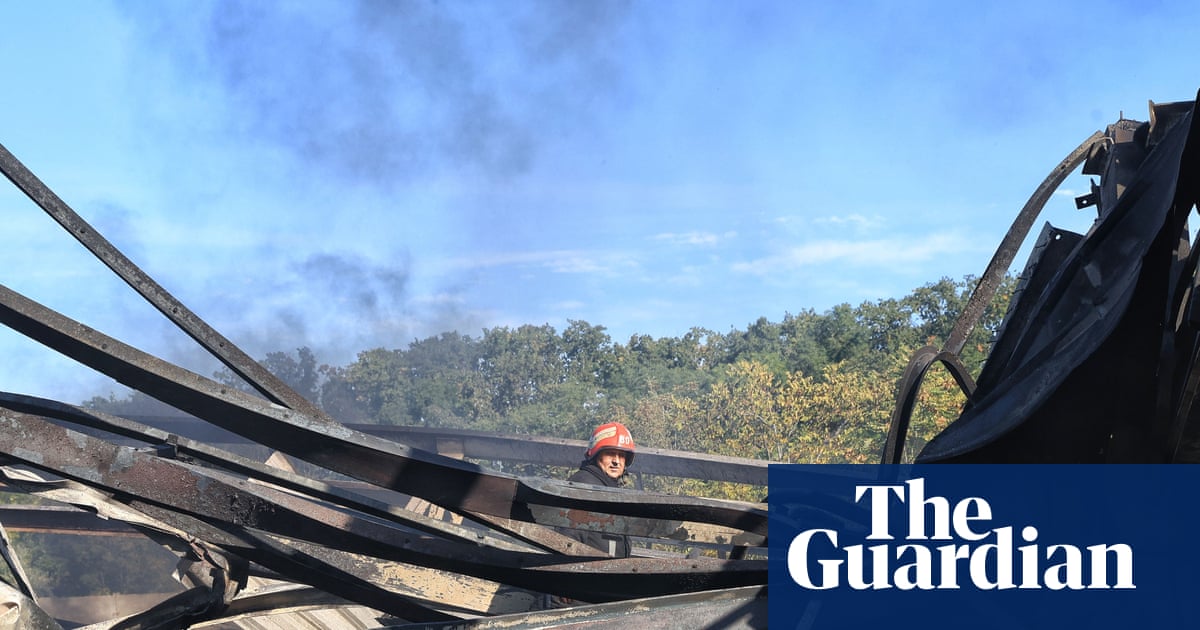
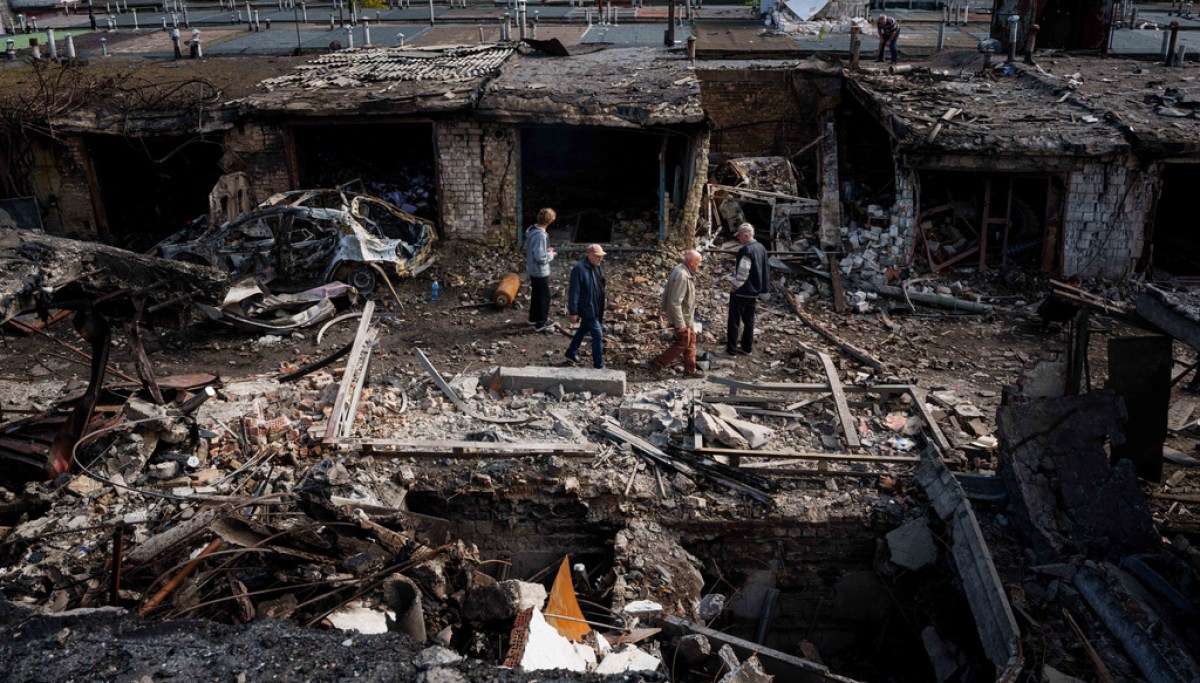
Kravchenko said Russian attacks this year alone had caused an estimated $10bn in damage to fixed assets, with steel plants, warehouses, logistics infrastructure and, most recently datacentres, among the targets. asserted
attacks → say → targets
Russia has also effectively blockaded Ukraine’s Black Sea ports, which before the blockade carried the bulk of the country’s exports. asserted
which → blockade → exports
The minister believed the government was better prepared this year for what could be the “hardest, the harshest winter” of the war, with further pressure expected on energy supplies, infrastructure and businesses already weakened by months of strikes. uncertain
pressure → believe → strikes
To protect against future strikes, the government is now discussing ways to allow more private companies to purchase Ukraine’s air-defence system, the minister said, although he cautioned that businesses could never fully protect themselves from Russian missiles and drones. uncertain
businesses → protect → missiles
The ongoing damage from strikes has added to an already severe strain on the state’s finances. asserted
damage → add → finances
The president, Volodymyr Zelenskyy, has recently put Ukraine’s remaining budget shortfall this year at about $27bn, a figure that has prompted questions among some European governments over how the gap emerged, despite the EU having already agreed a €90bn loan package for Ukraine covering 2026 and 2027. asserted
EU → put → 2026
Kravchenko said the government had since narrowed the shortfall to $20bn through spending cuts and by identifying additional domestic reserves. asserted
government → say → reserves
Kyiv was now seeking further support from the EU, Japan, Canada and the UK, including potentially bringing forward loans that had been earmarked for next year, Kravchenko said. asserted
Kravchenko → seek → year
“There is very active work with all our international partners to get additional sources of funding,” he said. asserted
he → be → funding
Kravchenko dismissed suggestions that the shortfall was the result of mismanagement or corruption. asserted
shortfall → dismiss → mismanagement
He also said it was not due to excessive spending under former defence minister Mykhailo Fedorov, whose drive to overhaul military procurement and rapidly expand Ukraine’s drone programme had made him one of the government’s most prominent reformers before his dismissal in July, a move that triggered street protests. asserted
that → say → protests
Instead, he said the gap reflected both weaker-than-expected state revenues and the rising cost of waging the war. asserted
gap → say → war
“The cost of war is simply increasing,” he said, pointing to the need for more air-defence systems and for Ukraine to accelerate development of drones capable of intercepting Russia’s new jet-powered weapons. But high-profile corruption scandals have also reached Zelenskyy’s inner circle, straining trust in the government both at home and among western donors. asserted
scandals → increase → donors
A recent poll by the Kyiv International Institute of Sociology found that corruption in government was the most cited concern among Ukrainians, named by 50% of respondents, ahead of mass missile and drone strikes at 40%. asserted
corruption → find → %
The same survey found that 72% believed Zelenskyy bore personal responsibility for corrupt actions by people around him. asserted
Zelenskyy → find → him
Kravchenko said progress had been made to tackle the issue but admitted that Ukraine faced both corruption itself and a persistent perception problem both inside Ukraine and abroad. asserted
Ukraine → say → Ukraine
“I very much appreciate the pressure of European partners on reforms,” he said, adding that Ukraine also needed to tackle perceptions of corruption at home and abroad. asserted
Ukraine → appreciate → home
Ukraine’s external financing needs for 2027 are estimated at $52.6bn, but only about $20bn has so far been secured, according to the minister, with further tax rises and spending cuts under discussion. uncertain
20bn → estimate → discussion
Asked whether the rise of parties sceptical of support for Ukraine in France and Germany could weaken western commitment to Kyiv, he said: “Am I worried? uncertain
I → ask → Kyiv
I think I should be, probably.” asserted
I → think → ?
“The overall fatigue is increasing in Europe,” he added. asserted
he → increase → Europe

💬Give feedback
🕘History 🎫Support