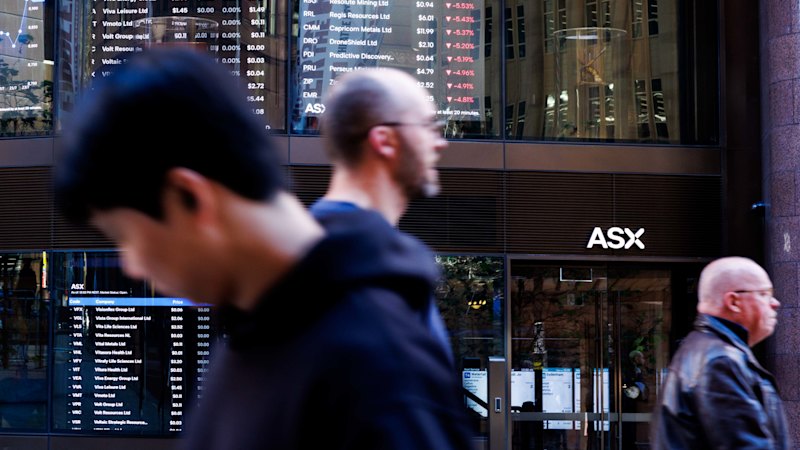
The Australian sharemarket is poised to open little changed on Wednesday, as traders digest the Reserve Bank’s move to lift interest rates to a 15-year high and await key inflation figures for clues whether there’s more rate hikes to come.
asserted
traders → poise → clues
The local bourse on Tuesday edged up 0.3 per cent after the rate call by the RBA, which flagged the possibility of further hikes, without signalling they were imminent.
asserted
they → edge → hikes
The Australian dollar was trading at US69.83¢ shortly after 7am AEST, having fallen below $US70¢ on Tuesday for the first time since early August after RBA governor Michele Bullock expressed “hope” the tightening delivered so far this year is sufficient to bring inflation back to target.
asserted
tightening → trade → target
Money markets scaled back bets on further moves as traders interpreted Bullock’s comments as less hawkish than the central bank’s statement on interest rates.
asserted
traders → scale → rates
While traders still expect the RBA will hike once more this cycle, the cash rate is now seen peaking below 5 per cent.
asserted
rate → expect → cent
The Australian Bureau of Statistics will release its monthly inflation data for August at 11.30am AEST, which is likely to be an important input for policymakers, though the RBA’s favoured quarterly report will be available before the next meeting in November.
asserted
report → release → November
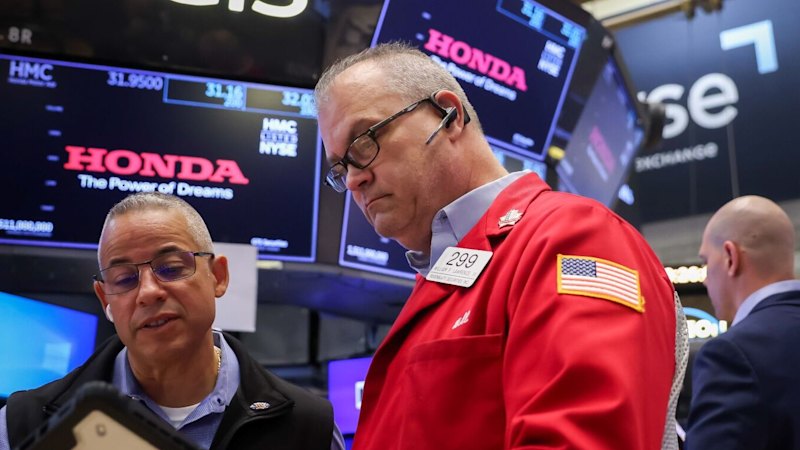
On Wall Street overnight, stocks drifted lower as long-term Treasury yields ticked higher, pressuring the market.
asserted
yields → drift → market
The S&P 500 fell 0.2 per cent, the Dow Jones Industrial Average slipped 0.3 per cent and the Nasdaq composite fell 0.1 per cent.
asserted
composite → fall → ?
Major indexes shifted lower after a quiet morning as rising bond yields undercut much of the heavy lifting being done by several technology behemoths.
asserted
yields → shift → behemoths
Nvidia, the market’s most influential stock, gave up an early gain and was down 0.2 per cent.
asserted
Nvidia → give → gain
Broadcom also gave up much of its gain and was up most recently by 2 per cent.
asserted
Broadcom → give → cent
US stocks have been under pressure as oil prices have swung sharply amid the US war with Iran, helping to push Treasury yields higher.
asserted
prices → swing → yields
The yield on the 10-year Treasury rose to 5.25 per cent and touched its highest level in 24 years.
asserted
yield → rise → years
The price of Brent crude oil fell 1.7 per cent to $US96.16 a barrel, but remains far above the roughly $US72 it cost before the war.
asserted
it → fall → war
Mediators continued to work with the United States and Iran on reaching a deal to end the fighting and open the Strait of Hormuz.
asserted
Mediators → continue → Hormuz
US President Donald Trump over the weekend rejected an offer from Tehran to reopen the key waterway.
asserted
Trump → reject → waterway
Energy stocks had some of the broadest losses.
asserted
stocks → have → losses
Exxon Mobil fell 1 per cent.
asserted
Mobil → fall → ?
Overall, rising oil prices have been fuelling a jump in Treasury yields.
asserted
prices → rise → yields
Higher yields threaten to slow economic growth by making borrowing more expensive for individuals and businesses.
asserted
borrowing → threaten → individuals
They can also hurt prices for stocks, especially those seen as expensive, including many technology companies that have soared because of the frenzy around AI technology.
asserted
that → hurt → technology
Wall Street will see several big economic updates this week that could help investors and the Federal Reserve get a better sense of where inflation is headed and how households and businesses are dealing with high prices.
uncertain
households → see → prices
Stubbornly high inflation has been sapping consumer confidence and pressuring the Fed, which recently raised its benchmark interest rate in an effort to cool prices.
asserted
which → sap → prices
The latest update of the central bank’s preferred measure of inflation will be released on Wednesday.
asserted
update → release → Wednesday
Economists expect the personal consumption expenditures index, or PCE, to show that the rate of inflation rose 3.7 per cent in August, matching July’s reading.
asserted
rate → expect → reading
Inflation rates have remained stubbornly above 3 per cent most of the year and that is well above the Fed’s target rate of 2 per cent.
asserted
that → remain → cent
Federal Reserve Bank of New York President John Williams said overnight one more interest-rate hike “late this year” may be appropriate to help contain inflation, prompting investors to dial back their expectations for an increase in October just before midterm elections.
uncertain
hike → say → elections
Williams underscored the point by saying there was no urgency to act following the central bank’s decision to lift rates earlier this month.
asserted
Williams → underscore → rates
with AP, Bloomberg
The Business Briefing newsletter delivers major stories, exclusive coverage and expert opinion.
asserted
newsletter → deliver → stories
 The Aporia