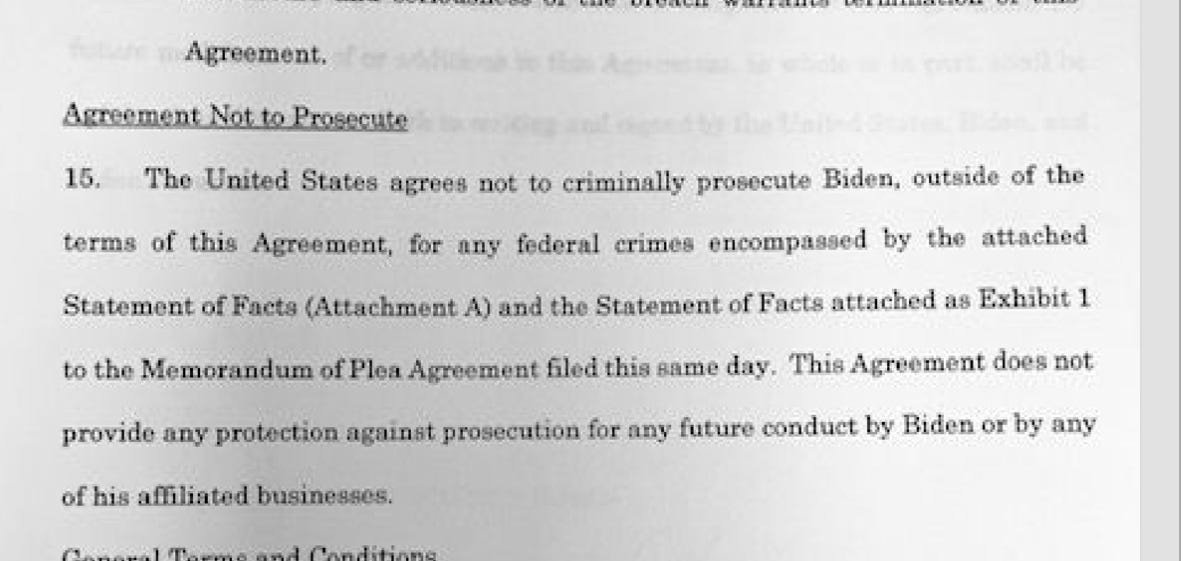
This post was largely overtaken by Politico’s subsequent publication of the plea and diversion agreements, discussed at the end — see supplement.
asserted
post → overtake → supplement
The urge to comment on events immediately, as they are happening, before we have the information necessary to evaluate them, is corrosive.
asserted
we → comment → them
It’s also overpowering and pervasive in the era of social media.
asserted
It → ’ → media
Nobody wants to wait for tomorrow’s morning paper, or even tonight’s newscast.
asserted
Nobody → want → paper
We want answers and we want them now.
asserted
we → want → them
Many of us also want to be the ones providing those answers — the first ones providing those answers — for those sweet clicks, comments, likes, and attention.
asserted
Many → want → clicks
Today Robert Hunter Biden’s long-anticipated guilty plea on two misdemeanor counts of failure to file a tax return was derailed.
asserted
plea → anticipate → return
You’ve seen the news by now, and if you haven’t, you’ve probably seen the social media reactions, many of which are nonsensical and uninformed.
asserted
many → see → which
But, judging from the news stories, and with the greatest respect to those reporters, it seems they didn’t completely understand what was happening.
asserted
what → judge → reporters
They couldn’t report many verbatim quotes (they should have brought someone who takes shorthand) and federal courts don’t allow broadcast or media recoding of proceedings.
asserted
courts → report → proceedings
So we’re left with a series of impressions by reporters who picked up bits and pieces of what was happening.
asserted
what → leave → bits
Many of those reporters are intelligent and sophisticated but it’s not clear they have the experience with federal criminal law to pick up exactly what was going on.
asserted
what → ’ → law
The truth further eludes us because we lack the most important document — the written plea agreement between the U.S. Attorney’s Office.
asserted
we → elude → Office
I argued weeks ago, when news of the plea deal came out, that until we got the plea agreement we could not fully evaluate the many claims that Hunter Biden was getting a “sweetheart deal.”
uncertain
Biden → argue → deal
In many federal districts it would be filed as a matter of course before the plea hearing, the government said in an earlier filing that it would be filed, and it still hasn’t been filed, leaving crucial questions unanswered and making it very difficult to interpret today’s events.
asserted
it → file → events
Here’s what we know, and what we still need to know.
asserted
we → ’ → what
We know that Hunter Biden showed up in court to enter his guilty plea.
asserted
Biden → know → plea
A federal guilty plea is an involved process; it’s routine for it to last anywhere from fifteen minutes (very fast) to an hour (slow).
asserted
it → ’ → hour
It involves a searching inquiry by the judge into whether the defendant understands the terms of the deal, the rights they are giving up, the sentence and sentencing process they are facing, the facts supporting the plea, and the voluntariness of the deal.
asserted
they → involve → deal
Today that process went sideways, as it sometimes does.
asserted
it → go → ?
From press reports, it appears that U.S. District Judge Maryellen Noreika asked questions about the scope of the deal.
asserted
Noreika → appear → deal
Specifically, she asked whether the government was agreeing not to prosecute Hunter Biden further just on these tax issues, or on any other issues it was investigating, including the Foreign Agent Registration Act.
asserted
it → ask → Act
The government responded that the deal only precluded the government from prosecuting any other tax crimes related to these facts; Hunter Biden’s lawyers said that was wrong and if that was the case there was no deal.
asserted
that → respond → facts
The judge told them to go talk and work it out.
asserted
judge → tell → it
Apparently they did - and Hunter Biden agreed with the government that he was only protected from further tax prosecution on these facts, not from other prosecutions based on other investigations — but the judge asked the parties to submit briefs clarifying the scope of the non-prosecution promise and to come back, and did not accept the plea.
asserted
judge → do → plea
This is strange, and we can’t interpret the extent of the strangeness because we don’t have the written plea agreement.
asserted
we → interpret → agreement
Federal plea agreements typically spell out, very explicitly, the government’s non-prosecution promises.
asserted
agreements → spell → promises
A standard agreement will say that the government agrees that this specific U.S. Attorney’s Office will not prosecute the defendant further for the facts and circumstances described in the plea agreement, but that the deal doesn’t cover any other crimes and doesn’t bind any other office or entity.
asserted
deal → say → office
That’s very narrow.
asserted
That → ’ → ?
It’s also very explicit and not subject to easy misunderstanding.
asserted
It → ’ → misunderstanding
So for things to go wrong here, one of the following had to happen:
The government didn’t define the scope of its promise of non-prosecution in the agreement.
asserted
government → go → agreement
The government defined the scope of its non-prosecution promise in the plea agreement but the scope was vague or badly drafted.
asserted
scope → define → agreement
That’s unusual and also a mistake.
asserted
That → ’ → ?
The fact that the judge saw fit to inquire about the scope of the deal makes this possibility plausible — if the plea agreement was as clear on this point as it should be, and the judge read it, the judge wouldn’t have to ask that question.
asserted
judge → see → question
Hunter Biden’s lawyers didn’t read the plea agreement carefully or didn’t understand the non-prosecution promise.
asserted
lawyers → read → promise
Hunter Biden has experienced attorneys and that would be a huge and embarrassing blunder.
asserted
that → have → attorneys
If I could read the plea agreement I could tell you which of these scenarios happened.
uncertain
which → read → scenarios
But they haven’t filed the agreement and haven’t made it public, so we’re left to speculate.
asserted
we → file → agreement
The judge’s refusal to accept the deal for now was appropriate.
asserted
refusal → accept → deal
If there’s no meeting of the minds — if the parties don’t agree on the terms of the deal — the judge shouldn’t accept the plea.
asserted
judge → ’ → plea
…and 51 more, not listed.
 The Aporia