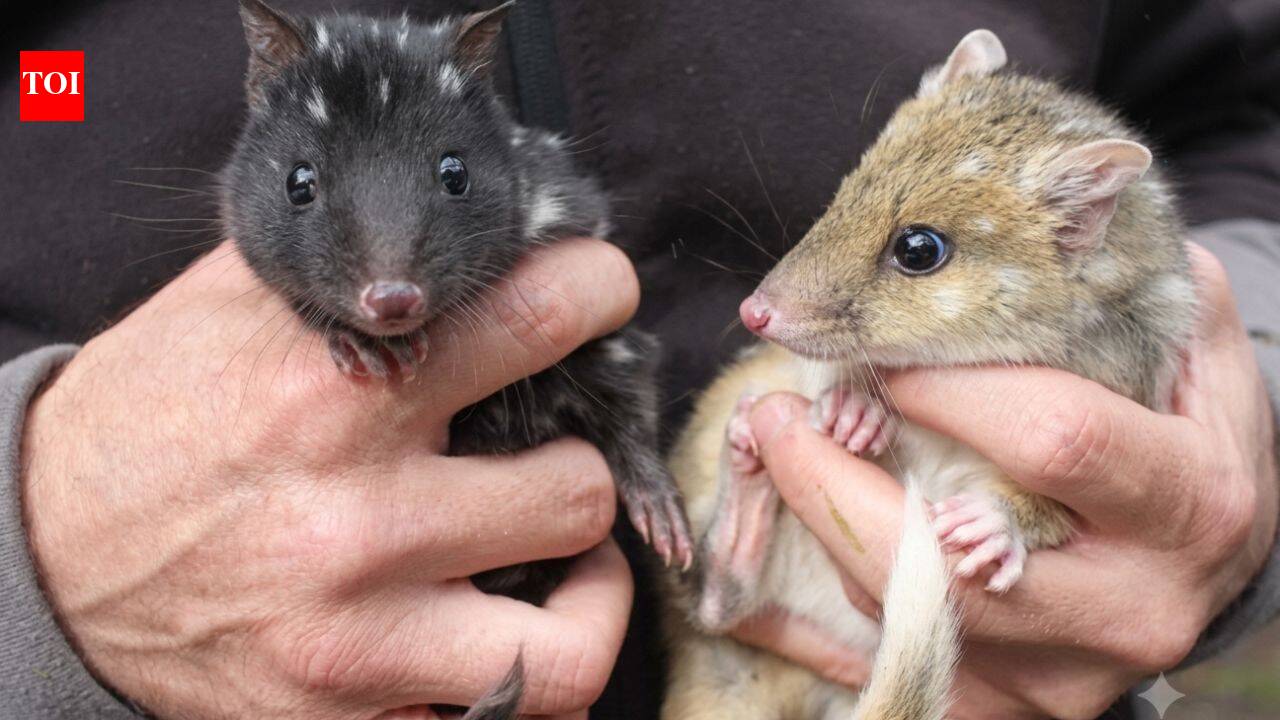
Australia’s endangered eastern quolls welcome new joeys; after vanishing from mainland for 60 years

World News, Today World News, Latest International News, World Breaking News, Trending News of World - Times of India · collected 2026-09-04 · by TOI World Desk
Read the original at World News, Today World News, Latest International News, World Breaking News, Trending News of World - Times of India ↗

Summary

Captive-bred eastern quolls released in Tasmania have successfully reproduced, with one female carrying six joeys in her pouch. The eastern quoll, once common across eastern Australia, went extinct on the mainland by the 1960s due to threats such as habitat loss, disease, and predation by invasive animals. According to a 2023 study, the species has experienced a major decline in Tasmania, with populations dropping sharply around 2000 and again in 2009. Conservationists are using captive breeding and rewilding programs to help strengthen remaining eastern quoll populations in Tasmania.
Written by the local model on 2026-09-05, using this article's own text rather than the other coverage of the same event (that is the story summary below).

Signals How these are calculated →

Claims extracted
53
claim-shaped sentences
Uncertain
8%
4 of 53 hedged
Leaning
withheld
no quote in the article backed the model's score
Publisher trust
94.3
red-flag proxy, not a credibility rating
Outlets on this story
1
Environment
Narrative spread
1
articles carrying this framing
Analyzed 2026-09-05 · how these are computed

AI analysis (generated at analysis time, not now)

Story summary

Eastern quolls, a small nocturnal marsupial that was once common in eastern Australia, are showing signs of recovery after years of decline. 54 years ago, they vanished from the mainland, but wild populations still exist in Tasmania where foxes are absent. To help strengthen these remaining populations, conservationists are using captive breeding and rewilding programs. A recent success was announced when a female eastern quoll released in Tasmania was found to be carrying six joeys (baby quolls) in her pouch, demonstrating the species' ability to reproduce in the wild. Researchers believe that cats, which were previously thought to be one of the main threats to the quolls' survival, may actually play a significant role in their decline in Tasmania. The eastern quoll was considered extinct on the mainland due to habitat loss, disease, road accidents, and predation by cats, dogs, and invasive foxes.

Written for “Australian Quoll Conservation Success” on 2026-09-05, grounded in this article and the 0 other(s) covering the same event.
Why this leaning score
The model judged this article politically coded and scored it +0.35, but every quote it verified points left, so the score is not published.
Written under an earlier scoring contract, which gave a paragraph rather than checkable quotes. Re-analysing this article replaces it.
Leaning score withheld for article 4313: score contradicts its own evidence · logged 2026-09-05

Story

📰 Australian Quoll Conservation Success
Environment · 1 article(s) covering the same event. This is the one the site leads with.

How this is being covered How these are calculated →

Article leaning vs. publisher reliability
Source leaning vs. consistency

Compared with similar articles

Nothing to compare against. No article is close enough to this one for the pipeline to have linked or judged the pair.

Publisher

World News, Today World News, Latest International News, World Breaking News, Trending News of World - Times of India · 176 article(s) · 0 correction(s) detected
SignalValueWeight
Correction rate 0.000 0.4
Uncertainty density 0.115 0.25
Assertive mismatch rate 0.000 0.35
No corrections detected for this publisher. That may mean careful reporting, or simply that nothing has been checked.

Who wrote this

TOI World Desk
99 article(s) here · 1 carrying a prediction
🔮 They never knew if they could go to the same place the following year.
2026-09-06 · assertive framing · How Kentucky protected a vast elk landscape
🔮 Reinhardt said Twain believed that if Lester wrote a 100-word paragraph, he could express the same idea in 20 words.
🔮 A denial generally means a petition will not be approved, while revocation can affect a petition that had previously been approved.
🔮 As reported by WataugaOnline, the easement ensures that the landscape that once supported a 19th century mission will remain open, wooded and undeveloped for generations to come.
🔮 A ruling reported in May 2026 also dealt with access for grazing.
🔮 Officials are concerned that additional victims may not have reported their losses because of embarrassment or fear.
🔮 He saw an opportunity to build a business that could actually help people.
🔮 The training was apparently meant to reduce the immigration court backlog and they were taught that some continuances are sought solely for the purpose of delay and persons illegally present in the United States who wish to remain have a substantial incentive to prolong litigation so they may avoid deportation as long as possible.
🔮 The neighbourhood lacked a visible “heart” where community events could take place.
🔮 At 129 years old, the little Shotgun House has therefore gained something its original builders could hardly have anticipated: a second life as a place dedicated to making sure historic places are not forgotten.
Wire or desk byline, not an individual reporter.
More on this subject from TOI World Desk
Australian platypuses rescued during drought quickly rebuilt their home ranges after returning to the wild
2026-08-27 · World News, Today World News, Latest International News, World Breaking News, Trending News of World - Times of India · 53% similar
All 99 articles by TOI World Desk →

Topics

Australia European Mongabay Tasmania Tasmanian

Subjects

Tasmania GPE · 8× Australia GPE · 5× Mongabay ORG · 2× Barrington Tops GPE · 1× David Hamilton PERSON · 1× European NORP · 1× Sydney GPE · 1× Tasmanian NORP · 1× the National Parks and Wildlife Service ORG · 1× the Tasmanian Land Conservancy ORG · 1×

Narrative

Researchers and conservationists from universities, zoos, sanctuaries, non-governmental organisations and captive-breeding facilities are working together to understand the problem. Rob Brewster, rewilding manager for the Invasive Species Council, believes cats are a major contributor to eastern quoll deaths in Tasmania.
framing: assertive · carried by 1 article(s) · first seen 2026-09-05
🔮 There was a possible sign that some eastern quolls may have survived longer than official records suggested.
2026-09-05 · World News, Today World News, Latest International News, World Breaking News, Trending News of World - Times of India
Australia’s endangered eastern quolls welcome new joeys; after vanishing from mainland for 60 years · assertive framing

Claims (53 extracted, 4 hedged)

The eastern quoll, a small nocturnal marsupial once common across eastern Australia, is showing signs of recovery after years of decline. asserted
quoll → show → decline
Captive-bred eastern quolls released in Tasmania have successfully reproduced, with one female carrying six joeys in her pouch. asserted
female → breed → pouch
Eastern quolls are considered extinct in the wild on mainland Australia. asserted
quolls → consider → Australia
According to Mongabay, the species disappeared from the mainland by the 1960s after facing several threats, including habitat loss, disease, road accidents and predation by cats, dogs and invasive foxes. uncertain
species → accord → cats
Wild eastern quoll populations still survive in Tasmania, where foxes are absent. asserted
foxes → survive → Tasmania
However, researchers have also recorded a decline in the Tasmanian population. asserted
researchers → record → population
Conservationists are now using captive breeding and rewilding programmes to help strengthen these remaining populations and bring the species back to areas where it has disappeared. asserted
it → use → areas
It has two main colour forms- light fawn and blackish-brown, both with white spots across the body. asserted
It → have → body
How quolls disappered Eastern quolls were once widespread along Australia's eastern coastal fringe. asserted
quolls → disappere → fringe
Historical accounts described them as being in 'plague abundance'. asserted
accounts → describe → abundance
Farmers also valued them because they hunted rodents, while some people kept them as pets. asserted
people → value → pets
The species was sometimes called a 'native cat' in the 1800s because of its size and hunting behaviour, which were similar to those of domestic cats brought to Australia by European settlers. asserted
which → call → settlers
That widespread presence did not last. asserted
presence → last → ?
By the 1960s, the last known eastern quoll population on mainland Australia had disappeared. asserted
population → disappear → Australia
Several factors contributed to the decline, including disease, loss of habitat, collisions with vehicles and attacks by cats, dogs and invasive foxes. asserted
factors → contribute → cats
There was a possible sign that some eastern quolls may have survived longer than official records suggested. uncertain
records → be → ?
In 2016, a taxidermied eastern quoll surfaced after reportedly being collected as roadkill in Barrington Tops, northwest of Sydney, in 1989. uncertain
quoll → taxidermie → 1989
The specimen had been handed to the National Parks and Wildlife Service almost three decades later. asserted
specimen → hand → Service
Today, Tasmania remains an important refuge for the species. asserted
Tasmania → remain → species
The island has no invasive fox population, although conservationists are concerned about the impact of cats. asserted
conservationists → have → cats
Cats remain a threat David Hamilton, a conservation ecologist at the Tasmanian Land Conservancy and an adjunct researcher at the University of Tasmania, is part of a group studying the threats facing eastern quolls. asserted
Hamilton → remain → quolls
Research published in 2023 found a major decline in eastern quoll numbers across Tasmania. asserted
Research → publish → Tasmania
The study used historical wildlife survey data and more recent sightings. asserted
study → use → data
It found that populations had declined sharply around 2000 and again in 2009. asserted
populations → find → 2009
“Some of the research that has come out over the last decade or so shows this concerning downward trajectory in eastern quolls in Tasmania,” Hamilton said. asserted
Hamilton → come → Tasmania
“There was a steep decline around the start of this century, and that’s continued unabated in some areas, whereas in some others they’ve recovered relatively well,” he told Mongabay. asserted
he → be → Mongabay
“While the initial declines were strongly linked to climate, we don’t really know why some populations have failed to recover.” asserted
populations → link → climate
Researchers and conservationists from universities, zoos, sanctuaries, non-governmental organisations and captive-breeding facilities are working together to understand the problem. Rob Brewster, rewilding manager for the Invasive Species Council, believes cats are a major contributor to eastern quoll deaths in Tasmania. asserted
cats → work → Tasmania
“We know that some of our quolls that we’ve released in Tasmania as part of that Tasmanian Land Conservancy-University of Tasmania partnership have been killed by cats,” Brewster said. asserted
Brewster → know → cats
“We can directly implicate cats in the decline of eastern quoll populations in Tasmania.” asserted
We → implicate → Tasmania
Captive-breds reproduce Conservationists are using 'rewilding' to strengthen eastern quoll populations. asserted
Conservationists → use → populations
The approach has involved several trials. asserted
approach → involve → trials
A 2025 study recorded the release of 20 captive-bred adult eastern quolls including 10 males and 10 females at Silver Plains, a 6,500-hectare conservation property owned by the Tasmanian Land Conservancy. asserted
study → record → Conservancy
Researchers expected the released animals to reproduce. asserted
animals → expect → ?
However, genetic testing of juveniles captured in December 2021 and January 2022 showed that none of the released adults from the 2020 group had contributed to the population. asserted
none → capture → population
“We think that was partly down to the fact that there was a release of adults who hadn’t had any reproductive experience in the wild,” Hamilton said. asserted
Hamilton → think → wild
The researchers then changed their approach. asserted
researchers → change → approach
Later releases included both adult and juvenile eastern quolls and took place in areas where populations were struggling to recover. asserted
populations → include → areas
After an initially slow start, captive-bred quolls released there in 2025 successfully reproduced. asserted
quolls → breed → 2025
One released female now has six joeys in her pouch. asserted
female → release → pouch
…and 13 more, not listed.

💬 Give feedback
🕘 History 🎫 Support