Beware The Flood Of Trump Sentencing Disinformation

The Popehat Report · collected 2026-09-04 · by Ken White commentary
Read the original at The Popehat Report ↗

Summary

The article's author argues that media outlets frequently mislead readers by reporting on the maximum possible sentence a defendant could face, rather than the actual sentence they are likely to receive. According to the US Probation Office and federal sentencing guidelines, a recommended sentence is calculated using complex formulas, resulting in a sentencing range of months. The author claims that this range is almost always below the statutory maximum, especially for white-collar cases with multiple counts.
Written by the local model on 2026-09-05, using this article's own text rather than the other coverage of the same event (that is the story summary below).

Signals How these are calculated →

Claims extracted
72
claim-shaped sentences
Uncertain
6%
4 of 72 hedged
Leaning
Leans right
expected in commentary, which argues a position
Publisher trust
not scored
Commentary is not rated for newsroom trust
Outlets on this story
1
Crime & Law
Narrative spread
1
articles carrying this framing
Analyzed 2026-09-05 · how these are computed

AI analysis (generated at analysis time, not now)

Story summary

The Washington Post published a column on Friday that inaccurately reported the potential sentence Donald Trump could face in his three pending criminal cases, citing the statutory maximum sentences as if they were actual sentencing ranges. This is not how federal sentencing works, according to Ken White of The Popehat Report. Under the US Sentencing Guidelines, which were established by the Supreme Court's 2005 ruling that the guidelines are only recommendations and not mandatory, judges have discretion to impose sentences within a recommended range. The actual sentence Trump faces will likely be different from the statutory maximum cited in the Washington Post article, and White argues that reporting on these maximums is often clickbait-style misinformation.

Written for “Trump Sentencing Coverage Bias” on 2026-09-05, grounded in this article and the 0 other(s) covering the same event.
Why this leaning score
The article's own words the score was based on. Each is quoted verbatim and was checked against the article text before being stored, so you can find it in the original.
Score +0.35 Confidence high
Leaning score +0.35 for article 4269 (high confidence, 1 verified quote) · logged 2026-09-05

Story

📰 Trump Sentencing Coverage Bias
Crime & Law · 1 article(s) covering the same event. This is the one the site leads with.

How this is being covered How these are calculated →

Article leaning vs. publisher reliability
Source leaning vs. consistency

Compared with similar articles

This article reads leans right and hedges 6% of its claims. Each row says how that neighbour differs.
Zeteo
⚖️ Leans strongly left further left than this 🔴 17% hedged 4 of 23
“Article B discusses a column by the Washington Post about Donald Trump's hypothetical sentence, while Article A mentions mail-in voting restrictions and a related court case”
The Popehat Report
⚖️ Leans strongly left further left than this 🔴 11% hedged 9 of 82
“Article A discusses a general critique of public legal commentators, while Article B refers to a specific Washington Post column about Trump's sentencing, indicating two different discussions”
The Bulwark
⚖️ Leans strongly left further left than this 🔴 0% hedged 0 of 8
“Article A discusses Trump's threat to Kristen Welker with the FCC, while Article B critiques a Washington Post column about hypothetical Trump sentencing, indicating two distinct events”
Zeteo
⚖️ Leans strongly left further left than this 🔴 19% hedged 5 of 26
“Article A discusses a Washington Post column about Donald Trump's hypothetical sentence, while Article B mentions two whistleblower reports but does not mention sentencing or any specific news article”

Publisher

The Popehat Report · 20 article(s) · 0 correction(s) detected

Commentary. The three signals behind a trust score all measure a newsroom's record with its own reporting, so they are not computed for this source. How trust is scored.

No corrections detected for this publisher. That may mean careful reporting, or simply that nothing has been checked.

Who wrote this

Ken White
20 article(s) here · 1 carrying a prediction
🔮 I think it comes down to this: being beaten by the police doesn’t make you either a good person or a bad person, but some people would like to believe that it does.
2026-09-05 · assertive framing · Deserve’s Got Nothing To Do With It
🔮 With impeccable timing that only a university administration could achieve, BU announced Zaslav as its commencement speaker the day after the Writer’s Guild of America went on strike.
2026-09-05 · assertive framing · Speech or Cancel Culture At Boston University?
🔮 I pointed out that the somewhat predictable assignment of the case to Judge Aileen Cannon — who proved herself to be an arguably lawless Trump partisan when she entertained his attempts to derail his own investigation — will make it extraordinarily difficult to convict him.
2026-09-05 · assertive framing · Jack Smith, Donald Trump, and the Kobayashi Maru
🔮 It begins with a broad, rather vague pronouncement: (a) Any justice, judge, or magistrate judge of the United States shall disqualify himself in any proceeding in which his impartiality might reasonably be questioned.1 We’ll get back to that.
🔮 For more than half a century, courts have used a (purportedly) objective standard to determine whether a threat is true, asking whether a reasonable person, familiar with the context, would interpret the threat as a sincere expression of intent to do harm.
🔮 They couldn’t report many verbatim quotes (they should have brought someone who takes shorthand) and federal courts don’t allow broadcast or media recoding of proceedings.
2026-09-04 · assertive framing · Hunter Biden And The Fog Of War
🔮 Glenn is agitated because the United States decided to drop a charge of conspiracy to commit campaign finance violations it had previously brought against infamous manchild Sam Bankman-Fried, the answer to the question “how bad could it be, being raised by two Stanford professors?”
🔮 Assuming, as we have, for it has not been challenged, that this statistical side of the Department of Agriculture is the exercise of a function within the purview of the Constitution, it must follow that any conspiracy which is calculated to obstruct or impair its efficiency and destroy the value of its operations and reports as fair, impartial, and reasonably accurate would be to defraud the United States by depriving it of its lawful right and duty of promulgating or diffusing the information so officially acquired in the way and at the time required by law or departmental regulation.
2026-09-04 · assertive framing · People Are Lying To You About The Trump Indictment
🔮 In the old days, the resulting sentencing range was mandatory and bound the court; in 2005 the Supreme Court ruled that the Guidelines could only be treated as a recommendation, not a mandate.
2026-09-04 · assertive framing · Beware The Flood Of Trump Sentencing Disinformation
🔮 One is to describe, to the best of your ability, what you believe the state of the law is, how and where courts might agree or disagree with you, and how your view of what the law should be differs from how courts currently interpret it.
More on this subject from Ken White
People Are Lying To You About The Trump Indictment
2026-09-04 · The Popehat Report · 54% similar
All 20 articles by Ken White →

Topics

The United States Probation Office Washington Post the Probation Office’s the United States Sentencing Guidelines the Washington Post

Subjects

Washington Post ORG · 2× the Washington Post ORG · 2× Donald Trump PERSON · 1× Josh Barro PERSON · 1× Post ORG · 1× The United States Probation Office ORG · 1× The Washington Post’s ORG · 1× the Probation Office ORG · 1× the Probation Office’s ORG · 1× the Supreme Court ORG · 1×

Narrative

In our recent Very Special Episode of Serious Trouble about how to be an informed and critical consumer of legal news, Josh Barro and I spent a long time discussing one of the most important things the media gets badly wrong: it reports the statutory maximum sentences defendants face as if those numbers had anything to do with the actual sentences the defendants face.
framing: assertive · carried by 1 article(s) · first seen 2026-09-05
🔮 In the old days, the resulting sentencing range was mandatory and bound the court; in 2005 the Supreme Court ruled that the Guidelines could only be treated as a recommendation, not a mandate.
2026-09-05 · The Popehat Report
Beware The Flood Of Trump Sentencing Disinformation · assertive framing

Claims (72 extracted, 4 hedged)

I just turned 54 and I’ve grown used to things hurting — lots of things hurting — first thing in the morning. asserted
lots → turn → morning
However, I am unaccustomed to awakening only to be kicked right in the junk by the Washington Post before my morning coffee. asserted
I → awaken → coffee
I refer to an appallingly bad Washington Post column about the hypothetical sentence Donald Trump faces based on his (to date) three pending criminal cases. asserted
Trump → refer → cases
When I awoke on Friday, about two dozen gleeful people had sent it to me in some sort of cruel exercise of modern bearbaiting. asserted
people → awake → bearbaiting
How Federal Sentencing Actually Works asserted
Sentencing → work → ?
In our recent Very Special Episode of Serious Trouble about how to be an informed and critical consumer of legal news, Josh Barro and I spent a long time discussing one of the most important things the media gets badly wrong: it reports the statutory maximum sentences defendants face as if those numbers had anything to do with the actual sentences the defendants face. asserted
defendants → spend → sentences
They almost never do. asserted
They → do → ?
Adding up all the statutory maximum sentences for all the counts charged in an indictment is an exercise in clickbait disinformation. asserted
Adding → add → disinformation
I’ve been ranting about this for more than a decade but we are still here. asserted
we → rant → decade
Here’s how federal sentencing works. asserted
sentencing → work → ?
The United States Probation Office, with the input of the parties, proposes a recommended sentence calculated using the United States Sentencing Guidelines. asserted
Office → propose → Guidelines
The Guidelines are extremely complex; calculating a sentence under them can be comparable to filling out a business’ tax return. asserted
calculating → calculate → return
The parties can then object to the Probation Office’s calculations and make arguments to the court about whether and how the Probation Office got it wrong. asserted
it → object → court
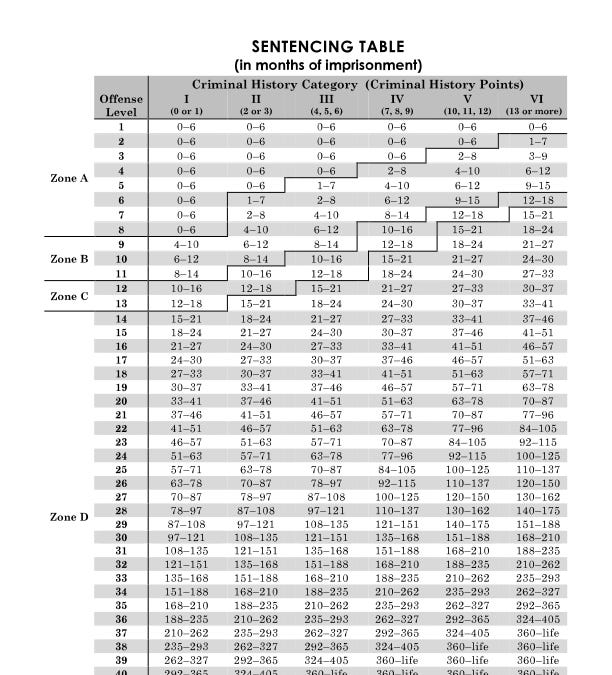
Once the judge determines the Criminal History Category and Offense Level, he or she applies them to the Sentencing Table to generate a sentencing range in months: asserted
he → determine → months
In the old days, the resulting sentencing range was mandatory and bound the court; in 2005 the Supreme Court ruled that the Guidelines could only be treated as a recommendation, not a mandate. uncertain
Guidelines → result → recommendation
So now federal judges treat the Guidelines sentence as a recommendation — a starting point — and sentencing defendants based on mandatory factors set forth in federal statutes. asserted
judges → treat → statutes
What’s the result? asserted
result → ’ → ?
In cases where a defendant has been convicted of multiple counts and the statutory maximum is high, the sentence is almost always far below the statutory maximum. asserted
sentence → convict → maximum
White collar criminals only get sentenced close to the statutory maximum when (1) they are only convicted of one or two counts with very low statutory maximum (say, one count of a crime with a five-year statutory maximum, as part of a plea bargain), or (2) cases involving truly extraordinary amounts of money. asserted
they → sentence → money
That’s why you repeatedly see white collar criminals being sentences to just a small fraction of the statutory maximum sentence they face. asserted
they → ’ → sentence
How The Washington Post Blew It The Washington Post’s deeply irritating column is very nominally about telling you that actual sentences and maximum sentences are different, but it does it in a way almost certain to mislead and misinform, and provides no useful information of substance. asserted
it → blow → substance
First, the core of the Post’s article is a splashy infographic meant to act as Resistance porn. asserted
core → mean → porn
It adds up, on a Candyland-style path, the maximum sentence on each count in the New York state indictment against Trump, the Florida federal indictment for wrongfully retaining documents, and the new Washington D.C. indictment for his January 6 fraud. asserted
It → add → fraud
The infographic is plainly the beating clickbait heart of the piece. asserted
infographic → beat → piece
It’s also completely useless. asserted
It → ’ → ?
The combined maximum sentences from the three cases is a meaningless, masturbatory number. asserted
sentences → combine → cases
It has nothing to do with what federal sentences he faces, as I note above, and New York criminal law experts (and I am not one) say that the maximum sentences in that case have nothing to do with the plausible sentence he faces there. asserted
he → have → sentence
Second, when the Post gets around to contradicting its own splashy infographic, its effort is desultory. asserted
effort → get → infographic
The column says: First of all, that figure depends upon his being convicted of each and every one of the 78 counts he has been charged with — meaning that prosecutors would have to bat a thousand in each venue. asserted
prosecutors → say → venue
Outside observers generally agree the Mar-a-Lago case is the strongest and the case in Manhattan much weaker. asserted
case → agree → Manhattan
Should District Attorney Alvin Bragg be unable to convict on his 34 counts, there’s a century-plus sliced off the total right there. asserted
Bragg → convict → total
That’s not the first reason the number is wrong at all. asserted
number → ’ → ?
The number of counts has very little impact on federal sentences (or, in this context, on New York sentences). asserted
number → have → sentences
Sentences are typically driven by what the Guidelines call relevant conduct — the universe of facts underlying the conviction. asserted
Guidelines → drive → conviction
Most of the time in white collar cases that universe is governed by the amount of money involved in the crime. asserted
universe → govern → crime
A defendant who is convicted of two counts of wire fraud and a defendant convicted of ten counts of wire fraud will get very similar sentences if both cases involve a million dollars in loss, for example. asserted
cases → convict → example
That’s certainly the case in New York — where the prosecution’s 34 counts of doing the same thing is performative and non-substantive — and in Florida, where Jack Smith’s charging 32 counts of wrongfully retaining documents is mostly performative and about making sure he can present all of those documents at trial, not about driving a sentence. asserted
he → ’ → sentence
The Post’s “first” point therefore misses the point. asserted
point → miss → point
But the Post isn’t done yet: asserted
Post → do → ?
Second, the total assumes that Trump would receive the maximum sentence for each guilty verdict. asserted
Trump → assume → verdict
…and 32 more, not listed.

💬 Give feedback
🕘 History 🎫 Support