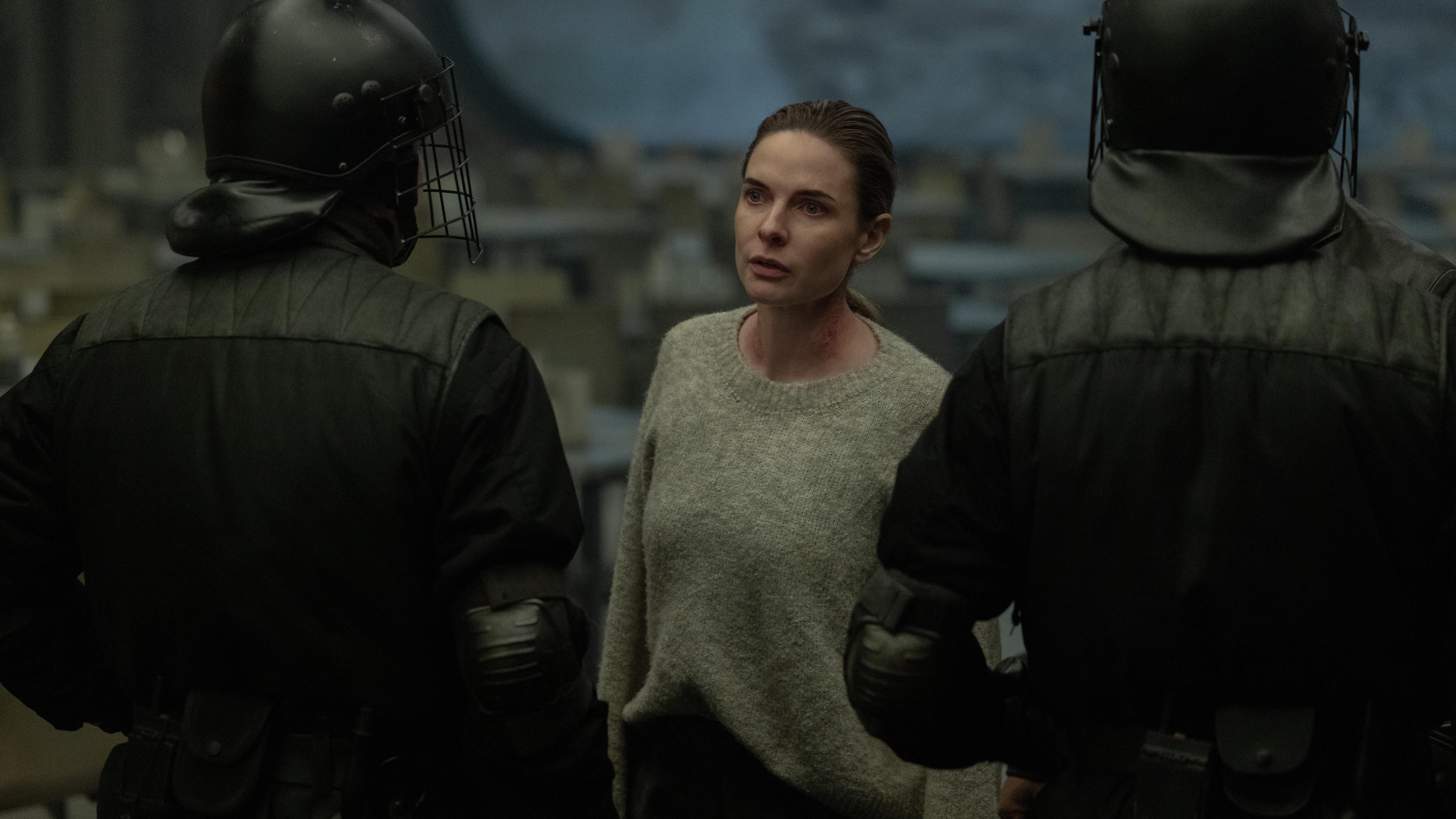
Following the stunning final scene of Season 2 of Silo, the third season has diverged into two timelines: one with Juliette (Rebecca Ferguson) and company in Silo 18 fighting for their survival, and another unfolding before the silo program began.
asserted
program → follow → survival
The season’s penultimate episode delivered some big revelations: The all-knowing Algorithm program that ensures the survival of the silo isn’t actually a digital algorithm, but a person watching from Silo 1, deciding everyone’s fates.
asserted
that → deliver → fates
Before he dies in Episode 9, Bernard (Tim Robbins) offers some hope: “A person can be defeated.”
asserted
person → die → hope
Meanwhile, in the past timeline, Daniel (Ashley Zukerman) and Helen (Jessica Henwick) discover the origins of the silos, only for a shocking nuclear explosion to separate them.
asserted
explosion → discover → them
That’s a hell of a way to end an episode, and the Season 3 finale of Silo, “Troy,” brings us straight into Silo 1, where those running the system live, far in the future.
asserted
those → ’ → future
“Three hundred and fifty years,” says series creator Graham Yost.
asserted
Yost → say → ?
“It’s revealed in Episode 9 that the silos were part of a 500-year plan.
asserted
silos → reveal → plan
Inside Silo 1, we see Daniel waking from cryo-sleep.
asserted
Daniel → see → sleep
Except he’s no longer called Daniel: He is now Troy.
asserted
He → call → ?
And while Troy looks physically the same as Daniel, he’s completely changed.
asserted
he → look → Daniel
That’s made crystal clear when he settles into his shift and has to deal with the outbreak in Silo 17, the same silo Juliette ventured to in Season 2.
asserted
Juliette → make → Season
Troy, without hesitation, delivers a ruthless decision to execute every single person—man, woman, and child—who left the silo.
asserted
who → deliver → silo
A top priority of Silo 1 is to prevent silos from discovering that any other silos exist.
asserted
silos → prevent → silos
His decision to unleash drone warfare is met with disapproval by drone pilot Susan, who is actually Daniel’s sister Charlotte (Jessica Brown Findlay).
asserted
who → unleash → Susan
Neither of them recognizes one another from the past.
asserted
Neither → recognize → past
“He’s completely bloodless about it.
asserted
He → ’ → it
It’s just his job,” says Yost.
asserted
Yost → ’ → ?
(Yost does suggest that Charlotte’s negative reaction to Troy’s behavior is worth our attention, though he won’t say why).
asserted
he → suggest → behavior
That lack of emotion bears no resemblance to the past Daniel.
asserted
lack → bear → Daniel
It turns out there’s a system designed to keep memories suppressed.
asserted
It → turn → memories
Yost divulges some key details behind this Silo 1 initiative.
asserted
Yost → divulge → initiative
“Your skill set, your skill knowledge, your expertise stays with you, and so that's why Daniel, as an engineer, is someone who can solve problems.
asserted
who → stay → problems
There is an effort to wipe and control memory, so people don't know who they were.
asserted
they → be → memory
But they know who they became in the project.”
asserted
they → know → project
Yost says we’ll discover more about specifics next season.
asserted
we → say → specifics
It’s precisely the same idea the Algorithm pushed Camille to implement in Silo 18, a major plot point of Season 3.
asserted
Algorithm → ’ → Season
If she had done it, the silo would have continued to function, but there would have been huge problems.
asserted
silo → do → it
“People would forget they had kids and not feed them, and people would forget they were married to each other,” says Yost.
asserted
Yost → forget → other
The memory suppression plotline is influenced by a book by British neurologist Oliver Sacks.
asserted
plotline → influence → Sacks
“In one of his books, a guy has extraordinary short-term memory loss.
asserted
guy → have → loss
He’ll say ‘Hello, nice to meet you’ every 15 seconds or so.
asserted
He → say → you
But if he sits down at the piano, he can play an entire concerto.
asserted
he → sit → concerto
So there's something about that persistence of memory; that part of his brain keeps going.
asserted
part → be → brain
We modeled it on that.”
asserted
We → model → that
also discover that Daniel reports to Victor (Matt Craven), whom audiences first met as Charlotte’s doctor at the beginning of the season and who is one of the leading minds behind the silo program.
asserted
who → discover → program
Further, we see that Victor is actually the voice behind the almighty Algorithm.
asserted
Victor → see → Algorithm
Victor seems deeply disturbed by Troy’s willingness to massacre the people of silo.
asserted
Victor → seem → silo
Interestingly, he does not have a different name from the one he had before—and neither does the silo director, Senator Rosalind Thurman (Laura Innes).
asserted
director → have → one
They have maintained their identities, and unlike Daniel/Troy, they know everything that’s happened in the last 350 years.
asserted
that → maintain → years
“Power dictates who is in power, and that power gets to retain memory.
asserted
power → dictate → memory
…and 40 more, not listed.
 The Aporia