That is 0 articles you have read today.
The Aporia is free and carries no advertising, so readers are the only
thing paying for it. If you are getting this much out of it, a small
donation is what keeps it independent.
Daily limit reached
You have read 0 articles today.
That is more than the 15 a day The Aporia gives away,
and well past what it can carry on nothing. Your allowance resets at
midnight.
There is no advertising here and nothing about you is sold, so readers
are the only thing paying for it. If the site is worth this much of
your day, it is worth a few dollars.
Everything else stays open: the
maps, the
directory and
search do
not count against this, and neither does re-opening something you have
already read today.
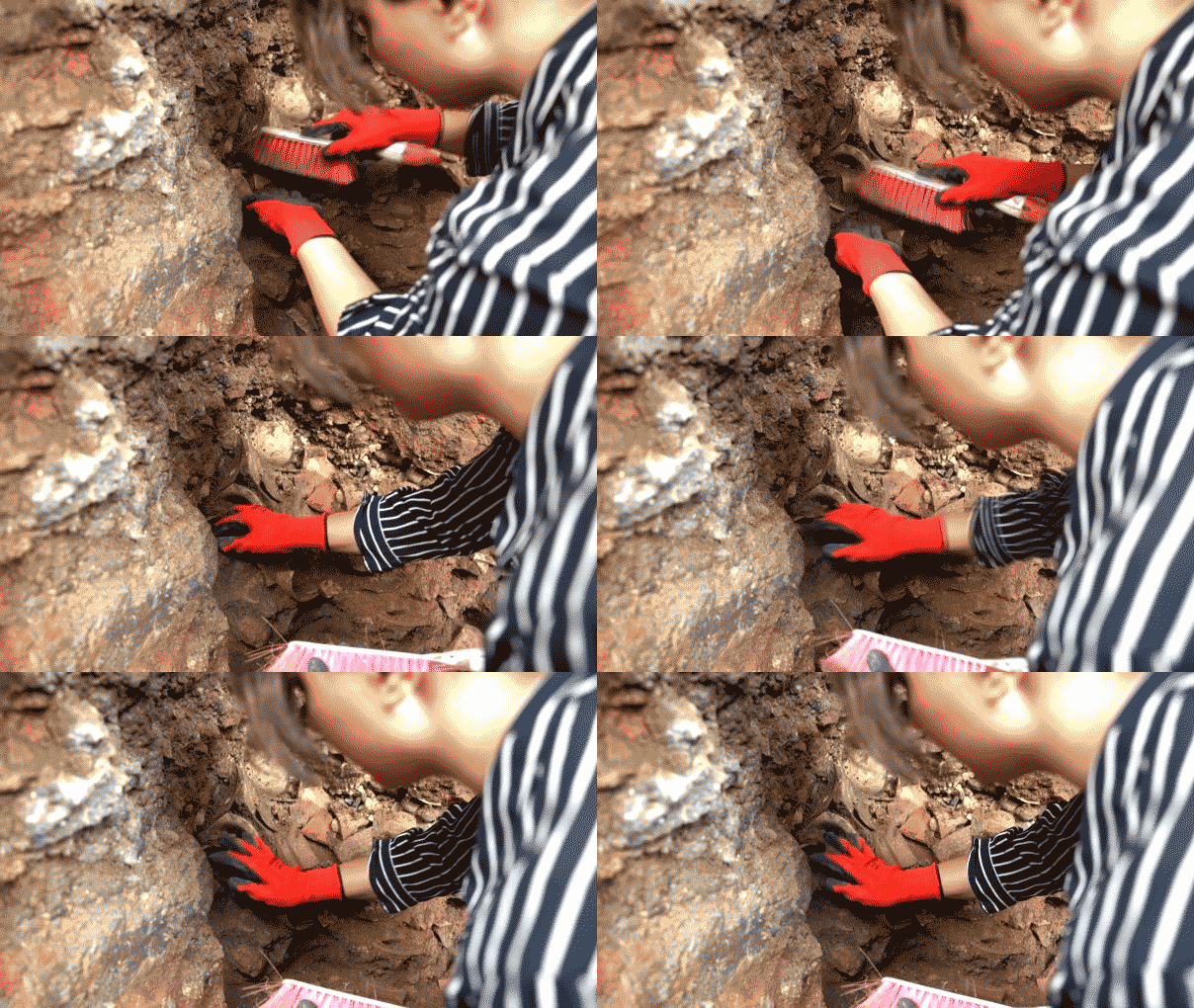
Renovation workers in Tbilisi, Georgia, uncovered ancient pottery dating back between the 10th and 11th centuries during roadwork on Rustaveli Avenue. David Lordkipanidze, director of the Georgian National Museum, stated that finding artifacts from this period is logical given Tbilisi's history as a cultural and economic crossroads along the Silk Road. Further studies will determine the precise age of the pottery using 3D scanning technology.
Written locally by qwen2.5:14b on 2026-09-28,
using this article's own text rather than the other coverage of the
same event (that is the story summary below).
Story summary
Workers renovating Rustaveli Avenue, a major thoroughfare in Tbilisi (the capital city of Georgia), discovered ancient pottery dating back approximately 1,000 years. The artifacts were found buried about 20 feet below ground level and include intricately decorated fragments and jugs from workshops active during that period. This discovery is not surprising given Tbilisi's rich archaeological history as a multicultural crossroads for cultures and commerce.
The roadwork is part of an ongoing project to upgrade Rustaveli Avenue with new pedestrian crossings, improved signage, and other enhancements. The director of the Georgian National Museum, David Lordkipanidze, noted that Tbilisi has been ruled by various powers over its long history, including Arabs during the Middle Ages when it served as an important stop along the Silk Road.
Further studies using techniques like 3D scanning will help researchers more accurately determine the exact age and significance of these artifacts.
Written for “Ancient Discovery During Renovation” on 2026-10-05,
grounded in this article and the 1 other(s) covering the same event.
The roadwork is part of a larger project to upgrade Rustaveli Avenue with new pedestrian crossings, improved signage and other improvements, according to Reuters.
uncertain
roadwork → upgrade → Reuters
David Lordkipanidze, director of the Georgian National Museum, told Reuters the discovery was not entirely unexpected given Tbilisi’s history.
asserted
discovery → tell → history
“Tbilisi is very rich with archaeological material … so it’s very logical to find workshops of different periods,” he said.
asserted
he → ’ → periods
Lordkipanidze also pointed to Tbilisi’s long history as a crossroads for cultures and commerce.
asserted
Lordkipanidze → point → cultures
“Tbilisi was always multicultural,” he said.
asserted
he → say → ?
The pottery appears to date between the 10th and 11th centuries, when Tbilisi was under Arab rule and served as an important stop along the Silk Road.
asserted
Tbilisi → appear → Road
Additional studies, including 3D scanning, will help researchers more precisely determine the artifacts’ age.
asserted
researchers → include → age
Georgia, cradled between Europe and Asia, forms part of the Caucasus region alongside Armenia and Azerbaijan.
asserted
Georgia → cradle → Armenia
Tbilisi was founded in the fourth century, and the region has since come under the control of various powers, including Mongols, Persians and Russians, as well as Arabs during the Middle Ages.
asserted
region → found → Ages
The discovery comes as workers across the world stumble on ancient sites during routine work.
asserted
workers → come → work
In Italy, construction crews building a new highway unexpectedly uncovered the remains of an ancient sanctuary dating to the fifth century BC, prompting an archaeological investigation.
asserted
crews → build → investigation
Last summer in Peru, utility workers digging trenches for an underground gas network unearthed two pre-Incan tombs belonging to the Chancay culture, which existed from roughly 1000 to 1470 AD.
asserted
which → dig → AD
 The Aporia