[This post is co-
asserted
post → co → ?
]
Over the past decade, many legal challenges have turned on whether a particular position is an "officer of the United States" or an "office . . . under the United States."
asserted
position → turn → States
In the Foreign Emoluments Clause litigation, the plaintiffs argued that the President holds an "office . . . under the United States."
asserted
President → argue → States
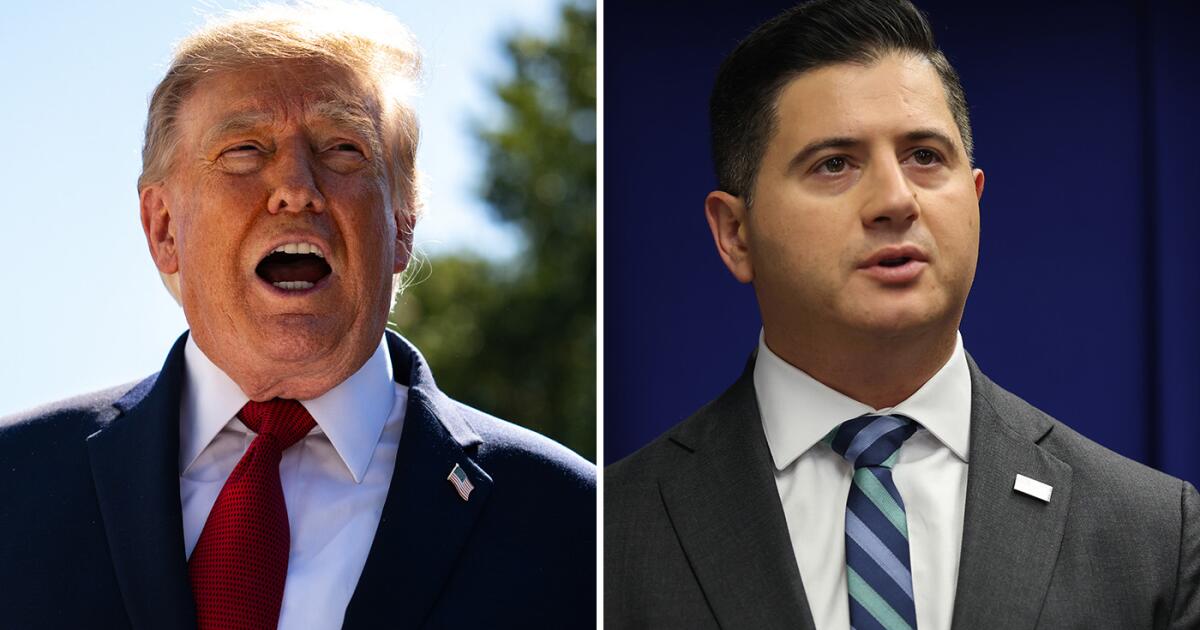
In the Special Counsel's prosecution of Donald Trump, the former President argued that Jack Smith's position is properly characterized as a principal "officer of the United States" who must be appointed by the President pursuant to the Appointments Clause, rather than by the Attorney General.
asserted
who → argue → General
During the Amendment XIV, Section 3 litigation, state voters argued that Donald Trump was disqualified from serving as President because he took an oath of office as an "Officer of the United States" and the presidency was an "Office under the United States."
asserted
presidency → argue → States
All of these cases were high-profile and related to important political controversies.
asserted
All → relate → controversies
But there is another case pending in the courts that turns on the meaning of "Officer of the United States" that is far less in the news, but nevertheless has the potential to significantly reshape U.S. constitutional law.
asserted
that → be → law
The qui tam provision of the False Claims Act ("FCA") authorizes relators to pursue a case against those accused of defrauding the federal government.
uncertain
provision → authorize → government
In short, the relators can bring a suit in the name of the United States against private parties.
asserted
relators → bring → parties
The relators are not appointed by the President or the Attorney General (the head of the department).
asserted
relators → appoint → department
Any private citizen can bring suit as a relator.
asserted
citizen → bring → relator
For decades, any number of conservative legal scholars and practitioners have argued that the qui tam provision violates the separation of powers.
asserted
provision → argue → powers
In 1989, William Barr, the Assistant Attorney General for the Office of Legal Counsel, put forward that position in a memorandum opinion for the Attorney General.
asserted
Barr → put → General
But in 1996, Walter Dellinger, as head of OLC, repudiated Barr's views.
asserted
Dellinger → repudiate → views
More recently, in United States ex rel. Polansky v. Executive Health Resources, Inc., Justice Thomas wrote that "FCA's qui tam provisions have long inhabited something of a constitutional twilight zone."
asserted
provisions → write → zone
In 2024, in USA ex rel. Zafirov v. Florida Medical Associates, LLC, a federal district court in the Middle District of Florida declared the qui tam provision to be unconstitutional.
asserted
provision → declare → Florida
Judge Mizelle found that relators are properly characterized as "officers of the United States," and therefore, they had to be appointed pursuant to the provisions of the Appointments Clause.
asserted
they → find → Clause
Given that the relator in this case was only a private citizen, and was not appointed per the Appointments Clause, the lawsuit was dismissed.
asserted
lawsuit → give → Clause
The Eleventh Circuit has now reversed the trial court.
asserted
Circuit → reverse → court
The unanimous panel held that relators are not "officers of the United States."
asserted
relators → hold → States
The court remanded the case to the district court with directions to consider the defendants' remaining arguments in support of defendants' motion to dismiss based on the Take Care Clause and the Article II Vesting Clause.
asserted
court → remand → Clause
In this blog post, we will walk through the circuit court's analysis that relators are not "officers of the United States," and we speculate on the next steps for this case.
asserted
we → walk → case
A starting point for interested readers is the amicus brief we filed before the Eleventh Circuit in the challenge to Special Counsel Jack Smith's appointment.
asserted
we → file → appointment
We tried to bring some clarity to what is an otherwise complicated area of law: Where is the line between an "Officer of the United States" and a mere employee?
asserted
line → try → States
The crux of the Eleventh Circuit's decision is that relators "do not hold a continuing position," and therefore, they are not "Officers of the United States," and thus, they do not need to be appointed by the President or the Attorney General.
asserted
they → hold → President
The Eleventh Circuit correctly cites the Supreme Court's recent decision in Lucia v. SEC, which stated that an "officer of the United States" position must be a "'continuing' position established by law."
asserted
position → cite → law
This test from Lucia stretches back to three nineteenth-century decisions.
asserted
test → stretch → decisions
United States v. Hartwell (1868) stated that the term officer "embraces the ideas of [i] tenure, [ii] duration, [iii] emolument, and [iv] duties."
asserted
term → state → tenure
United States v. Germaine (1879) further explained that the "duties" of an "Officer of the United States" must be "continuing and permanent, not occasional or temporary."
asserted
duties → explain → States
The Court would apply the Germaine-Hartwell framework in Auffmordt v. Hedden (1890).
asserted
Court → apply → Hedden
Lucia primarily focused on a single factor of the four-factor Germaine-Hartwell test: continuity.
asserted
Lucia → focus → test
What has created some confusion is how to map Lucia's "continuity" test to the factors of the Germaine-Hartwell four-factor test.
asserted
created → create → test
Before Lucia, the courts never squarely addressed this issue.
asserted
courts → address → issue
But after Lucia, this question may no longer matter.
uncertain
question → matter → Lucia
The requirement that matters now is continuity.
asserted
that → matter → ?
But what does it mean for a position to be "continuous"?
asserted
position → mean → what
The Eleventh Circuit adopted the framework from Auffmordt and an earlier circuit court decision from Chief Justice Marshall, United States v. Maurice.
asserted
Circuit → adopt → Maurice
The Eleventh Circuit panel stated:
So in determining whether a person holds a continuing position established by law, the Supreme Court has evaluated whether that person holds a "permanent" tenure, whether his employment has "duration as to time," and whether he receives a "continuing emolument."
asserted
he → state → emolument
And with respect to "duties," Chief Justice Marshall asked "if [the] duties continue, though the person be changed."
asserted
person → ask → duties
United States v. Maurice, 26 F. Cas. 1211, 1214 (C.C.D. Va. 1823) (No. 15,747) (Marshall, C.J.); see also Auffmordt, 137 U.S. at 327 (relying on Maurice in a continuing-position analysis).
asserted
States → see → analysis
…and 72 more, not listed.
 The Aporia