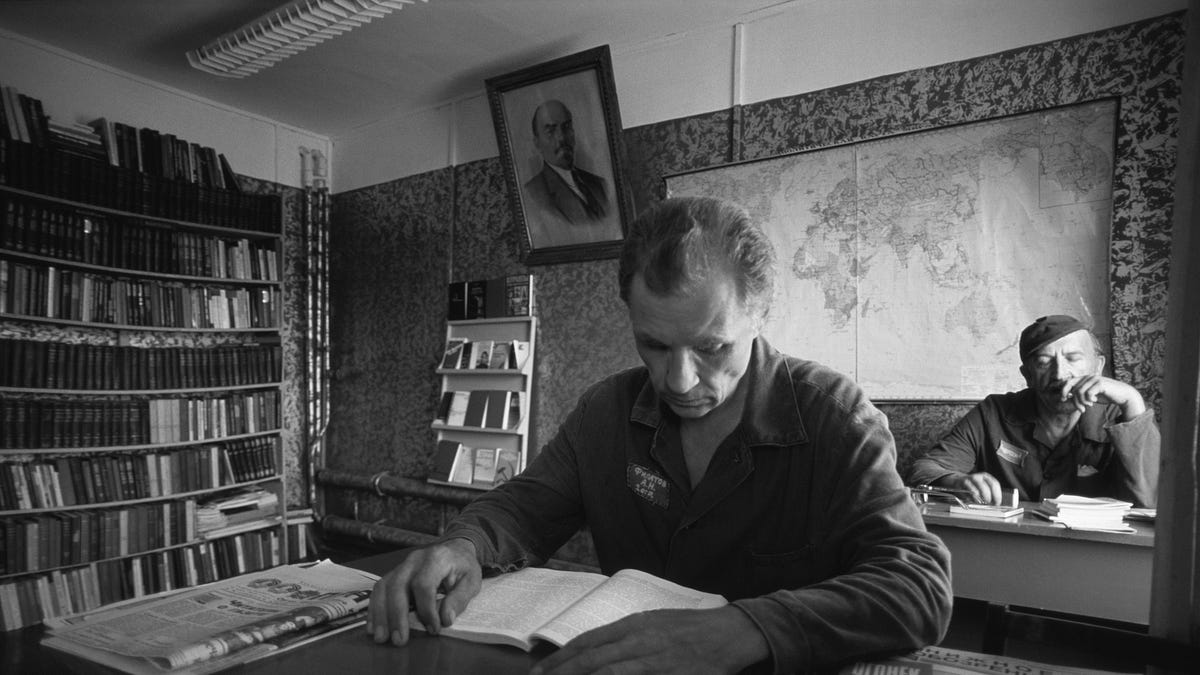
Natan Sharansky: I Found Socrates in a KGB Prison

The Free Press · collected 2026-09-04 · by Natan Sharansky analysis
Read the original at The Free Press ↗

Summary

Natan Sharansky recounts his experience in a KGB prison during the Soviet Union era. He was arrested in March 1977 and spent 16 months in Lefortovo, where he underwent over 100 interrogations. Within the prison's extensive library of classic literature, which contained confiscated books from Moscow's intelligentsia, Sharansky encountered Socrates' works for a second time. This encounter allowed him to engage more deeply with Socrates' philosophy than his initial reading at age 15.
Written by the local model on 2026-09-04, using this article's own text rather than the other coverage of the same event (that is the story summary below).

Signals How these are calculated →

Claims extracted
14
claim-shaped sentences
Uncertain
7%
1 of 14 hedged
Leaning
Centre
of the writing, not the subject
Publisher trust
96.2
red-flag proxy, not a credibility rating
Outlets on this story
1
World
Narrative spread
1
articles carrying this framing
Analyzed 2026-09-04 · how these are computed

AI analysis (generated at analysis time, not now)

Story summary

Natan Sharansky, a former prisoner in the Soviet Union, recalls growing up in Moscow with an extensive home library of classic literature, which was allowed because it was seen as less threatening to the authorities than modern literature. This collection of over 1,000 books included works by authors such as Socrates, who was not familiar to Sharansky until he encountered him in a KGB prison, Lefortovo, where he spent 16 months from March 1977 to July 1978 undergoing over 100 interrogations. Despite being confined and interrogated, the library at Lefortovo was surprisingly extensive, reflecting the twisted legacy of Joseph Stalin's purges, during which many members of the intelligentsia were killed or had their property seized.

Written for “Natan Sharansky's Soviet Interlude” on 2026-09-05, grounded in this article and the 0 other(s) covering the same event.
Why this leaning score
The article's own words the score was based on. Each is quoted verbatim and was checked against the article text before being stored, so you can find it in the original.
Score +0.15 Confidence high
Leaning score +0.15 for article 3934 (high confidence, 1 verified quote) · logged 2026-09-04

Story

📰 Natan Sharansky's Soviet Interlude
World · 1 article(s) covering the same event. This is the one the site leads with.

How this is being covered How these are calculated →

Article leaning vs. publisher reliability
Source leaning vs. consistency

Compared with similar articles

Nothing to compare against. No article is close enough to this one for the pipeline to have linked or judged the pair.

Publisher

The Free Press · 55 article(s) · 0 correction(s) detected
SignalValueWeight
Correction rate 0.000 0.4
Uncertainty density 0.075 0.25
Assertive mismatch rate 0.000 0.35
No corrections detected for this publisher. That may mean careful reporting, or simply that nothing has been checked.

Who wrote this

Natan Sharansky
1 article(s) here · 1 carrying a prediction
🔮 His logic could be understood only by reading commentaries and learning about his historical background.
2026-09-04 · assertive framing · Natan Sharansky: I Found Socrates in a KGB Prison
The only article under this byline in the corpus.

Topics

Jewish KGB Moscow USSR the Soviet Union

Subjects

Socrates PERSON · 4× KGB ORG · 3× Jewish NORP · 2× Athenian NORP · 1× Joseph Stalin’s PERSON · 1× Moscow GPE · 1× USSR GPE · 1× the Soviet Union GPE · 1×

Narrative

It is ironic, then, that the most notorious KGB prison, Lefortovo—where I spent 16 months between my arrest in March 1977 and my trial in July 1978, and where I underwent more than 100 interrogations—had the most extensive library of classic literature I encountered in the USSR.
framing: assertive · carried by 1 article(s) · first seen 2026-09-04
🔮 His logic could be understood only by reading commentaries and learning about his historical background.
2026-09-04 · The Free Press
Natan Sharansky: I Found Socrates in a KGB Prison · assertive framing

Claims (14 extracted, 1 hedged)

When I was growing up in the Soviet Union in the mid-20th century, the intelligentsia—in particular, the Jewish intelligentsia—had extensive home libraries. asserted
intelligentsia → grow → libraries
Most of them were classic literature, for a simple reason: This was the least dangerous kind of book to possess. asserted
This → possess → book
Modern literature was heavily censored and had to belong to the genre of socialist realism, in which the oppressed working class is always right and the capitalist oppressors are invariably doomed to defeat. asserted
oppressors → censor → defeat
But the older a book, the more likely it was to survive the official censors. asserted
it → survive → censors
To read classic literature, therefore, was a kind of escapism; it allowed us to enter a world free from the ever-looming presence of the KGB. asserted
us → read → KGB
It is ironic, then, that the most notorious KGB prison, Lefortovo—where I spent 16 months between my arrest in March 1977 and my trial in July 1978, and where I underwent more than 100 interrogations—had the most extensive library of classic literature I encountered in the USSR. asserted
I → spend → USSR
This was the twisted legacy of Joseph Stalin’s purges, when many members of Moscow’s intelligentsia were killed and their property seized. asserted
property → kill → intelligentsia
Confiscated books, after going through a rigorous redaction process to remove all “enemy” names, were then distributed to the various organs of the KGB. asserted
books → confiscate → KGB
And this is how, within the confines of Lefortovo, I had my second meeting with one of the world’s first philosophers: Socrates. asserted
I → have → philosophers
The first time I met Socrates—the great Athenian philosopher of the fifth century BCE, who was sentenced by his own city to death by poison for denying the gods and corrupting the youth—was when I was 15 and reading books from my home library. asserted
I → meet → library
Socrates’s language, while well-translated, was confusing to me. asserted
language → translate → me
His logic could be understood only by reading commentaries and learning about his historical background. uncertain
logic → understand → background
At that point, I didn’t have the time or patience to study these texts carefully. asserted
I → have → texts
I simply wanted, like every intelligent young Jewish boy, to know about Socrates’s fate and, at the appropriate moment, to use such popular phrases as, “We have to drink our cup to the end.” asserted
We → want → end

💬 Give feedback
🕘 History 🎫 Support