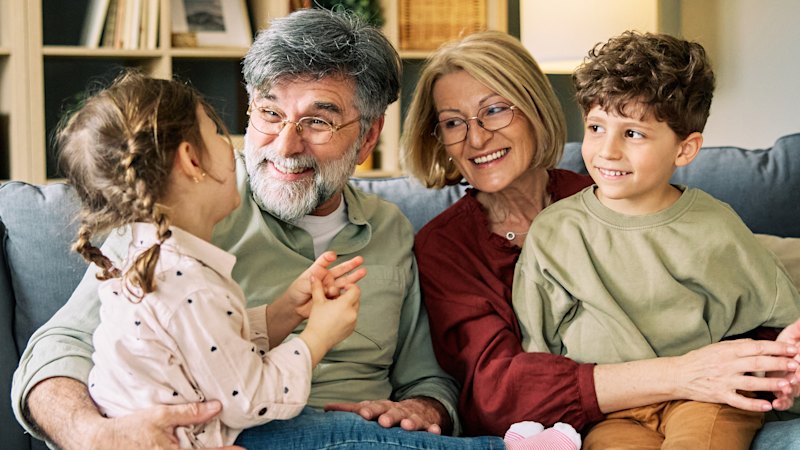
Being a grandparent may mean many things: making the best biscuits, giving the warmest hugs, passing along hard-won wisdom and sharing family stories.
uncertain
Being → mean → stories
But beyond giving you a sense of joy and meaning, there’s emerging evidence that being a grandparent has other benefits: it may help protect your brain during ageing.
uncertain
it → give → ageing
Recent research has found grandparenthood may be linked to not only slower cognitive decline, but also a lower risk of dementia and even a younger-looking brain.
uncertain
grandparenthood → find → dementia
There are still relatively few studies looking at how grandparenthood changes cognition and the brain, but more research is underway.
asserted
research → be → cognition
“This is kind of a new frontier, and we’re just kind of at the beginning of it,” says James Rilling, a professor of psychology at Emory University.
asserted
Rilling → ’re → University
But the benefits of caregiving as a grandparent make sense, considering scientists have also identified long-term benefits in mothers and fathers, in which parents with more children had increased functional connectivity in brain networks that tend to thin with age.
asserted
that → make → age
“By taking care of others, it might help us to support healthy brain ageing,” Rilling says.
uncertain
Rilling → take → ageing
In one of the first population studies of American grandparents and dementia, researchers looked at over 10,000 grandparents and found that caring for grandchildren was linked to a lower risk of dementia over 16 years of longitudinal data, says Seung-won Emily Choi, an associate professor of sociology at Texas Tech University who researches cognitive health in ageing and conducted the study.
asserted
who → look → study
A study published in 2025 of over 10,000 older adults in China found that caregiving for less than 40 hours a week was associated with a 24 per cent reduced risk of dementia compared with grandparents not providing care for grandchildren.
asserted
grandparents → publish → grandchildren
The researchers’ analyses concluded this could be in part because of reduced loneliness and increased digital technology access.
uncertain
this → conclude → loneliness
Also, the act of caregiving itself may be linked to the cognitive benefits.
uncertain
act → link → benefits
Compared with grandparents not involved in caregiving, those who were involved had higher verbal fluency and episodic memory, according to a 2026 study conducted by Flavia Chereches, a graduate student of developmental psychology at Tilburg University in the Netherlands.
uncertain
who → compare → Netherlands
Grandmothers versus grandfathers
Intriguingly, the research suggests there may be differences in the effects for grandmothers and grandfathers.
uncertain
research → suggest → grandmothers
In Choi’s study on the link to dementia risk, for example, grandmothers had the most benefits when they were engaged in lower-intensity caregiving (less than 500 hours over two years), while grandfathers benefited from higher intensity (over 500 hours).
asserted
grandfathers → have → hours
And in Chereches’s research, only caregiving grandmothers had less cognitive decline.
asserted
grandmothers → caregive → decline
Grandmothers tend to be more involved in the more physically demanding labor of feeding, cleaning and managing care, which may be more beneficial in lower amounts.
uncertain
which → tend → amounts
The differences may also relate to the “grandmother hypothesis” for the evolutionary reasons adult female humans live long past their reproductive age, a trait shared by few other mammals, including some whales and chimpanzees.
uncertain
humans → relate → whales
Evidence suggests that grandmothers have a consistently positive impact on their grandchildren’s health, Rilling says.
uncertain
Rilling → suggest → health
However, for cognitive benefits, it might not “necessarily matter if you’re a grandma or grandpa, but more like how you experience caregiving,” Chereches says.
uncertain
Chereches → matter → caregiving
Bonding across generations
There are many known ingredients that go into healthy ageing, such as being embedded in a social network, staying physically active and stimulating your mind.
“Caregiving is one meaningful social role that might provide access to all of this,” Chereches says.
uncertain
Chereches → bond → this
When grandparents are with their grandkids, they report more instances of feeling sadness or worry – perhaps due to concern over the children’s well-being, as well as bittersweet feelings about the transience of life – compared with when they spend time with others.
asserted
they → report → others
But more often, they report more feelings of pride and love, Chereches and her colleagues found in a 2026 study.
asserted
Chereches → report → study
“There seems to be something special about this connection,” she says.
asserted
she → seem → connection
Time connecting with grandchildren can connect grandparents with others, too.
asserted
Time → connect → others
While “interacting with the grandchildren, they have more chances of getting along with their other children or the other family members and even well in the community,” Choi says.
asserted
Choi → interact → community
At the same time, the kinds of interactions nans and pops have with their grandkids can be very mentally stimulating, with storytelling, playing make-believe and reading books.
And you don’t necessarily need to be an actual grandparent to benefit.
asserted
you → have → books
Research on older adults volunteering with Experience Corps, a program run by AARP that trains teams to volunteer in elementary schools, also found that the experience helped improve memory and executive function, as well as decreased brain volume loss in areas associated with dementia.
asserted
experience → volunteer → dementia
A younger brain
More recent research suggests that the act of caregiving as a grandparent may also be linked to a younger brain.
uncertain
act → suggest → brain
In a 2025 study, Rilling and his colleagues scanned the brains of 50 grandmothers and compared them to those of 25 women of similar ages who were not grandparents.
asserted
who → scan → ages
On average, the grandmothers’ brains looked five and a half years younger according to age estimates calculated by a computer model.
uncertain
brains → look → model
However, these studies are associational and can’t show causation.
asserted
studies → show → causation
It’s very possible that people who are healthier are more likely to provide active grandparent caregiving, for example.
asserted
who → ’ → example
The grandmothers in the imaging study are “almost like super-grandmothers” because they signed up for a study about grandmothers, Rilling says.
asserted
Rilling → sign → grandmothers
They’re not overextended, and they’re really highly engaged with their grandchildren.
asserted
they → ’re → grandchildren
The research also points to the importance of balance: caregiving can be physically and mentally exhausting – perhaps an obvious statement to anyone who has engaged in it – which can detract from the benefits.
asserted
which → point → benefits
Research shows that grandparents who are the sole caretakers of their grandchildren are less likely to have cognitive benefits, for example.
asserted
who → show → example
“We should not expect that grandparenthood or grandchild care is the right thing for everyone,” Chereches says.
asserted
Chereches → expect → everyone
“If grandparents want to provide grandchild care, if the role is important to them and there’s something they want to do, then it’s definitely a great way to maintain oneself active, engaged with a meaningful social role, but then we also need to acknowledge that there are people that maybe would like to do something else.
asserted
that → want → something
The key is to take care of your own physical well-being with proper sleep, diet and exercise and to maintain other social connections, Choi says, and at the same time, enjoy the more stimulating parts of taking care of grandchildren.
asserted
Choi → take → grandchildren
 The Aporia