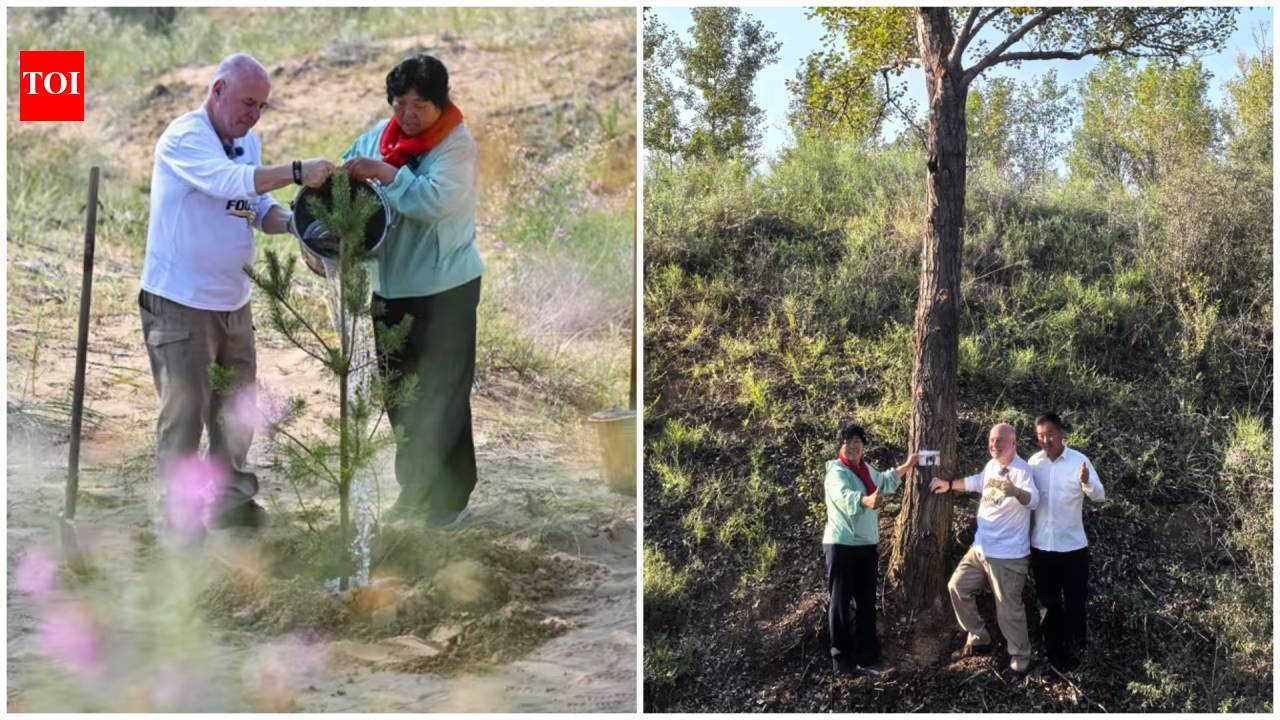
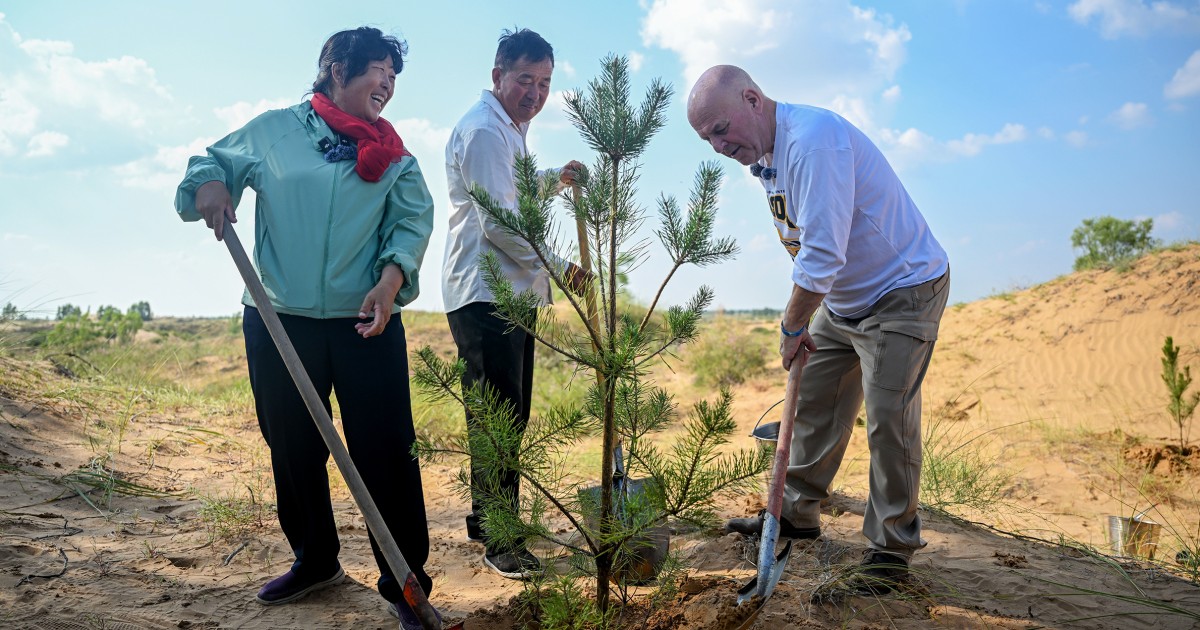
Ronald Sakolsky, a retired Pennsylvania teacher, recently returned to the Maowusu Desert in northern China after 26 years and found that his $5,000 donation had helped transform barren desert into a lush forest with around 50,000 mature trees. In 1999, Sakolsky learned about Yin Yuzhen, a local farmer who began planting trees to combat the harsh environment; he funded her efforts and met her in person the following year. The Chinese government has highlighted their story as an example of Sino-American cooperation on environmental issues and climate change, with President Xi Jinping mentioning it during a state dinner toast in Washington.
Written locally by qwen2.5:14b on 2026-10-02,
using this article's own text rather than the other coverage of the
same event (that is the story summary below).
Ronald Sakolsky, a 69-year-old retired teacher from Pennsylvania, recently returned to China for the first time in 26 years and was stunned to see what had become of the once-barren landscape he had helped support.
asserted
he → return → landscape
A stretch of desert in northern China’s Inner Mongolia region has been transformed into a lush forest containing around 50,000 mature trees.
asserted
stretch → transform → trees
Sakolsky was teaching English in China’s Henan province in 1999 when he came across a television report about Yin Yuzhen, a farmer and “sand-control worker” who had begun planting trees in the Mu Us Desert, also known as the Maowusu Desert.
asserted
who → teach → Desert
Yin had started planting trees more than a decade earlier after moving to the desert region following her marriage.
asserted
Yin → start → marriage
Determined to make her surroundings greener and combat the harsh environment, she continued planting trees despite the difficult conditions.
asserted
she → make → conditions
Ronald Sakolsky reunites with Yin Yuzhen after 26 years.
asserted
Sakolsky → reunite → years
Moved by her story, Sakolsky raised $5,000 and sent the money to Yin to help her plant more trees.
asserted
her → move → trees
The pair met in person in 2000, when Yin promised that she and her family would take care of the saplings.
asserted
she → meet → saplings
More than two decades later, Sakolsky returned to China after Yin launched an online campaign earlier this year to track him down.
asserted
Yin → return → him
“Seeing it with my own eyes, that was the biggest surprise,” Sakolsky told Chinese state media.
asserted
Sakolsky → see → media
“I saw pictures, I was told all about it, but until you see it is when you realize that it’s real.”
asserted
it → see → it
From desert to forest
During his 10-day visit last month, Sakolsky reunited with Yin in the forest that had grown from the tree-planting efforts he had helped support.
asserted
he → reunite → efforts
The trees now reportedly stand more than 30 feet tall, and the local government has named a grove after him.
uncertain
government → stand → him
The two also planted a friendship tree together.
asserted
two → plant → tree
Sakolsky collected a jar of sand to take back to Pennsylvania, while Yin gifted him a cross-stitch bearing the words, “One Earth, One Dream.”
asserted
Yin → collect → words
“I want him to know that I kept my word, and that Chinese people keep our promises,” Yin said.
asserted
Yin → want → promises
She called Sakolsky her “brother” and said she believed the tree they planted together would still be standing tall when they meet again 26 years from now.
asserted
they → call → Sakolsky
Chinese authorities have highlighted Sakolsky and Yin’s story as an example of cooperation between China and the United States, particularly on issues such as environmental protection and climate change.
asserted
authorities → highlight → protection
The story was also mentioned by Chinese President Xi Jinping during a state dinner toast in Washington, where he described it as an example of friendly exchanges between the two countries.
asserted
he → mention → countries
Reports of Sakolsky’s reunion with Yin have received significant attention on Chinese social media, with some commenters describing him as “a real friend of Chinese people.”
asserted
commenters → receive → people
The country’s so-called “Great Green Wall” campaign was launched in 1978 as a decades-long effort to combat desertification and reduce sandstorms.
asserted
campaign → call → sandstorms
However, experts have noted that the campaign has had mixed results.
asserted
campaign → note → results
Judith Shapiro, who teaches in the Department of Environment, Development and Health at American University, described the initiative as a “great initiative in principle” while noting concerns over China’s emphasis on top-down environmental targets.
asserted
who → teach → targets
In the programme’s early years, fast-growing and water-intensive trees such as poplars were widely planted, which contributed to pressure on water supplies in some areas.
asserted
which → grow → areas
More suitable and biodiverse species are now being used, according to Shapiro.
uncertain
species → use → Shapiro
Sakolsky calls for more people to plant trees
Sakolsky also connected his experience in China with the wider challenge of climate change.
Speaking at a news conference in Beijing, he expressed sadness over devastating flooding in the Nepal-China border region and said environmental damage affects the entire planet.
asserted
damage → call → planet
“I know now the world is alive, and if I keep throwing paper on the ground or if I keep letting trees die, I am killing the life of the world, which means I am actually killing mankind,” he said.
asserted
he → know → mankind
Sakolsky believes his experience with Yin can inspire others to take small steps toward environmental conservation.
asserted
experience → believe → conservation
He urged people who were moved by their story to “go out and plant one tree.”
“If everybody plants one tree in their backyard or in their park after watching this,” he said, “can you imagine how many trees we would have in the world?”
asserted
we → urge → world
 The Aporia