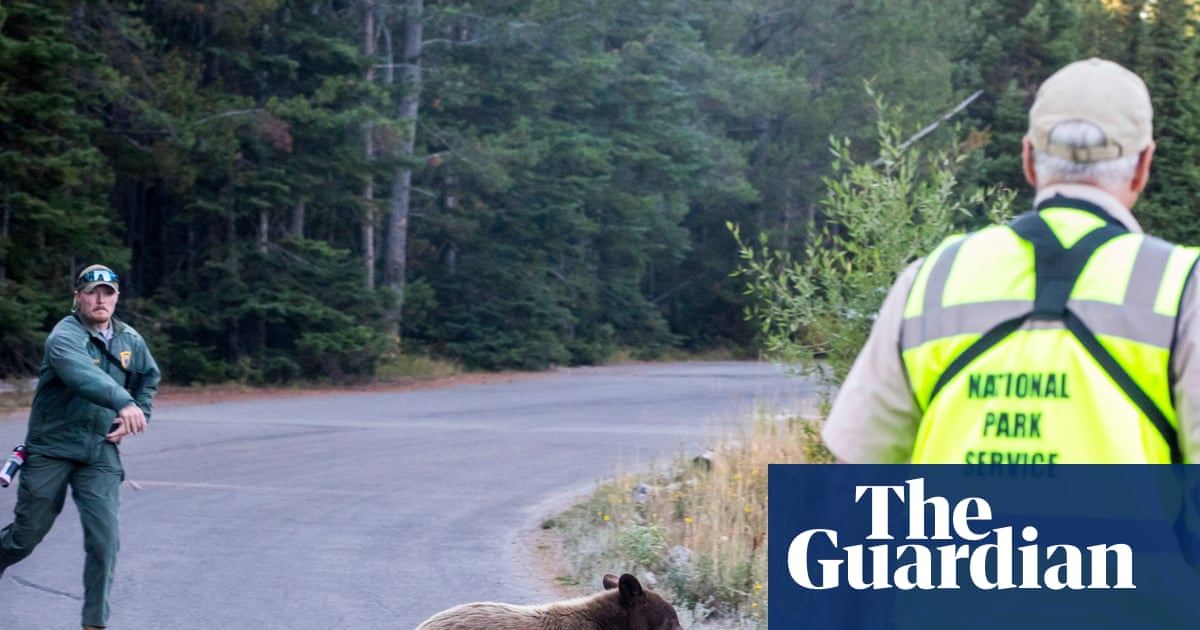
Dan Thompson, supervisor of the large carnivore section of the Wyoming game and fish department, enjoys the field work of capturing mountain lions, wolves, black bears and grizzly bears to study them.
asserted
Thompson → enjoy → them
“I have always been personally intrigued with carnivores and their role throughout any ecosystem,” Thompson said.
asserted
Thompson → intrigue → ecosystem
“I actually feel very fortunate to get paid to do what we do.”
asserted
we → feel → what
Still, like most jobs, there are tasks he does not enjoy but must do: grappling with attacks and human injuries, having to sometimes put animals down and then facing the public blowback.
asserted
he → be → blowback
This year, he expects the number of bears he and other state workers have to kill to be among the highest on record.
asserted
he → expect → record
That is because Wyoming, like other states, has seen a significant uptick in the number of encounters between humans and bears.
asserted
Wyoming → see → humans
There has been an increase this year in at least 15 states across the US, the Washington Post reported, revealing a national picture of more, and more intense, encounters between humans and bears.
asserted
Post → report → humans
Experts largely attribute the increase to the impact of unusual weather on the animal’s food sources and a rebound in recent decades in black, brown and grizzly bear populations.
asserted
Experts → attribute → populations
The animals entering places where humans live forces people like Thompson to do something he doesn’t like or face tragic consequences.
“None of us got into this job to kill the animals we love,” Thompson said.
asserted
Thompson → enter → animals
After persecution and habitat loss during the 19th and 20th centuries drastically reduced many bear populations in North America, restricting hunting and preventing the complete clearcutting of forest ecosystems – instead, just doing sustainable logging – has caused bear numbers to grow over the last 50 years, said Nate Bowersock, a biologist with the Missouri department of conservation.
asserted
Bowersock → reduce → conservation
Meanwhile, human development has expanded, and visits to US national parks, where bears roam, have increased.
asserted
bears → expand → parks
In 1994, the parks saw 268 million visitors; in 2024, 331 million people visited, according to the National Park Service.
uncertain
people → see → Service
“We definitely are seeing more people moving into areas where bears are common, and so that does lead to more encounters,” said Bowersock, who also chairs BearWise, an organization dedicated to helping bears and humans coexist.
asserted
bears → see → BearWise
This year, the western US experienced a warmer winter and severe drought conditions, which limited vegetation, like berries and acorns, that bears eat to regain fat after hibernating.
asserted
bears → experience → fat
That prompted some bears to seek food in developed areas.
asserted
That → prompt → areas
“Their whole lives revolve around recovering from hibernation and preparing for hibernation, and they have really high caloric needs and so when they can’t find their natural food sources, they have to go look for alternatives,” Bowersock said.
asserted
Bowersock → revolve → alternatives
Connecticut has had a steady increase in bears entering homes over the last decade.
asserted
bears → have → decade
In 2022, 2024 and 2026, the state had at least 60 annual reports.
asserted
state → have → reports
In Florida, the fish and wildlife conservation commission received an average of 2,500 complaints concerning bears annually from 2006 to 2010, according to the state; from 2021 to 2025, the state average was more than 6,400.
uncertain
average → receive → 2025
Black bears were once designated an “imperiled species” in the state; in 2025, the population had grown enough to where the state allowed black bear hunting for the first time in a decade.
asserted
state → designate → decade
The agency has euthanized 294 bears, three times the 2025 amount.
asserted
agency → euthanize → bears
This month, a black bear bit a woman on her forearm through her tent, and a black bear entered a condo through a bedroom window in the middle of the night and scratched a woman.
asserted
bear → bite → woman
In August in New Mexico, which also has had more bear encounters this year, one killed a 67-year-old wildland firefighter inside his home.
asserted
one → have → home
The depleted natural food sources has “pretty much forced [bears] to take higher risk food opportunities, so stuff like going into communities and getting in the garbage or maybe investigating a campsite or even investigating a person as maybe a potential source of food”, said Wes Larson, a bear biologist who hosts the podcast Tooth & Claw and maintains a popular Instagram account.
asserted
who → deplete → account
Still, bear attacks remain rare.
asserted
attacks → remain → ?
Humans can minimize their risks by not leaving pet or human food outside, securing garbage inside a bear-resistant container and not feeding bears.
asserted
Humans → minimize → bears
When exploring the outdoors where bears live, people should carry bear spray and store food and toiletries in bear-resistant containers rather than in tents.
asserted
people → explore → tents
If a bear approaches, people should hold their ground, wave their arms and yell “hey bear,” until it leaves, according to BearWise.
uncertain
it → approach → BearWise
Such measures don’t just save people; they help keep bears alive too.
asserted
they → save → bears
“Once bears have obtained food rewards that they associate” with people, “we call that human-food conditioning.
asserted
we → obtain → conditioning
Once they are at that level, we are going to have to put that bear down,” Thompson said.
asserted
Thompson → go → bear
But with proper precautions, seeing a bear in the wild is not necessarily cause for alarm.
asserted
seeing → see → alarm
“If they have done a necessary amount of education to where they know how to respond to a bear, it puts them in a headspace that they can then enjoy that encounter rather than be afraid,” said Larson, who has received more photos and videos of bear encounters this year than ever before.
asserted
who → do → encounters
“In a perfect world, I would love that every encounter between human and bear is full of wonder and awe.
asserted
encounter → love → wonder
But unfortunately, there are some that become a lot scarier or even violent.”
asserted
that → be → ?
Despite that increase this year and projections that the climate crisis will produce more severe droughts, Thompson, who has been with the Wyoming department for almost two decades, thinks this year is an anomaly.
asserted
year → produce → decades
“I have seen over the years and decades that things ebb and flow,” he said.
asserted
he → see → years
“The high level of animals that were removed in conflict, that takes those out of the equation, right?
asserted
that → remove → equation
And so for all those reasons, I would not expect this to be the norm.”
asserted
this → expect → reasons
 The Aporia