- See more Daily Mail on Google - save us as a Preferred Source
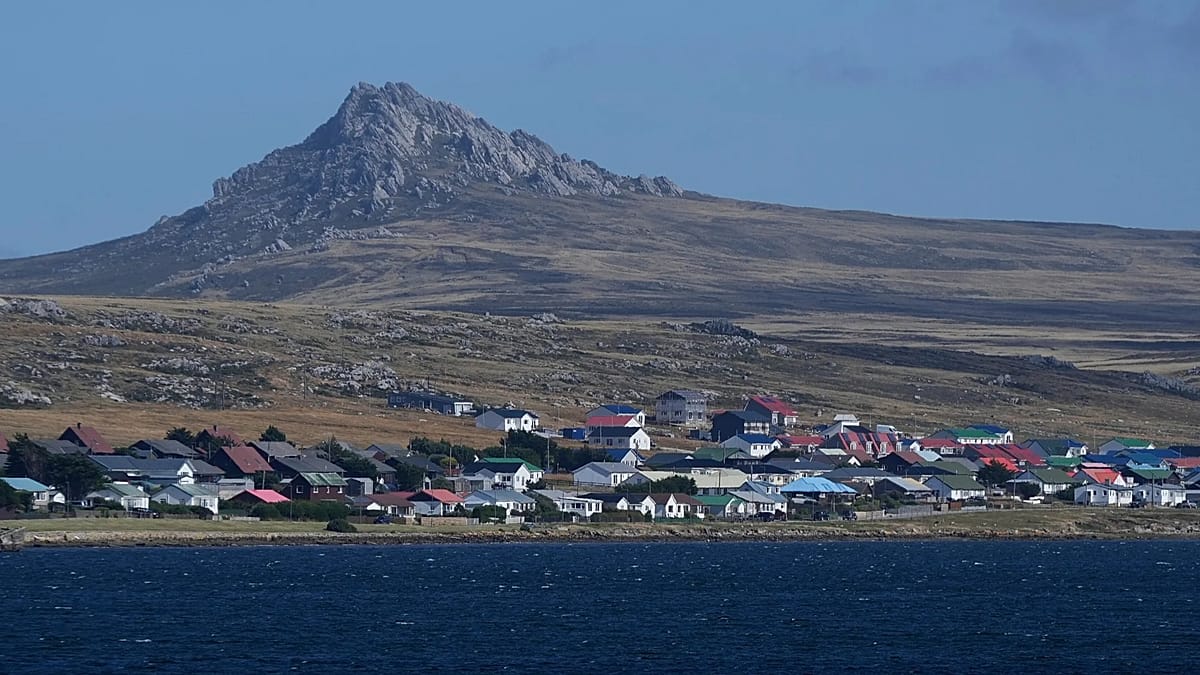
Tensions between Britain and Argentina have escalated this week as a decades-old dispute over the Falkland Islands has been reignited.
asserted
dispute → see → Islands
Argentina's firebrand president Javier Milei warned yesterday that sanctions would be imposed on companies drilling for oil off the Falklands, while insisting that the islanders have no right to self-determination.
With an election just a year away and his poll numbers falling, Mr Milei said Argentina must 'recover these islands' and vowed to use 'all the tools of the state: diplomatic, economic, judicial and legal' to obstruct drilling at the Sea Lion oilfield, which is estimated to contain 1.7 billion barrels of oil.
asserted
which → warn → oil
While he did not threaten military action, Mr Milei also announced an emergency decree to build a naval base on Tierra del Fuego, the part of Argentina closest to the Falklands.
asserted
Milei → threaten → Falklands
The islands have remained a bitter point of contention since Argentina's 1982 invasion, which prompted Britain to send a task force 8,000 miles to retake them.
asserted
which → remain → them
A total of 907 people were killed in the conflict, including 255 British servicemen.
asserted
total → kill → servicemen
During the 1982 conflict, Argentina initially held a significant numerical advantage in the South Atlantic, with more than 200 aircraft and a garrison of around 13,000 troops on the islands.
asserted
Argentina → hold → islands
However, its forces faced significant disadvantages, including limited training and logistical difficulties.
asserted
forces → face → training
Britain ultimately overcame Argentina’s numerical advantage through a combination of nuclear submarine power, the effectiveness of its Sea Harrier jets and the superior combat training of its professional infantry forces.
asserted
Britain → overcome → forces
But more than four decades after the war, Mr Milei's renewed claims raise a fresh question – how does Argentina's military compare with Britain's today?
uncertain
military → renew → Britain
In 1982, Britain ultimately overcame Argentina’s numerical advantage through a combination of nuclear submarine power, the effectiveness of its Sea Harrier jets and the superior combat training of its professional infantry forces
According to the ATLAS Index, the UK has a substantial overall military advantage over Argentina, ranking eighth in the world compared with Argentina in 52nd place.
uncertain
UK → overcome → place
The UK scores 52.5 out of 100, compared with Argentina's 29.4, with Britain outperforming Argentina across all six pillars measured by the index.
asserted
Britain → score → index
These include defence budget, manpower, ground forces, naval power, air power and nuclear deterrence.
asserted
These → include → budget
One of the clearest differences is defence spending – the UK has a defence budget of around £62.0billion, projected to rise to £79.1billion by 2029, compared with just £2.95billion for Argentina.
asserted
UK → have → Argentina
Defence spending accounts for 2.4 per cent of UK GDP, compared with just 0.6 per cent in Argentina.
asserted
spending → account → Argentina
The UK also has a larger active military, with around 183,000 active personnel, according to the latest Ministry of Defence figures, compared with 103,000 in Argentina.
uncertain
UK → have → Argentina
Britain had a further 32,000 reserve personnel as of April 2026, while Argentina relies primarily on active-duty personnel and does not maintain a reserve force.
asserted
Argentina → have → force
The biggest disparities emerge in air power.
asserted
disparities → emerge → power
Argentina has between 215 and 241 military aircraft in total, including 101 helicopters, but only 32 combat aircraft.
asserted
Argentina → have → helicopters
The UK, by contrast, operates around 945 airframes across all categories, including 249 helicopters and approximately 171 combat aircraft.
asserted
UK → operate → helicopters
Britain's air force also benefits from a significantly more modern and capable combat fleet.
asserted
force → benefit → fleet
The UK operates Eurofighter Typhoons and F-35B Lightning II fighter jets, alongside aircraft including the Voyager tanker, A400M and C-17 transport aircraft, and P-8A Poseidon maritime patrol aircraft.
The RAF had 129 Typhoons in its inventory in the latest Ministry of Defence figures, alongside its F-35 fleet.
Argentina, by contrast, has spent years operating an ageing fighter fleet but has now begun a major effort to rebuild its combat aviation capability.
asserted
Argentina → operate → capability
Its combat aircraft inventory is considerably smaller and includes A-4 Skyhawks, while its acquisition of newer F-16s represents an effort to modernise its ageing fighter fleet.
asserted
acquisition → include → fleet
Wildcat Helicopters from 815 Naval Air Squadron, flies past UK Carrier HMS Prince of Wales
Argentina operates the TAM, a locally produced medium tank that is undergoing a major modernisation programme
Meanwhile, Britain operates two aircraft carriers, HMS Queen Elizabeth and HMS Prince of Wales, while Argentina has none.
asserted
Argentina → fly → none
The two countries are surprisingly close when it comes to tanks.
asserted
it → come → tanks
Argentina operates the TAM, a locally produced medium tank that is undergoing a major modernisation programme, while Britain's main battle tank is the Challenger 2, which is being upgraded to the new Challenger 3 standard.
asserted
which → operate → standard
Unofficial, non-government figures put Argentina's fleet at 231 main battle tanks, compared with 227 for the UK.
asserted
figures → put → UK
Britain has, however, a much broader fleet of armoured and protected vehicles.
asserted
Britain → have → vehicles
The Ministry of Defence's latest equipment statistics record around 4,000 combat-equipment platforms, including armoured fighting vehicles, armoured personnel carriers and protected mobility vehicles.
asserted
statistics → record → vehicles
Argentina does not publish an equivalent figure.
asserted
Argentina → publish → figure
Its armoured forces are nevertheless undergoing a major overhaul, with the government moving ahead with plans to acquire 235 US-made Stryker 8x8 armoured vehicles.
asserted
government → undergo → vehicles
Britain also has the larger and more sophisticated naval force.
asserted
Britain → have → force
The Royal Navy operates destroyers, frigates, patrol vessels, mine-countermeasure vessels and other surface ships, supported by the Royal Fleet Auxiliary (RFA).
asserted
Navy → operate → Auxiliary
The latest Ministry of Defence figures count 52 Royal Navy surface-fleet vessels and 12 RFA vessels.
asserted
figures → count → vessels
Argentina operates a smaller fleet of frigates, corvettes, patrol vessels and support ships, with unofficial numbers placing the figure at around 42 vessels.
asserted
numbers → operate → vessels
The UK's nuclear capability creates another major difference between the two forces.
asserted
capability → create → forces
Argentina has no nuclear weapons, while the UK is estimated to possess 225 nuclear warheads, including 120 deployed warheads.
asserted
UK → have → warheads
Britain's nuclear deterrent is based on its fleet of four Vanguard-class ballistic-missile submarines.
asserted
deterrent → base → submarines
It also possesses five attack submarines.
asserted
It → possess → submarines
The disparity in military resources is also reflected in the two countries' wider economies.
asserted
disparity → reflect → economies
The UK has a GDP of approximately £3.03trillion, making it the fifth largest economy in the world, compared with Argentina's £510billion, placing it at number 26 worldwide.
asserted
it → have → number
…and 15 more, not listed.
 The Aporia