Trump ‘wasn’t trying to dominate’ at state dinner with Xi, as body language expert notes ‘sign of respect’

Read the original at New York Post ↗
New York Post · collected 2026-09-25 · by Victor Nava

Quick Summary

A body language expert analyzed President Trump's interactions with Chinese leader Xi Jinping during a White House state dinner, suggesting that Trump was attempting to show respect rather than dominate. Sean Johns noted unusual behavior from Trump, such as not engaging in his typical aggressive handshakes and maintaining a neutral demeanor during the toast despite positive words. However, when Trump spoke about the new White House ballroom under construction, he displayed genuine excitement and more expressive body language, including pointing directly at the camera which is seen as an assertive gesture.
Written locally by qwen2.5:14b on 2026-09-26, using this article's own text rather than the other coverage of the same event (that is the story summary below).

AI analysis runs on qwen2.5:14b, locally

Story summary

Before the Xi-Trump summit in September 2026, US soybean farmers expected tariff reductions on their exports to China. However, China excluded soybeans from a list of agricultural goods set to receive reduced tariffs, including corn, wheat, meat, and dairy products. This decision disappointed American farmers like John Bartman, an Illinois-based fifth-generation soybean farmer, who saw it as a missed opportunity. Despite this exclusion, China committed to buying more than 12 million metric tons of US soybeans through 2028. The tariff on soybeans remains at 10%, which is considered too high by traders for private crushers to absorb, although state buyers continue purchases.

Written for “US-China Tariff Cuts Deal” on 2026-10-13, grounded in this article and the 284 other(s) covering the same event.

Story

📰 US-China Tariff Cuts Deal
Economy/Business · 285 article(s) covering the same event. Compare every outlet's account →

Compared with similar articles

This article reads unscored and hedges 5% of its claims. Each row says how that neighbour differs.
Washington Examiner
⚖️ leaning not scored 🔴 8% hedged 2 of 24 📰 publisher trust 68
“Both articles describe the state dinner between Trump and Xi on the same date.”
South China Morning Post
⚖️ leaning not scored 🔴 0% hedged 0 of 4 📰 publisher trust 67
“Both articles describe the same White House dinner between Xi Jinping and Trump on September 25, 2026.”
The Hindu
⚖️ Leans left 🔴 13% hedged 3 of 23 📰 publisher trust 60
“Both articles describe the exact same state dinner between Trump and Xi Jinping on September 25, 2026.”
Al Jazeera
⚖️ Leans right 🔴 0% hedged 0 of 13 📰 publisher trust 60
“Both articles describe President Trump hosting a state dinner for Chinese leader Xi Jinping on the same date, discussing the same social and diplomatic event.”
BBC News
⚖️ Leans left 🔴 21% hedged 7 of 33 📰 publisher trust 72
“Both articles describe President Trump's state dinner with Chinese leader Xi Jinping on the same date, indicating coverage of the same specific diplomatic meeting.”
Euronews
⚖️ leaning not scored 🔴 0% hedged 0 of 4 📰 publisher trust 60
“Both articles describe the same White House state dinner hosted by US President Donald Trump for Chinese President Xi Jinping on September 25, 2026.”
ABC News (AU)
⚖️ leaning not scored 🔴 12% hedged 3 of 26 📰 publisher trust 61
“Both articles describe the same White House state dinner hosted by President Trump for Chinese leader Xi Jinping on September 25, 2026.”
Daily Mail
⚖️ Leans right 🔴 9% hedged 5 of 55 📰 publisher trust 64
“Both articles describe the same State Dinner event between Trump and Xi Jinping on the same date.”
BBC News
⚖️ leaning not scored 🔴 2% hedged 1 of 45 📰 publisher trust 72
“Both articles describe the same state dinner between Trump and Xi at the White House on the same date.”
NPR
⚖️ leaning not scored 🔴 15% hedged 5 of 34 📰 publisher trust 60
“Both articles describe President Trump's state dinner for Xi Jinping on the same date, focusing on different aspects of the same specific diplomatic event.”

Cite this article

Nava, V. (2026, September 25). Trump ‘wasn’t trying to dominate’ at state dinner with Xi, as body language expert notes ‘sign of respect’. New York Post. https://nypost.com/2026/09/25/us-news/trump-wasnt-trying-to-dominate-at-state-dinner-with-xi-body-language-expert/

Dated when The Aporia collected the article, usually within hours of publication. Check the original for its exact date and byline.

How this article was measured signals, leaning charts, publisher record, byline, topics and claims

Signals How these are calculated →

Claims extracted
38
sentences that state something as happening or true
Uncertain
5%
2 of 38 hedged ("reportedly", "may", "according to")
Leaning
not political
takes no side on a contested political question
Publisher signals
67/100
New York Post's corrections and hedging, across everything collected from it. Not a measure of accuracy.
Outlets on this story
285
Economy/Business
Same framing elsewhere
1
articles that frame the event the way this one does
Analyzed 2026-09-26 · how these are computed

How this is being covered How these are calculated →

Article leaning vs. publisher reliability
Source leaning vs. consistency

Publisher

New York Post · 9862 article(s) · 30 correction(s) detected
Running correction rate · 30 correction(s)

Who wrote this

Victor Nava
47 article(s) here · 1 carrying a prediction
🔮 Emhoff has privately told people that he would prefer for his wife to stay out of the 2028 presidential race, the Wall Street Journal reported on Friday.
🔮 “If you want to stop illegal alien criminals from being released into your communities, you must elect Bruce Blakeman and a Republican Congress and we will ban sanctuary cities and sanctuary states at long last,” he promised.
🔮 “And we will not forget, Norway.”
🔮 Right when we were trying to get that emergency money out for Hurricane Helene so that our farmers and our small communities could repair and prepare for this year’s harvest.
🔮 “I think it’s really important to note that my opponent decided not to show up for work 58% of the time this year, on policies that could have helped to support Iowans and Iowa farmers, including the Iowa Farm Bill.
🔮 Democratic Maryland Gov. Wes Moore wouldn’t commit to serving a full, four-year term if re-elected governor during Tuesday’s gubernatorial debate.
🔮 The investigation, led by the department’s Assistant Secretary for Civil Rights Kimberly Richey, will seek to determine whether the district’s handling of sexual harassment and assault claims against teachers, administrators, and other school personnel violated federal Title IX rules – including by being swept under the rug.
🔮 “We had an idea that there might be a threat, so why would I leave them there?” he told reporters.
🔮 President Trump signed an executive order Monday waiving restrictions on the use of tax-exempt red-dye diesel, which he said will ease the pain at the pump for truckers and lower the cost of groceries nationwide.
🔮 “Secretary of War Pete Hegseth has recommended — and President Donald J. Trump has approved — death by U.S. Army firing squad for convicted terrorist Nidal Malik Hasan, the jihadist who opened fire on unarmed American soldiers at Fort Hood in 2009,” Pentagon spokesman Sean Parnell wrote on X. Hasan killed 12 US service members, one civilian and wounded 32 others during his November 2009 rampage at the Texas Army base. Parnell noted the Army-officer-turned-terrorist was “shouting ‘Allahu Akbar’ during the attack.” “The Secretary of the Army will set the time and place of the execution,” the Pentagon spokesman added.
Also by Victor Nava
Nothing else under this byline is closely related to this article, so these are simply their most recent.
All 47 articles by Victor Nava →

Topics

BodyLytics Chinese The Post White House

Subjects

Johns PERSON · 11× Trump PERSON · 11× Chinese NORP · 2× Donald Trump PERSON · 2× White House ORG · 2× BodyLytics ORG · 1× Sean Johns PERSON · 1× The Post ORG · 1× Xi Jinping PERSON · 1×

Narrative

Sean Johns, who has 20 years of experience analyzing nonverbal communication and is the founder of the body language training company BodyLytics, told The Post that from Trump’s initial handshake with Xi and through the toast, the president appeared to be trying his best to make his Chinese counterpart feel welcomed and respected during the high-stakes visit.
framing: assertive · carried by 1 article(s) · first seen 2026-09-26
🔮 Johns pointed out that at the end of the handshake Trump forced “a little false smile,” which he would later deploy again during his toast for Xi.

Claims (38 extracted, 2 hedged)

President Trump was trying to “connect” with Xi Jinping, rather than “dominate” him, at the White House state dinner for the Chinese leader, according to a body language expert. uncertain
Trump → try → expert
Sean Johns, who has 20 years of experience analyzing nonverbal communication and is the founder of the body language training company BodyLytics, told The Post that from Trump’s initial handshake with Xi and through the toast, the president appeared to be trying his best to make his Chinese counterpart feel welcomed and respected during the high-stakes visit. asserted
counterpart → have → visit
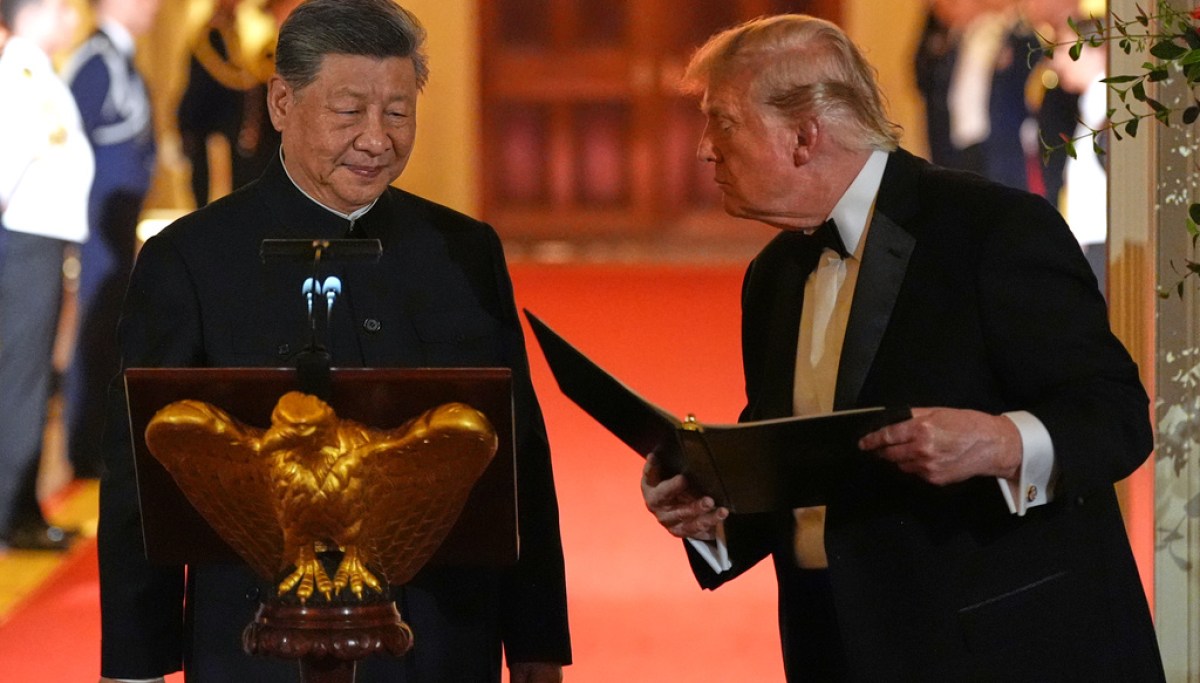
Johns noticed the president “closed the distance” and “came towards” Xi during the arrival ceremony on the North Portico, which he found “not typical for Donald Trump.” asserted
he → notice → Trump
“Closing the distance between people is trying to kind of like connect. asserted
Closing → close → people
In a strange way, you’re connecting. asserted
you → connect → way
So you’re closing that gap,” he explained. asserted
he → close → gap
“What we’re looking at with this handshake is what was not there,” Johns said. asserted
Johns → look → handshake
“Because Donald Trump is known for the aggressive handshake. asserted
Trump → know → handshake
He shakes for too long. asserted
He → shake → long
He kind of grabs you by the arm often. asserted
He → grab → arm
“And with President Xi, he didn’t do that.” asserted
he → do → that
Trump’s approach to the handshake was “more of a sign of respect,” according to the body language expert. uncertain
approach → accord → expert
“I think that he wasn’t trying to dominate, which he usually does,” Johns said, noting that Trump typically overdoes it with handshakes and aggressive pats on the back “depending on who he’s dealing with.” asserted
he → think → who
“This showed that there was a lot of respect for [Xi]. asserted
This → show → Xi
And it was a very two-sided thing,” he continued, adding that both leaders “looked quite comfortable around each other … and there was no dominance play from either side.” asserted
leaders → continue → side
Johns pointed out that at the end of the handshake Trump forced “a little false smile,” which he would later deploy again during his toast for Xi. asserted
he → point → Xi
At several points in his toast, Trump displayed what Johns described as “incongruence” between his remarks and body language. asserted
Johns → display → remarks
“He emphasized that ‘We’re delighted to have you here,’ but there was no body language delight … asserted
We → emphasize → you
the words were positive, but the body language was neutral,” the expert noted. asserted
expert → note → ?
“And he did this twice.” asserted
he → do → this
“When he said, ‘We’re happily celebrating,’ It didn’t look like he was happy celebrating, it just looked like protocol.” asserted
it → say → protocol
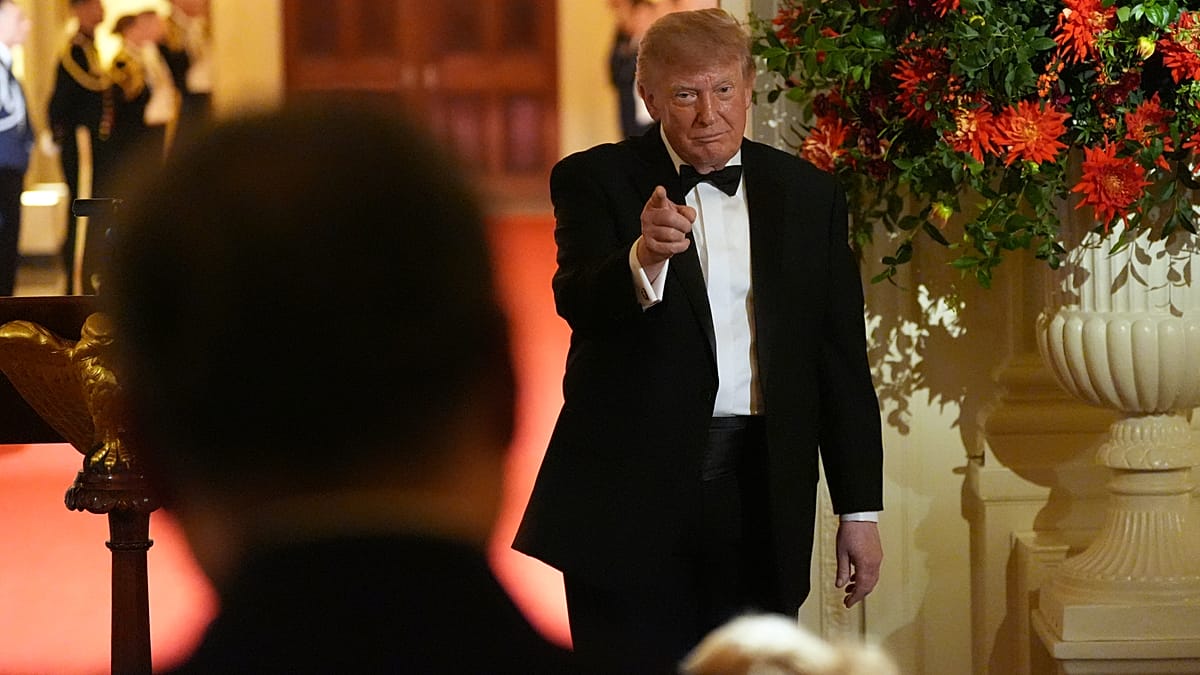
Another moment that stood out to Johns during Trump’s speech was when the president went off-script to invite guests to tour the new White House ballroom, which is still under construction. asserted
which → stand → construction
“That’s the first time where you see a genuine smile,” Johns said, “and he almost came across like a naughty schoolboy. asserted
he → ’ → schoolboy
When discussing the ballroom, Trump became more expressive and aggressive than at any other point in his remarks or interactions with Xi. asserted
Trump → discuss → Xi
“He makes his first hand gesture, bearing in mind that his hands have been down the whole time,” Johns observed. asserted
Johns → make → mind
“He points directly at the camera. asserted
He → point → camera
Pointing, in body language, with the index finger, is considered aggressive,” he continued, noting that again, Trump’s words and body language were “not congruent.” asserted
words → point → finger
“You’re making a slightly aggressive gesture with a finger point, but you’re saying the ‘beautiful ballroom.’” asserted
you → make → ballroom
“There’s a disconnect there somewhere between the perception of perhaps the ballroom and all the drama that surrounded it,” Johns said. asserted
Johns → ’ → it
Based on his body language, the president was also genuinely pleased with the large, bald eagle statue he gifted Xi at the dinner. asserted
he → base → dinner
“When they reveal the bald eagle statue, Trump does, kind of, two awkward steps … asserted
Trump → reveal → steps
I think that was a closing distance gesture between him and the statue,” Johns said. asserted
Johns → think → him
“It’s showing approval towards it almost. asserted
It → show → it
You get close to things you like. asserted
you → get → things
So he’s closed the distance and then, interestingly, he’s kind of does an exaggerated look at it and then looks back at Xi …. asserted
he → close → Xi
he’s trying to signal to him, ‘Look at the wonderful statue that we gave you.’” asserted
we → try → you
Johns’ biggest takeaway was the “lack of physical, non-verbal aggression” throughout the dinner that Trump “usually shows certain people.” asserted
Trump → show → people
“I think that what it shows to me is the amount of respect and perhaps the importance of the meeting and the fact that it was an important guest that had importance to even the economy, I would say,” he explained. “So he took that very seriously, aside from the odd joke or two.” asserted
he → think → joke

💬Give feedback
🕘History 🎫Support