Pakistan's Prime Minister Shehbaz Sharif addressed the United Nations General Assembly on Friday, strongly condemning Houthi attacks on Saudi Arabia and warning that any threat to Mecca and Medina is a “red line.” He emphasized Muslims' global outrage over these incidents, which Riyadh claims targeted the holy cities. Sharif also discussed Pakistan’s trilateral defense pact with Saudi Arabia and Turkey but clarified that Islamabad has refrained from directly supporting Riyadh in its conflict with the Houthis, highlighting instead potential future cooperation based on threat levels.
Written locally by qwen2.5:14b on 2026-09-26,
using this article's own text rather than the other coverage of the
same event (that is the story summary below).
Pakistan’s prime minister has condemned Houthi attacks on Saudi Arabia, warning that any “threat to the sanctity” of the Muslim holy cities of Mecca and Medina is a “red line that must never be crossed”.
asserted
that → condemn → Mecca
Addressing the United Nations General Assembly in New York on Friday, Shehbaz Sharif denounced recent Houthi attacks as “deplorable”.
asserted
Sharif → address → attacks
list of 3 items- list 1 of 3Pakistan PM calls Houthi threats to Saudi holy sites a ‘red line’
- list 2 of 3Oil prices jump after Yemen’s Houthis claim attacks on Saudi facilities
- list 3 of 3Netanyahu’s UN belligerence wins cheers at home as world walks out
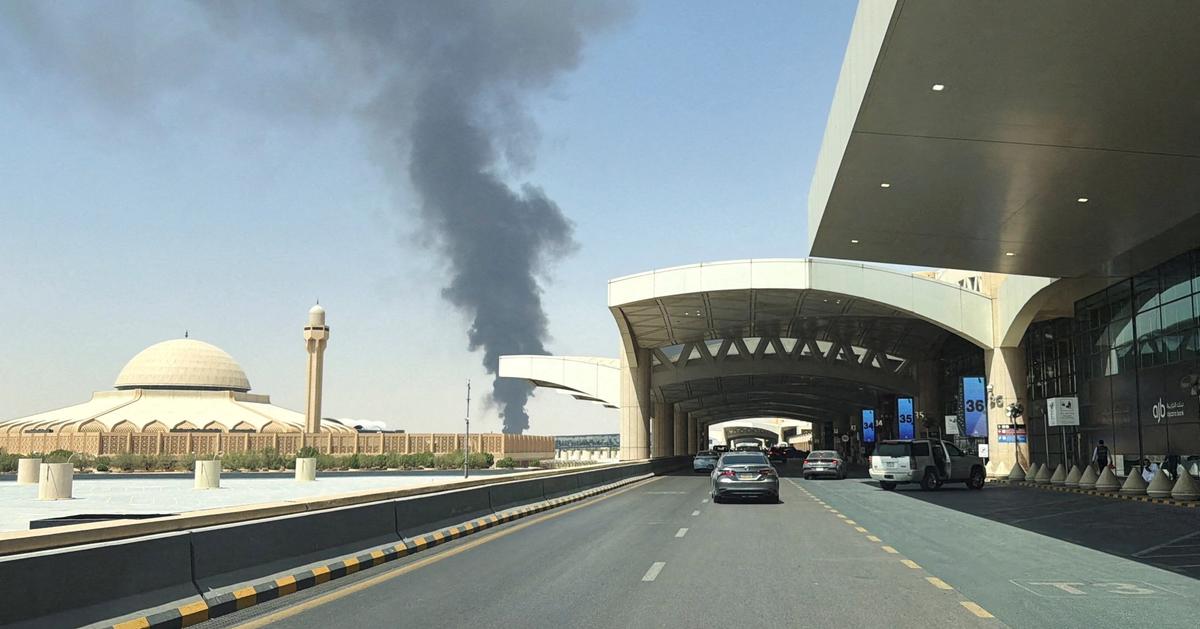
He added that an attack by the Iran-aligned Yemeni group, which Riyadh says targeted Mecca, “outraged Muslims across the globe”.
uncertain
Riyadh → call → globe
The Houthis have dismissed the accusations as a “heinous lie”.
asserted
Houthis → dismiss → lie
Last month, Pakistan, Saudi Arabia and Turkiye signed a trilateral defence pact, formally known as the Mecca Joint Defence Agreement.
asserted
Pakistan → sign → Agreement
The pact states that an attack on any member will be treated as an attack on all.
asserted
attack → state → all
However, Islamabad and Ankara have refrained from getting involved in Riyadh’s ongoing fight with the Houthis.
asserted
Islamabad → refrain → Houthis
The military chiefs of all three countries met in Riyadh on Friday and discussed enhancing intelligence sharing and military coordination, the Pakistani military said.
asserted
military → meet → sharing
The chiefs reviewed the security situation and threats facing Saudi Arabia, affirmed a commitment to collective defence and pledged to turn Mecca Agreement commitments into effective cooperation, the army added.
asserted
army → review → cooperation
It is not clear what, if any, support Ankara and Islamabad may provide to Riyadh.
uncertain
Ankara → provide → Riyadh
In a written interview published by the US media outlet Newsweek on Friday, Turkish President Recep Tayyip Erdogan said support could include “intelligence, logistics or ammunition, with more extensive military assistance possible depending on the scale of the threat”.
uncertain
support → write → threat
In Sharif’s UN address, he also referenced the US-Israeli war that was launched against Iran in late February, as well as Islamabad’s role as a co-mediator.
asserted
that → reference → mediator
Pakistan’s efforts culminated in the Islamabad Memorandum of Understanding, signed by Washington and Tehran, which was intended to help end the conflict.
asserted
which → culminate → conflict
The accord has since unravelled while regional countries push for a conclusive end to the war, which has caused a global energy crisis and exacerbated tensions across the Middle East.
“Yet amid the roar of missiles, drones and guns, the voice for diplomacy must echo even louder and stronger,” Sharif said.
asserted
Sharif → unravel → diplomacy
He added that the Strait of Hormuz, which Iran has effectively blockaded, and the Bab al-Mandeb waterway, which is now largely under Houthi control, are “arteries of the global economy” that should remain free and safe.
asserted
that → add → economy
The Pakistani prime minister also denounced what he described as Israel’s “genocidal agenda” in Palestine, while condemning “Israeli aggression against Lebanon and Syria”.
asserted
he → denounce → Lebanon
These were sentiments echoed earlier in the day by Lebanese Prime Minister Nawaf Salam in his UN General Assembly address.
asserted
These → echo → address
India, Kashmir, Afghanistan
Closer to home, Sharif’s speech touched on tensions with Pakistan’s neighbours.
asserted
speech → touch → neighbours
Criticising India, he accused New Delhi of weaponising the Indus waters, which both countries have jointly managed for more than six decades.
asserted
countries → criticise → decades
The two neighbours heavily rely on the Himalayan river network.
asserted
neighbours → rely → network
Sharif warned that “any attempt to stop, impede or divert Pakistan’s share of the waters will be treated as an act of war”.
asserted
attempt → warn → war
He also called for what he described as a “just and fair solution” to the Kashmir dispute, which both Pakistan and India claim in its entirety.
uncertain
Pakistan → call → entirety
Sharif alleged that there have been attempts to “alter the legal status” of Kashmir through demographic engineering.
asserted
Sharif → allege → engineering
Another pressing issue for Islamabad is the threat posed by the Tehrik-e-Taliban (TTP), or Pakistani Taliban.
asserted
issue → press → Taliban
Sharif said groups operate from “sanctuaries inside Afghanistan, with the aim of destabilising Pakistan”, insisting that attacks launched from Afghanistan “must come to a grinding halt”.
asserted
attacks → say → halt
This comes as the latest cross-border fighting left several Afghan Taliban fighters dead on Friday.
asserted
fighting → come → Friday
 The Aporia