California crews uncover possible 45-million-year-old ‘thunder beast’ fossils in Oceanside

Read the original at Times of India ↗
Cite

TOI Science Desk. (2026, September 25). California crews uncover possible 45-million-year-old ‘thunder beast’ fossils in Oceanside. Times of India. https://timesofindia.indiatimes.com/science/archaeology/california-crews-digging-12-feet-below-an-oceanside-infrastructure-project-uncovered-limb-bones-ribs-and-fragments-that-paleontologists-say-may-belong-to-a-thunder-beast-up-to-45-million-years-old/articleshow/134479820.cms

Dated when The Aporia collected the article, usually within hours of publication. Check the original for its exact date and byline.

Times of India · collected 2026-09-25 · by TOI Science Desk

Quick Summary

During routine construction in Oceanside, California, workers unearthed fossilized bones estimated to be 45 million years old, potentially belonging to a prehistoric mammal. The discovery includes limb bones and ribs from either a "thunder beast" (Titanothere) or an Amynodon ("swamp rhino"), both large hoofed mammals from the Eocene Epoch. Paleontologists spent seven days carefully excavating the fossils, which will undergo further analysis to determine the exact species.
Written locally by qwen2.5:14b on 2026-09-25, using this article's own text rather than the other coverage of the same event (that is the story summary below).

AI analysis runs on qwen2.5:14b, locally

Story summary

During routine construction work for an infrastructure project in Oceanside, California, workers uncovered fossilized bones dating back around 40 million years. The City of Oceanside announced that these remains were found about 12 feet below the surface and could belong to a prehistoric "thunder beast" or a "swamp rhino," both large hoofed mammals from the Eocene Epoch. Paleontologists, including Dr. Joseph El Adli, who identified the site during monitoring, are now studying these fossils further. The city has not disclosed the exact location of the discovery to protect it from unauthorized digging that could damage additional fossil remains still in the ground.

Written for “Thunder Beast Fossil Discovery Califo…” on 2026-10-17, grounded in this article and the 1 other(s) covering the same event.

Story

📰 Thunder Beast Fossil Discovery Califo…
Science · 2 article(s) covering the same event. See how they differ ↓

Compared with similar articles

This article reads unscored and hedges 29% of its claims. Each row says how that neighbour differs.
Times of India · 0.94 cosine similarity
⚖️ leaning not scored 🔴 18% hedged 3 of 17 📰 publisher trust 59
“Both articles describe the discovery of prehistoric mammal fossils by workers on a routine infrastructure project in Oceanside, California, with similar details about the location and nature of the find.”
How this article was measured signals, leaning charts, publisher record, byline, topics and claims

Signals How these are calculated →

Claims extracted
38
sentences that state something as happening or true
Uncertain
29%
11 of 38 hedged ("reportedly", "may", "according to")
Leaning
not political
takes no side on a contested political question
Publisher signals
59/100
Times of India's corrections and hedging, across everything collected from it. Not a measure of accuracy.
Outlets on this story
2
Science
Same framing elsewhere
1
articles that frame the event the way this one does
Analyzed 2026-09-25 · how these are computed

How this is being covered How these are calculated →

Article leaning vs. publisher reliability
Source leaning vs. consistency

Publisher

Times of India · 2727 article(s) · 2 correction(s) detected
Running correction rate · 2 correction(s)

Who wrote this

TOI Science Desk
266 article(s) here · 1 carrying a prediction
🔮 What protection means in practice Acquiring the land is the first step, but effective conservation will depend on ongoing management.
🔮 Now, more than 2,200 additional acres around the mountain are set to remain protected, giving the landscape a stronger shield against future development, states an online release by the official website of the Commonwealth of Virginia.
🔮 Stephanie Couch, executive director of the Lemelson-MIT Program, said research had shown that the year-long programme could change how students viewed their abilities and future opportunities.
🔮 The result has a statistical significance of 2.6 sigma, indicating a roughly 0.5% chance that known background processes alone could explain the event.
🔮 The report says it is so small that many resonators could be packed onto a chip to perform complex functions.
🔮 The dataset also includes environmental observations and three-dimensional digital reconstructions, which the field note says will help researchers track change over time while documenting the fragile site without disturbing it.
🔮 Future studies tracing the particles to their sources and testing for biological effects could reveal whether microplastic ingestion actually threatens sea snake health, and whether limiting laundry wastewater pollution might reduce exposure along the Gulf coasts.
🔮 The researchers could connect enzyme motion, iron chemistry, and water-mediated proton transfer by capturing structural snapshots over milliseconds to seconds of reaction time.
🔮 The findings, published in the journal Aging Cell in 2026, could help researchers understand how age-related changes occur and whether some of them can be reversed.
🔮 She also developed a Michaelis-Menten computational model to identify an optimal aragonite dose, an important step towards exploring how such a system could eventually be adapted for practical use, the report adds.
Wire or desk byline, not an individual reporter.
Also by TOI Science Desk
Nothing else under this byline is closely related to this article, so these are simply their most recent.
All 266 articles by TOI Science Desk →

Topics

California Oceanside San Diego San Diego County the City of Oceanside

Subjects

the City of Oceanside ORG · 3× Oceanside GPE · 2× California GPE · 1× El Adli PERSON · 1× El Adli's PERSON · 1× Joseph El Adli PERSON · 1× San Diego GPE · 1× San Diego County GPE · 1× the Los Angeles Times ORG · 1×

Narrative

Modern construction has also uncovered fossils elsewhere in Southern California, demonstrating how buried geological deposits can sometimes remain hidden until excavation reaches them. What happens to the fossils next? The recovered specimens are expected to undergo further preparation and scientific examination once researchers remove more of the surrounding rock.
framing: mixed · carried by 1 article(s) · first seen 2026-09-25
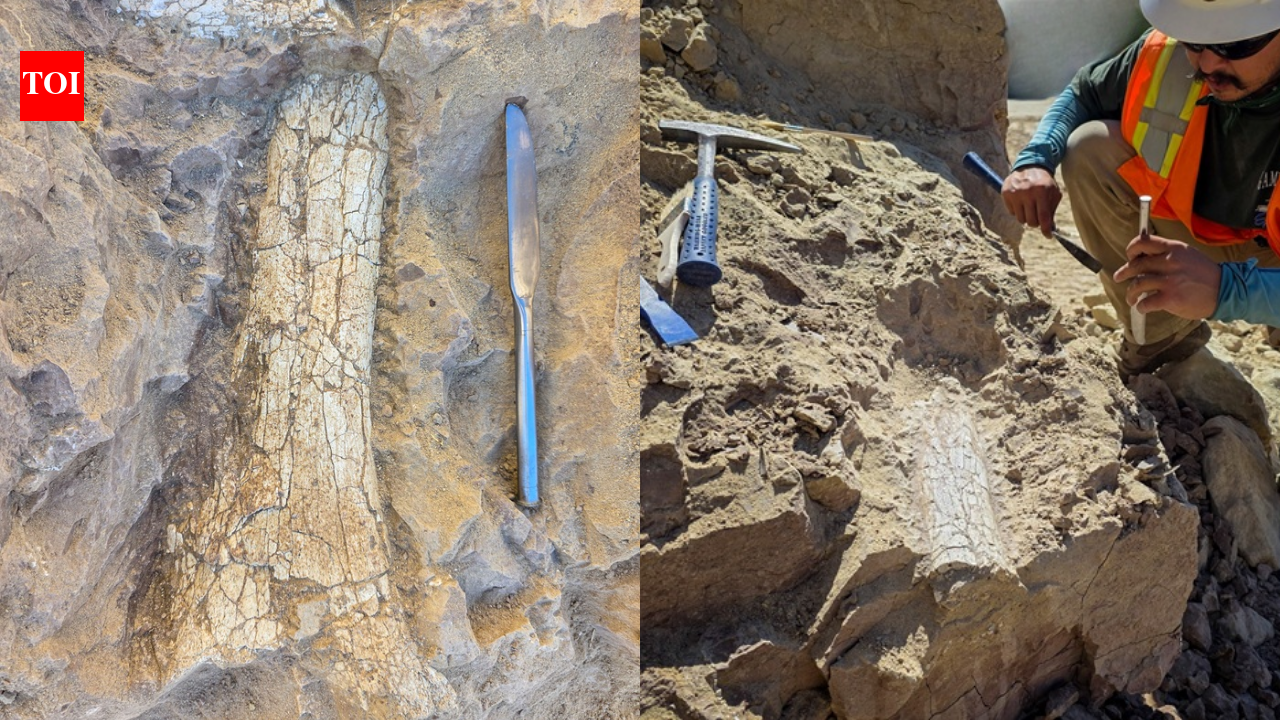
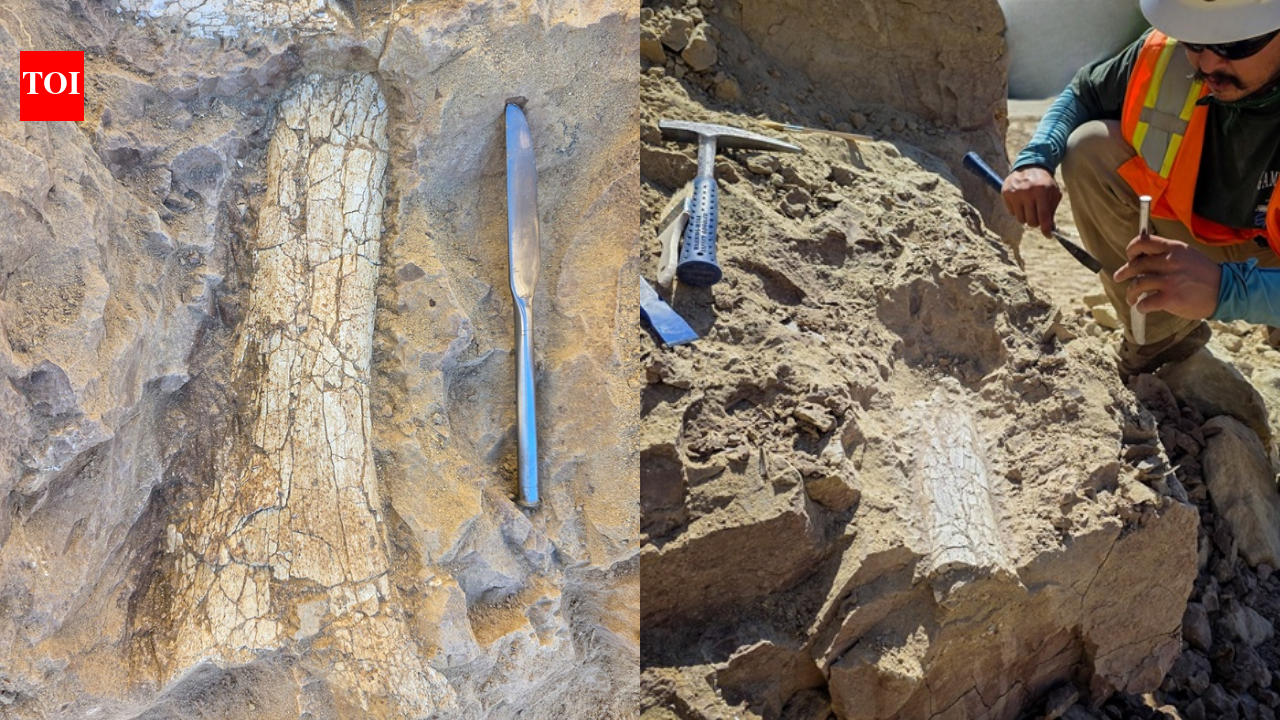
🔮 A routine infrastructure project in Oceanside, California, has led to an unexpected discovery from deep beneath the ground: fossilised bones that may have belonged to a huge hoofed mammal that lived as long as 45 million years ago.

Claims (38 extracted, 11 hedged)

A routine infrastructure project in Oceanside, California, has led to an unexpected discovery from deep beneath the ground: fossilised bones that may have belonged to a huge hoofed mammal that lived as long as 45 million years ago. uncertain
that → lead → mammal
According to the City of Oceanside, which announced the discovery, crews uncovered several limb bones, ribs and other fragments about 12 feet below the surface. uncertain
crews → accord → surface
Paleontologists believe the remains could belong to a prehistoric animal known as a “thunder beast”; another possibility is a creature known as a “swamp rhino”. uncertain
possibility → believe → rhino
Researchers are now studying the fossils to determine the animal's exact identity. asserted
Researchers → study → identity
Fossils emerge during routine construction asserted
Fossils → emerge → construction
The discovery was made recently while crews were carrying out excavation for a city infrastructure project in Oceanside, about 40 miles north of San Diego. asserted
crews → make → Diego
Workers digging roughly 12 feet below the surface came across several fossilised bones embedded in hardened sedimentary rock. asserted
Workers → dig → rock
The remains included multiple limb bones, ribs and numerous other bones and fragments. asserted
remains → include → bones
Their size and shape suggested to paleontologists that they belonged to a large hoofed mammal that lived in the region during the Eocene Epoch. uncertain
that → suggest → Epoch
The fossils were found in what the City of Oceanside describes as “Member C of the Santiago Formation,” a thick sequence of sedimentary rock in northwestern San Diego County. asserted
City → find → County
The formation dates to a period when the landscape of present-day Southern California was very different from what it is today. asserted
it → date → California
Rather than stopping construction entirely, the discovery prompted paleontologists to secure the area and carefully excavate the remains. asserted
discovery → stop → remains
Seven days of careful excavation Joseph El Adli, a paleontologist who was monitoring the construction site, recognised the importance of the discovery and led additional excavation work. asserted
who → monitor → work
According to the City of Oceanside, El Adli's team spent seven days exposing the fossils from beneath several tons of hardened mudstone and sandstone. uncertain
team → accord → mudstone
The bones were then placed inside a protective plaster field jacket so they could be transported safely to an off-site laboratory for further preparation. uncertain
they → place → preparation
The fossils are still encased in rock, meaning researchers have not yet been able to examine every part of the specimens. asserted
researchers → encase → specimens
That is also why the precise identity of the animal remains uncertain. asserted
identity → remain → animal
The exact location of the discovery is not disclosed yet, citing public safety concerns and the need to protect the site. asserted
location → disclose → site
Based on the size and shape of the recovered bones, El Adli believes the animal could belong to one of two groups of extinct mammals. uncertain
animal → base → mammals
One possibility is a Titanothere, commonly referred to as a “thunder beast”. asserted
possibility → refer → beast
These were large, hoofed mammals that lived in North America during the Eocene. asserted
that → live → Eocene
They were members of the extinct brontothere group and could reach considerable sizes. uncertain
They → reach → sizes
The second possibility is an Amynodon, sometimes described as a “swamp rhino”. asserted
possibility → describe → rhino
They belonged to an extinct group of large-bodied mammals and are thought to have had adaptations associated with life around wetlands. asserted
They → belong → wetlands
At this stage, paleontologists have not confirmed which of the two animals the Oceanside fossils represent. asserted
fossils → confirm → animals
Further preparation and examination of the bones should help narrow down their identity. asserted
preparation → help → identity
A glimpse into ancient Oceanside The fossils provide a window into a period when the landscape around present-day Oceanside was home to very different animals and environments. asserted
landscape → provide → animals
Officials said the mammal lived on ancient floodplains roughly 40 million to 45 million years ago. asserted
mammal → say → floodplains
The rocks surrounding the remains belong to the Eocene-aged Santiago Formation and fall within the Uintan North American Land Mammal Age. asserted
rocks → surround → Age
The find also adds to evidence that the region contains significant fossil deposits. asserted
region → add → deposits
According to the Los Angeles Times, other fossils have previously been recovered from the Santiago Formation, including remains of early saber-toothed carnivores and primates. uncertain
fossils → accord → carnivores
Modern construction has also uncovered fossils elsewhere in Southern California, demonstrating how buried geological deposits can sometimes remain hidden until excavation reaches them. What happens to the fossils next? The recovered specimens are expected to undergo further preparation and scientific examination once researchers remove more of the surrounding rock. asserted
researchers → uncover → rock
The additional work could reveal features that distinguish a thunder beast from a swamp rhino and provide more information about the animal's size and biology. uncertain
that → reveal → size
The researchers will also be able to determine whether the fragments belong to a single individual. asserted
fragments → determine → individual
The City of Oceanside said the specimens are ultimately expected to become part of a museum collection, where they can be preserved and made available to scientists and the public for further study. asserted
they → say → study
For now, the discovery remains a scientific mystery. asserted
discovery → remain → ?
What began as a routine excavation 12 feet beneath an Oceanside construction project has instead uncovered bones from an animal that may have walked across Southern California's ancient floodplains tens of millions of years ago. uncertain
that → begin → years
Further examination of the fossils will determine whether the long-buried remains belonged to a “thunder beast”, a swamp rhino or another prehistoric mammal. asserted
remains → determine → beast

💬Give feedback
🕘History 🎫Support