Claims extracted
14
sentences that state something as happening or true
Uncertain
0%
0 of 14 hedged
("reportedly", "may", "according to")
Leaning
not political
takes no side on a contested political question
Publisher signals
71/100
Dawn's corrections and
hedging, across everything collected from it. Not a measure of accuracy.
Outlets on this story
1
World
Same framing elsewhere
1
articles that frame the event the way this one does
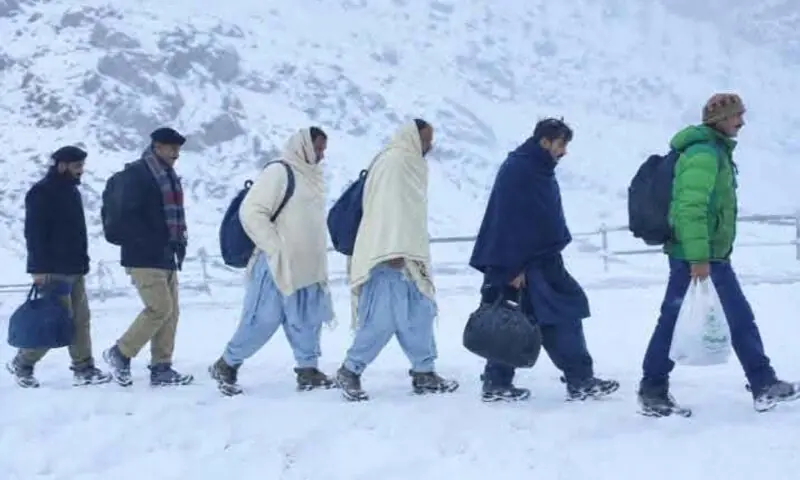
A ground team recovered the body of deceased Pakistani climber Asma Mushtaq from Gilgit-Baltistan’s Spantik Peak on Monday, almost 10 days after her death on the 7,027-metre-tall mountain.
asserted
team → recover → mountain
The 34-year-old climber died on Aug 20 while descending from the mountain after suffering from high-altitude sickness.
Alpine Club of Pakistan (ACP) Secretary General Ayaz Shigri told Dawn that a five-member team, comprising high-altitude mountaineers from Shigar, had initiated a new recovery mission on Friday after earlier attempts remained unsuccessful due to heavy snowfall.
Earlier recovery missions were carried out by a six-member team, and the new team comprised Mehboob, Hussain Ali, Mazahir Hussain, Mehboob Ali, Muhammad Abidin and Abbas Ali, who led the operation, Shigri said.
asserted
Shigri → die → operation
These volunteers were from Arundu in Shigar and carried out the operation as a self-funded mission, he added.
asserted
he → carry → mission
The rescue team began the operation at 3am today and found the body after around eight hours of searching, at around 11am.
asserted
team → begin → am
The team recovered the body near Camp 3 of the peak, which is located at a height of approximately 6,250 metres, Shigri said.
asserted
Shigri → recover → metres
He added that the body would be brought back to Camp 2 today and Pakistan Army helicopters were expected to airlift Mushtaq’s body to Skardu after its arrival at the base camp later.
asserted
helicopters → add → camp
Shigri had told Dawn the day that Mushtaq died that she was part of a five-member Pakistani women’s expedition team that summited Spantik, which included climbers Zoni Aslam, Zaba Shigri, Shama and Sohana.
asserted
which → tell → climbers
The mountaineer had successfully reached the 7,027m summit of Spantik and was in good health at the time, the ACP said in statements issued on Thursday.
asserted
ACP → reach → Thursday
However, she developed a serious high-altitude medical emergency at an elevation of about 6,400m during her descent.
asserted
she → develop → descent
High-altitude sickness encompasses a range of pulmonary and cerebral conditions caused by hypoxia, or oxygen deprivation, due to rapid ascent and inadequate acclimatisation to high altitudes.
asserted
sickness → encompass → altitudes
Climate change-induced shifts in weather patterns have worsened conditions on the peaks of the Karakoram Range in GB, creating serious difficulties for mountaineers.
asserted
shifts → induce → mountaineers
Experts have also pointed out that bringing a body down from a high-altitude peak, particularly from above 6,000m, is an extremely risky and challenging task.
asserted
bringing → point → m
In many cases, bodies at such extreme altitudes are left and buried under the snow rather than being brought down.
asserted
bodies → leave → snow
Sajid Sadpara buried the body of his father, renowned Pakistani mountaineer Ali Sadpara, at around 8,000m on K2 in 2021.
asserted
Sadpara → bury → 2021
 The Aporia