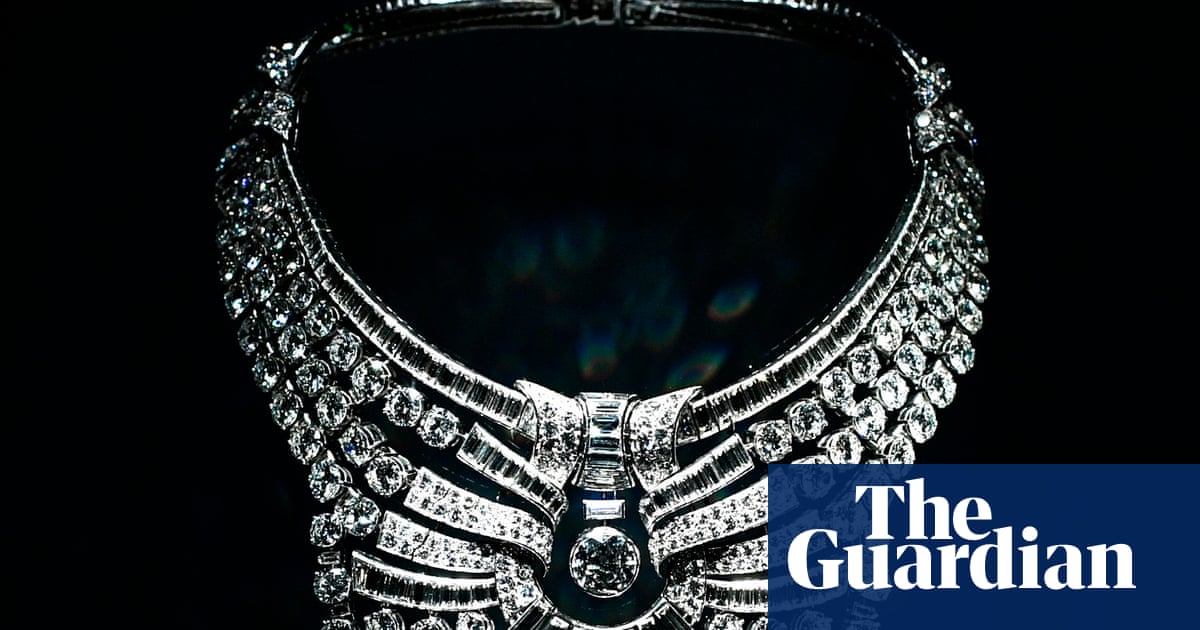
Egyptian queen’s 673-diamond necklace stolen in Vienna smash-and-grab raid

Read the original at The Guardian ↗
Cite

Berlin, D. C. i. (2026, August 31). Egyptian queen’s 673-diamond necklace stolen in Vienna smash-and-grab raid. The Guardian. https://www.theguardian.com/artanddesign/2026/aug/28/egyptian-queen-diamond-necklace-stolen-vienna-raid

Dated when The Aporia collected the article, usually within hours of publication. Check the original for its exact date and byline.

The Guardian · collected 2026-08-31 · by Deborah Cole in Berlin

Quick Summary

Two men are alleged to have stolen a 200-carat platinum necklace encrusted with 673 diamonds from the Museum of Applied Arts in Vienna on Thursday afternoon during opening hours. The necklace, which once belonged to Egyptian Queen Consort Nazli, was on loan to the museum and was valued at $4.3m after being sold by Sotheby's in New York in 2015. Austrian police released pictures of the suspects and are searching for them with the help of a tracking dog. This is one of several high-profile thefts from European museums in recent months, including a string of smash-and-grab raids across Europe that have become increasingly violent.
Written locally by qwen2.5:14b on 2026-08-31, using this article's own text rather than the other coverage of the same event (that is the story summary below).

AI analysis runs on qwen2.5:14b, locally

Story summary

Two men, allegedly working for a criminal gang, stole a 200-carat platinum necklace with 673 diamonds from the Museum of Applied Arts (MAK) in Vienna on Thursday afternoon. The necklace, which once belonged to Egyptian royalty, was on loan to the museum and had been part of an exhibition featuring the work of French designers Van Cleef & Arpels since June. The thieves, who bought tickets to the exhibition, smashed a glass display case with a hammer during opening hours before fleeing with the necklace. No one was hurt in the heist, but police have released pictures of the suspects captured by security cameras and are searching for them in the city centre. This is the latest in a string of high-profile thefts from European cultural institutions, including a €88m heist at the Louvre museum in Paris last October and a raid on the Treasure of Villena in Spain earlier this week.

Written for “Egyptian Queen's Necklace Stolen” on 2026-10-16, grounded in this article and the 0 other(s) covering the same event.

Story

📰 Egyptian Queen's Necklace Stolen
Crime & Law · 1 article(s) covering the same event.

Compared with similar articles

Nothing to compare against. No article is close enough to this one for the pipeline to have linked or judged the pair.
How this article was measured signals, leaning charts, publisher record, byline, topics and claims

Signals How these are calculated →

Claims extracted
15
sentences that state something as happening or true
Uncertain
0%
0 of 15 hedged ("reportedly", "may", "according to")
Leaning
not political
takes no side on a contested political question
Publisher signals
67/100
The Guardian's corrections and hedging, across everything collected from it. Not a measure of accuracy.
Outlets on this story
1
Crime & Law
Same framing elsewhere
1
articles that frame the event the way this one does
Analyzed 2026-08-31 · how these are computed

How this is being covered How these are calculated →

Article leaning vs. publisher reliability
Source leaning vs. consistency

Publisher

The Guardian · 1962 article(s) · 5 correction(s) detected
Running correction rate · 5 correction(s)

Who wrote this

Deborah Cole in Berlin
3 article(s) here · 0 carrying a prediction
🔮 But he said he would remain chancellor and party chair and continue a reform drive on fronts including taxes, healthcare, pensions and reducing bureaucracy.
🔮 Coming two weeks after a seismic election in Saxony-Anhalt in which the anti-immigration, pro-Kremlin Alternative für Deutschland (AfD) scored its highest ever result in a regional poll, the nativist party is expected to drain support again from Merz’s conservative Christian Democratic Union (CDU).
Also by Deborah Cole in Berlin
Nothing else under this byline is closely related to this article, so these are simply their most recent.

Topics

Austrian European French MAK Van Cleef & Arpels

Subjects

European NORP · 3× MAK ORG · 3× French NORP · 2× Van Cleef & Arpels ORG · 2× Austrian NORP · 1× Egyptian NORP · 1× Kronen ORG · 1× Nazli PERSON · 1× Vienna GPE · 1× the Museum of Applied Arts ORG · 1×

Narrative

European museums have been hit by a string of high-profile heists since thieves broke into the Louvre museum in Paris during the day last October and escaped within minutes with crown jewels worth €88m. In Spain on Thursday, thieves raided the Treasure of Villena, a collection of bronze age gold artefacts described as one of Europe’s most important prehistoric hoards.
framing: assertive · carried by 1 article(s) · first seen 2026-08-31

Claims (15 extracted, 0 hedged)

Austrian police are hunting two men alleged to have stolen a 200-carat platinum necklace encrusted with 673 diamonds that was on loan to a museum in Vienna and once belonged to Egyptian royalty. asserted
that → hunt → royalty
Authorities in the capital released pictures of the suspects captured by security cameras during the heist at the Museum of Applied Arts (MAK), amid a rash of spectacular smash-and-grab thefts from European cultural institutions. asserted
Authorities → release → institutions
The unmasked men bought tickets to the exhibition before shattering a glass display case with a hammer during opening hours on Thursday afternoon and making off with the diamond necklace. asserted
men → buy → necklace
In an appeal for information from the public, police said: “The perpetrators fled with the jewellery in an unknown direction.” asserted
perpetrators → say → direction
Officers fanned out through the city centre and deployed a police tracking dog to search for the suspects. asserted
Officers → fan → suspects
The Kronen newspaper said investigators believed the men were probably carrying out a “contract job” on behalf of a criminal gang. asserted
men → say → gang
MAK said the piece had been snatched from a jewellery exhibition that had been on display since June, featuring more than 300 works by the French designers Van Cleef & Arpels. asserted
that → say → designers
No one was hurt, although there were several witnesses in the room at the time. asserted
one → hurt → time
Documentation for the show said the necklace once belonged to Queen Consort Nazli of Egypt, who wore it at the 1939 wedding of her daughter Fawzia to Iran’s then crown prince, Mohammad Reza Pahlavi, who later became shah. asserted
who → say → prince
The necklace was sold by Sotheby’s in New York in 2015 for $4.3m. The MAK said the exhibition brought together about 200 “unique and rarely seen objects” from its own collection and pieces spanning the 120-year history of the Parisian jewellery house, from the Van Cleef & Arpels patrimonial collection. asserted
exhibition → sell → collection
A guided tour planned for Friday afternoon was listed as “cancelled” on the museum website and the exhibition, which was due to end on 27 September, was temporarily closed. asserted
which → guide → September
European museums have been hit by a string of high-profile heists since thieves broke into the Louvre museum in Paris during the day last October and escaped within minutes with crown jewels worth €88m. In Spain on Thursday, thieves raided the Treasure of Villena, a collection of bronze age gold artefacts described as one of Europe’s most important prehistoric hoards. asserted
thieves → hit → hoards
This month, four of the most important works by the 15th-century Renaissance master Antonello da Messina were stolen during a national holiday from a museum in the Sicilian port city of Messina. asserted
four → steal → Messina
Two days earlier, Italian police said they had recovered three paintings by the French masters Paul Cézanne, Pierre-Auguste Renoir and Henri Matisse that were taken this year from a private museum near the northern city of Parma. asserted
that → say → Parma
A report by Europol this month found that robberies at European museums are becoming increasingly violent, with thieves sometimes brandishing guns, assaulting staff and using sledgehammers, axes and even explosives to smash their way to targeted loot. asserted
thieves → find → loot

💬Give feedback
🕘History 🎫Support