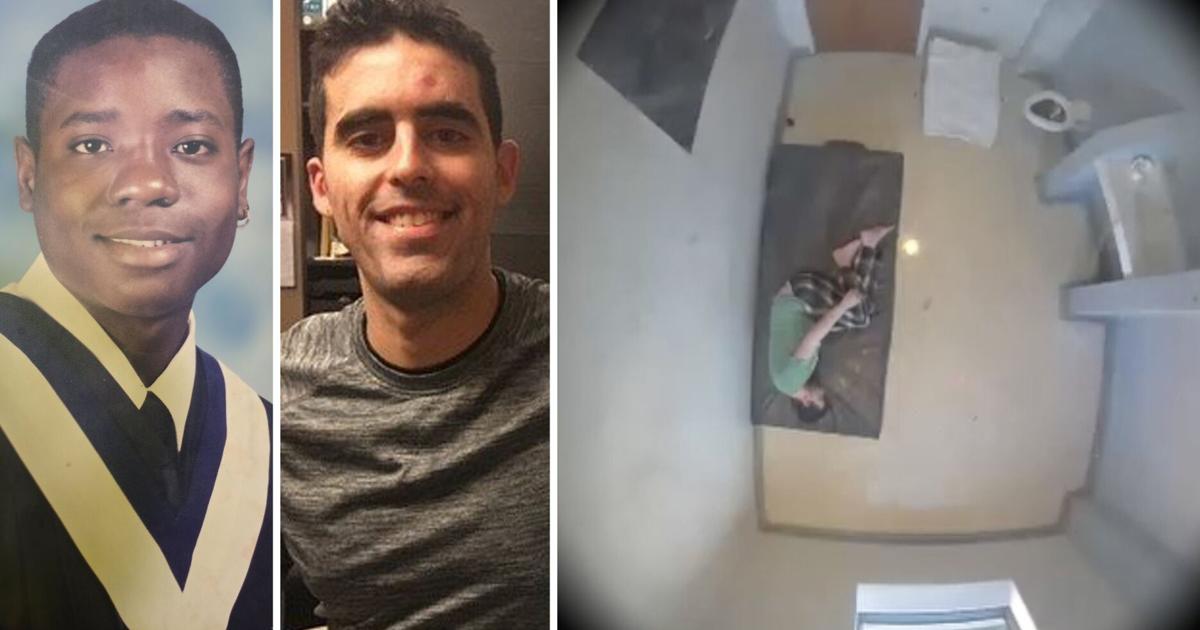
An independent oversight body has delivered a clear message to Ontario’s only maximum-security psychiatric hospital when it comes to keeping patients in long-term isolation: It’s time you started following your own policies.
asserted
you → deliver → policies
In a unanimous 33-page decision released last week, a five-member panel of the Ontario Review Board (ORB) provided its detailed reasons for why it ordered Waypoint Centre for Mental Health Care in Penetanguishene to implement measures to reduce the time that patient Andrew Azevedo spends in seclusion.
asserted
it → release → seclusion
Azevedo, a 39-year-old man with treatment-resistant schizophrenia, has spent much of the last five years locked in his room alone due to what the hospital describes as aggressive behaviour caused by his hallucinations — a “troubling duration,” the board said.
asserted
board → spend → hallucinations
The ORB had issued its orders earlier this month in a document called a disposition, in which it officially recognized that seclusion is harmful.
asserted
seclusion → issue → which
It mandated that Waypoint improve its staff training, ensure that Azevedo gets a minimum amount of time out of his room on seclusion relief, that he be assessed in person daily before the hospital decides if his seclusion should be maintained, and that there be weekly communication between his treatment team and family.
asserted
seclusion → mandate → team
“Essentially, for Mr. Azevedo’s disposition to maximize his potential for personal liberty while subject to detention at Waypoint, the panel is directing Waypoint’s treatment of him to be in compliance with its own policies,” says last week’s reasons written by panel member Eric Siebenmorgen, a retired Crown counsel.
asserted
reasons → maximize → Siebenmorgen
Siebenmorgen returned to the need for Waypoint to follow its own policies repeatedly in the decision.
asserted
Waypoint → return → decision
He said the panel was “indebted” to corrections expert Andrea Monteiro, who prepared an independent assessment of Azevedo’s case; without her thorough work, it would have been “extremely difficult” for the board to provide proper oversight of Azevedo’s seclusion experience due to what Siebenmorgen described as incomplete and inaccurate information compiled by Waypoint.
asserted
Siebenmorgen → say → Waypoint
It’s important that the board gets accurate information about Azevedo’s experience, given “the significant deprivation of liberty, and associated potential negative impacts” on him, Siebenmorgen wrote.
asserted
Siebenmorgen → ’ → him
Azevedo was profiled in the Star in April as part of its investigation into the use of long-term seclusion at Waypoint, a practice described by experts as “excessive,” akin to torture, and unlike anything seen in other North American hospitals.
asserted
Azevedo → profile → hospitals
Waypoint’s own policy stipulates that seclusion be only used as a last resort — and for as brief a time as possible — when dealing with a patient who poses an imminent risk of bodily harm to themselves or others, but the Star’s investigation has revealed that Waypoint is keeping patients secluded for years, including Camelott Hamblett, who has been locked in his room for 20 years and counting.
asserted
who → stipulate → years
Monteiro concluded that Waypoint is using seclusion to pre-emptively manage a patient who might become violent later, a practice she said is now prohibited in many prisons.
uncertain
she → conclude → prisons
The ORB panel said it couldn’t make a finding about that because Azevedo’s psychiatrist, Dr. Achal Mishra, wasn’t asked about it during Azevedo’s hearing before the board last month.
asserted
psychiatrist → say → board
But the panel said they hope their orders ensure that seclusion at Waypoint remains an exceptional measure “and does not become a long-term or ‘default’ risk management strategy.”
asserted
seclusion → say → Waypoint
Azevedo remains detained after being found unfit to stand trial for allegedly assaulting a psychiatrist.
uncertain
Azevedo → remain → psychiatrist
The ORB, made up of retired judges, lawyers, doctors, and laypersons, is responsible for deciding annually whether a person found unfit to stand trial or not criminally responsible should remain detained in hospital or be released, and under what conditions.
asserted
person → make → conditions
The Star’s investigation has also focused on whether the board should have done more to help get patients out of long-term seclusion, given that it’s also supposed to supervise the treatment and living conditions of patients under its jurisdiction.
asserted
it → focus → jurisdiction
For years, panels of the board maintained the detention of accused persons — including Azevedo — while making but a passing reference to their seclusion status, with no recommendations to get them out.
asserted
panels → maintain → them
Azevedo’s lawyer, Anita Szigeti, described last week’s comprehensive ORB decision as a “watershed” moment that could have a positive ripple effect on other patients in long-term seclusion at Waypoint.
uncertain
that → describe → Waypoint
“You can feel the winds of change,” she said.
asserted
she → feel → change
While other panels won’t be bound by the Azevedo panel’s decision, Szigeti said the decision is nevertheless persuasive.
asserted
decision → bind → decision
“The next panel can take some comfort in the fact that this hearing panel has expressly recognized that the board plays an oversight role with respect to the conditions, the length, and the experience of seclusion,” she said.
asserted
she → take → seclusion
Indeed, as Siebenmorgen wrote, just because the board was ordering that Azevedo remain detained at Waypoint — as agreed to by all parties — that “does not absolve the board of its responsibility to order conditions of his detention that seek to maximize his liberty while still protecting the public, including staff and other patients in the hospital.”
The panel also included lawyer and chairperson Janette Mills, psychiatrist Padraig Darby, psychologist Gjylena Nexhipi, and community member Cathy Plyley, a social service worker.
asserted
panel → write → Mills
‘It didn’t have to be this way,’ family says
Ultimately, the ORB can only make orders with respect to the patient before them.
asserted
ORB → have → them
And it has no jurisdiction over Waypoint patients who have not been accused of any crimes, such as 31-year-old Jake Gordon, a man with schizophrenia involuntarily admitted under the Mental Health Act.
asserted
who → have → Act
Gordon, who was profiled in the Star this month, also spent five years in seclusion.
asserted
who → profile → seclusion
Six hours of video footage from last year shows him living in a small, sparse room with little to do.
asserted
him → show → little
He can be seen napping, eating and pacing, only occasionally interacting with staff at his doorway.
asserted
He → see → doorway
Szigeti reiterated her call for an independent and public review of the use of seclusion at Waypoint.
asserted
Szigeti → reiterate → Waypoint
“People really need to care about what’s going on,” she said.
asserted
she → need → ?
Waypoint, which had urged the board not to issue any orders, has the option of appealing the Azevedo decision to the Ontario Court of Appeal; the hospital says it is reviewing the board’s reasons.
asserted
it → urge → reasons
“Waypoint remains committed to our shared priorities with the ORB to deliver quality patient care while protecting public safety,” said CEO Dr. Nadiya Sunderji.
asserted
Sunderji → remain → safety
Azevedo is already on the cusp of being released from seclusion due to a significant improvement in his behaviour over the last few months that his psychiatrist attributes entirely to medication adjustments, while his family and Szigeti point to the heightened level of care and supports provided to him by the hospital in the wake of the Star’s coverage.
asserted
family → release → coverage
Azevedo’s sister-in-law, Susan, said he is “forever changed” by being in seclusion for so long, and the family can’t help but wonder what his life would have looked like had he received the kind of care he’s getting now.
asserted
he → say → care
“It didn’t have to be this way,” she said.
asserted
she → have → ?
She said the family is grateful for the board’s decision.
asserted
family → say → decision
Azevedo is doing well and is currently allowed out of his room for six hours a day with staff, as the hospital gradually releases him from seclusion, Susan said.
asserted
Susan → do → seclusion
“We know Andrew has a lifelong illness, and we will spend our lives advocating for him,” she said.
asserted
she → know → him
“Being sick, having this severe level of schizophrenia, shouldn’t be a sentence to seclusion for the rest of your life with no treatment.”
asserted
Being → have → treatment
The ORB panel said it felt it was “necessary and appropriate” to issue orders to “safeguard Mr. Azevedo’s liberty interests” should his condition deteriorate and should he be once again placed in seclusion.
asserted
he → say → seclusion
…and 13 more, not listed.
 The Aporia