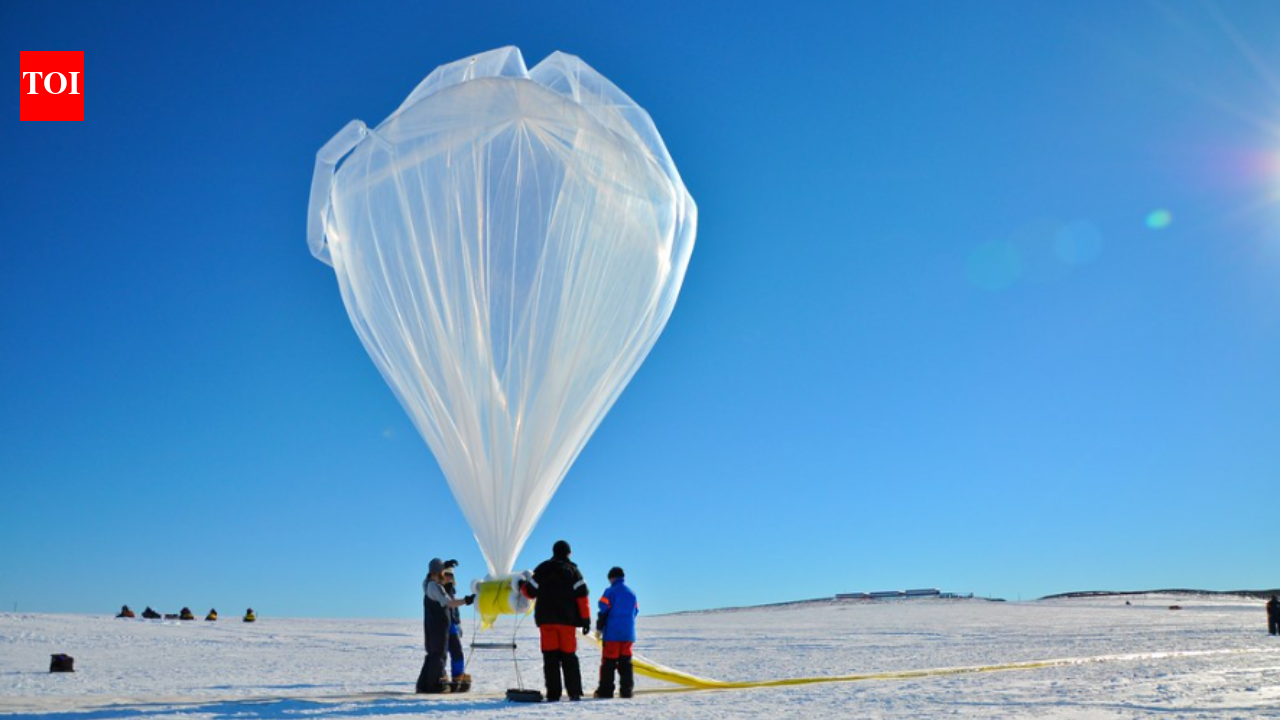
Nasa sent 20 balloons over Antarctica in 2013 to track particles from space

World News, Today World News, Latest International News, World Breaking News, Trending News of World - Times of India · collected 2026-08-28 · by TOI Science Desk
Read the original at World News, Today World News, Latest International News, World Breaking News, Trending News of World - Times of India ↗

Summary

In January 2013, NASA launched 20 large balloons over Antarctica as part of the BARREL mission to track X-rays produced by energetic particles entering Earth's upper atmosphere. The experiment aimed to understand how particles are trapped and released from the Van Allen radiation belts surrounding the planet. The balloons were released at intervals of a day or two, with some staying aloft for up to 40 days, as they drifted through polar winds while carrying instruments capable of detecting X-rays. This unusual pairing allowed scientists to study both ends of the particle process: movement through near-Earth space and interaction with the atmosphere.
Written by the local model on 2026-08-28, using this article's own text rather than the other coverage of the same event (that is the story summary below).

Signals How these are calculated →

Claims extracted
52
claim-shaped sentences
Uncertain
17%
9 of 52 hedged
Leaning
not political
takes no side on a contested political question
Publisher trust
94.0
red-flag proxy, not a credibility rating
Outlets on this story
1
Science
Narrative spread
1
articles carrying this framing
Analyzed 2026-08-28 · how these are computed

AI analysis (generated at analysis time, not now)

Story summary

In January 2013, NASA's BARREL mission sent 20 balloons drifting through the polar winds over Antarctica to track particles from space. The balloons carried instruments designed to detect faint X-rays produced when energetic particles entered Earth's upper atmosphere, and their measurements were matched with observations from NASA's Van Allen Probes, which were traveling through the radiation belts themselves. This unusual pairing allowed scientists to examine both ends of the same process: particles moving through near-Earth space and the traces they left behind when they reached the atmosphere. The experiment was part of a larger effort to understand what happens inside the Van Allen radiation belts**, where charged particles can become trapped by Earth's magnetic field and later escape towards the poles.

Written for “Antarctic Particle Research Mission” on 2026-08-31, grounded in this article and the 0 other(s) covering the same event.
Why this leaning score
This article does not take a side on a contested political question, so it has no leaning score. That is an answer rather than a gap: a match report or a rescue can be warmly or critically written without being left or right, and scoring it anyway is how approval of a subject gets recorded as a political position.
No political leaning scored for article 3108 · logged 2026-08-28

Story

📰 Antarctic Particle Research Mission
Science · 1 article(s) covering the same event. This is the one the site leads with.

How this is being covered How these are calculated →

Article leaning vs. publisher reliability
Source leaning vs. consistency

Compared with similar articles

Nothing to compare against. No article is close enough to this one for the pipeline to have linked or judged the pair.

Publisher

World News, Today World News, Latest International News, World Breaking News, Trending News of World - Times of India · 97 article(s) · 0 correction(s) detected
SignalValueWeight
Correction rate 0.000 0.4
Uncertainty density 0.121 0.25
Assertive mismatch rate 0.000 0.35
No corrections detected for this publisher. That may mean careful reporting, or simply that nothing has been checked.

Who wrote this

TOI Science Desk
19 article(s) here · 1 carrying a prediction
🔮 A surface may be able to radiate heat towards the sky, but if it absorbs too much sunlight during the day, the solar heating can cancel much of that benefit.
🔮 High above the ice in Antarctica, a group of enormous balloons was quietly tracking a phenomenon that could not be seen from the ground.
🔮 If the current phase works as expected, the scale will change rapidly.
🔮 What if the rocks beneath our feet could one day be turned into a giant hydrogen factory, not by drilling up an existing fuel reserve, but by sending controlled bursts of electricity deep underground?
🔮 When Apollo 15 astronauts David Scott and James Irwin explored the Moon in 1971, they were looking for rocks that could reveal how the lunar surface formed.
🔮 Air voids replace white pigments The researchers built on earlier work showing that simple polymers such as acrylic, silicone and PET can be effective heat radiators and could be used for PDRC.
🔮 Such regions can be especially important during adaptation because genetic variants introduced through interbreeding may provide useful traits in changing environments.
🔮 Domestic cattle would have indicated contact between Ireland’s Mesolithic communities and Neolithic farming societies elsewhere in Europe.
🔮 A 2023 presentation to the Seismological Society of America described the upper-crustal low-velocity zone as the primary magma reservoir, with estimates suggesting it may contain roughly 10% to 12% partial melt.
🔮 Water vapour in the stratosphere can affect how the atmosphere handles radiation, so adding such a large amount was never expected to be climatically neutral.
Wire or desk byline, not an individual reporter.
Also by TOI Science Desk
In 2022, MIT researchers built a 4-inch cooler that kept food fresh without electricity
2026-08-28 · World News, Today World News, Latest International News, World Breaking News, Trending News of World - Times of India
Scientists turn wood waste into foam that replaces plastic and decomposes in soil within months
2026-08-28 · World News, Today World News, Latest International News, World Breaking News, Trending News of World - Times of India
In 2025, a US startup used ‘underground lightning’ to crack rock and unlock hydrogen
2026-08-27 · World News, Today World News, Latest International News, World Breaking News, Trending News of World - Times of India
Apollo 15’s Genesis Rock, found in 1971, revealed a piece of the Moon’s 4-billion-year-old crust
2026-08-27 · World News, Today World News, Latest International News, World Breaking News, Trending News of World - Times of India
Nothing else under this byline is closely related to this article, so these are simply their most recent.
All 19 articles by TOI Science Desk →

Topics

BARREL Nasa South African National Antarctic Expedition

Subjects

Nasa ORG · 6× BARREL ORG · 1× South African National Antarctic Expedition ORG · 1×

Narrative

The experiment was part of a much larger effort to understand what happens inside the Van Allen radiation belts, where charged particles can become trapped by Earth's magnetic field and later escape towards the poles.
framing: assertive · carried by 1 article(s) · first seen 2026-08-28
🔮 High above the ice in Antarctica, a group of enormous balloons was quietly tracking a phenomenon that could not be seen from the ground.
2026-08-28 · World News, Today World News, Latest International News, World Breaking News, Trending News of World - Times of India
Nasa sent 20 balloons over Antarctica in 2013 to track particles from space · assertive framing

Claims (52 extracted, 9 hedged)

High above the ice in Antarctica, a group of enormous balloons was quietly tracking a phenomenon that could not be seen from the ground. uncertain
that → track → ground
In January 2013, Nasa's BARREL mission sent 20 balloons drifting through the polar winds, carrying instruments designed to detect faint X-rays produced when energetic particles entered Earth's upper atmosphere. asserted
particles → send → atmosphere
The experiment was part of a much larger effort to understand what happens inside the Van Allen radiation belts, where charged particles can become trapped by Earth's magnetic field and later escape towards the poles. asserted
particles → understand → poles
As the balloons moved with the winds, their measurements were matched with observations from Nasa's Van Allen Probes, which were travelling through the radiation belts themselves. asserted
which → move → belts
The unusual pairing gave scientists a chance to examine both ends of the same process: particles moving through near-Earth space and the traces they left behind when they reached the atmosphere. asserted
they → give → atmosphere
Nasa’s BARREL mission: How 20 giant balloons were used in 2013 to track X-rays over Antarctica asserted
balloons → use → Antarctica
The first Antarctic BARREL campaign involved 20 balloons. asserted
campaign → involve → balloons
They were released at intervals of roughly a day or two, allowing the team to build up a spread of measurements as the balloons moved with the circumpolar winds. asserted
balloons → release → winds
According to Nasa, when fully inflated, a BARREL balloon was about 90 feet (27 metres) across, while the scientific payload underneath was relatively small. uncertain
payload → accord → Nasa
Each flight carried instruments capable of detecting X-rays generated high in the atmosphere. asserted
flight → carry → atmosphere
The balloons could remain airborne for several days, and some stayed aloft for as long as 40 days. uncertain
some → remain → days
The launch sites included the South African National Antarctic Expedition base at SANAE IV and Halley Research Station. asserted
sites → include → IV
Antarctica offered a useful vantage point because Earth's magnetic field guides charged particles towards the polar regions. asserted
field → offer → regions
That made the continent a practical place to watch radiation belt particles arriving in the atmosphere. asserted
continent → make → atmosphere
PC: Nasa How scientists tracked particles escaping Earth’s radiation belts The balloons were not primarily studying Antarctica or its atmosphere. asserted
balloons → track → Antarctica
Earth is surrounded by the Van Allen radiation belts, regions containing energetic charged particles held in place by the planet's magnetic field. asserted
Earth → surround → field
The population of these particles changes as conditions in near-Earth space respond to activity from the Sun. asserted
conditions → change → Sun
During periods of disturbance, the radiation environment around Earth can become more hazardous for spacecraft. asserted
environment → become → spacecraft
Particles do not simply remain trapped in the belts. asserted
Particles → remain → belts
Some are scattered out and travel along Earth's magnetic field lines towards the atmosphere. asserted
Some → scatter → atmosphere
Understanding how quickly this happens, and under what conditions, helps scientists build a clearer picture of how the belts gain and lose energetic particles. asserted
belts → understand → particles
Why scientists looked for X-rays in the atmosphere An energetic electron falling into the atmosphere does not arrive unnoticed. asserted
electron → look → atmosphere
When these particles collide with atoms and molecules, they can produce X-rays. asserted
they → collide → rays
BARREL's instruments were built to detect that radiation. asserted
instruments → build → radiation
This gave scientists an indirect way of counting and studying particles that had escaped the radiation belts. asserted
that → give → belts
Instead of trying to follow every electron individually, the balloons measured the X-ray signature produced when populations of energetic electrons reached the atmosphere. asserted
populations → try → atmosphere
The balloons were effectively watching the consequences of particle loss while another spacecraft was measuring conditions inside the radiation belts themselves. asserted
spacecraft → watch → belts
How scientists tracked particles from space to the atmosphere Reportedly, BARREL was designed to work with Nasa's Van Allen Probes, two spacecraft launched in 2012 to travel through the radiation belts. uncertain
BARREL → track → belts
The satellites could measure the particles, fields and waves present in the belts, while the balloons observed the particles that had already begun making their way into the atmosphere. uncertain
that → measure → atmosphere
When observations from the two missions overlapped, scientists could compare the conditions in space with the resulting precipitation into the atmosphere. uncertain
scientists → overlap → atmosphere
This was particularly useful during periods of geomagnetic activity, when the behaviour of the radiation belts could change. uncertain
behaviour → change → belts
The aim was not simply to collect two separate sets of measurements. asserted
aim → collect → measurements
By putting the observations together, the researchers could investigate whether changes seen inside the belts matched increases or decreases in the particles reaching the atmosphere. uncertain
changes → put → atmosphere
The magnetic pathways that made the poles important The choice of polar regions was tied to Earth's magnetic field. asserted
choice → make → field
Its field lines extend towards the northern and southern magnetic regions, providing pathways along which charged particles can move into the upper atmosphere. asserted
particles → extend → atmosphere
That is why the broader BARREL mission eventually operated in both hemispheres. asserted
mission → operate → hemispheres
The first campaigns, however, were conducted in Antarctica in 2013 and 2014. asserted
campaigns → conduct → 2013
Later campaigns included balloon flights from Sweden, above the Arctic Circle. asserted
campaigns → include → Circle
Nasa describes the mission as studying X-rays in Earth's atmosphere near both the North and South Poles. asserted
Nasa → describe → Poles
So the description of BARREL as a polar balloon experiment covers the mission as a whole, rather than meaning that the original January 2013 flights took place at both poles. asserted
flights → cover → poles
…and 12 more, not listed.

💬 Give feedback
🕘 History 🎫 Support