- Published
Documents that set out Fifa's plan to part-privatise the World Cup and seen by the BBC show why the deal may have fallen apart.
uncertain
deal → publish → BBC
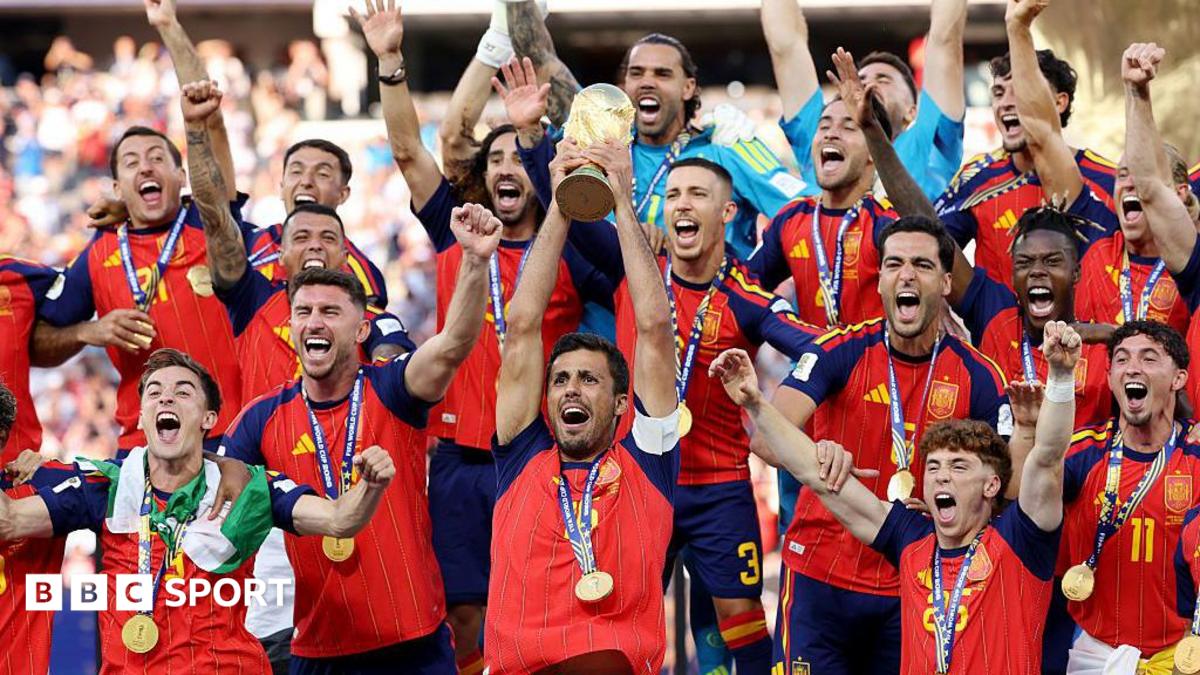
The sales pitch was circulated to Fifa members this week, setting out the case for Gianni Infantino's controversial plan featuring pictures of the Spain team lifting the trophy and Argentina's fans.
asserted
team → circulate → trophy
The 25-page deck of slides painted a picture of American football-level revenue expectations, which pointed to a potential continuation and extension of the controversial 2026 US-influenced World Cup model.
asserted
which → paint → model
It suggested there was the potential for $1,000+ tickets, dynamic pricing, and pressure to put broadcasting of the world's biggest sports tournament behind a paywall.
uncertain
It → suggest → paywall
The documents make it clear that the plan and Fifa's arguments never really stacked up.
asserted
plan → make → ?
In the slides, Fifa's central argument was that football does not raise enough cash in relation to its fan base, that "Fifa has been under-monetised versus other leagues" and so "global football development gets squeezed".
asserted
development → raise → leagues
It did this with reference to a comparative chart showing annual revenue as well as revenue per fan for Fifa, the Uefa Champions League, Premier League, US baseball and NFL American football.
asserted
It → do → Fifa
On the face of it, Fifa is the poorer cousin at just $1 per global fan, compared to NFL's $52.80.
asserted
Fifa → compare → 52.80
The World Cup is not an annual competition - it happens once every four years.
asserted
it → happen → ?
If instead this was done on revenue per World Cup 2026 match, Fifa makes multiples of the Premier League, perhaps more than three times as much.
asserted
Fifa → do → League
As important, football is decentralised globally, so more of the revenues go to individual leagues, such as the Premier League or Champions League.
asserted
more → decentralise → League
Fifa was effectively arguing it wanted to keep more of that overall football pie.
asserted
it → argue → pie
Football's fans are also spread across the globe, in rich and poor countries alike.
asserted
fans → spread → countries
NFL has a much smaller base concentrated in the US and is pretty much the whole of American Football.
asserted
NFL → have → Football
Finally, about half of NFL's revenues are paid out as wages.
asserted
half → pay → wages
Fifa does not pay Erling Haaland or Lionel Messi or Vozinha.
asserted
Fifa → pay → Haaland
Profits would have yielded a rather different result than the chart’s focus on revenues.
asserted
Profits → yield → revenues
According to the document, the new partly privatised entity, called Fifa Forward Enterprise (FFE), would have become the "organiser and operator of competitions" - i.e. the World Cup - and would be responsible for ticketing, broadcast, licensing and sponsorship.
uncertain
entity → accord → ticketing
That would have been a clear transfer of the organising power from a non-profit answerable to all of world football to a privately backed company, albeit one with majority of Fifa board members.
asserted
That → back → members
The slides said that the FFE structure would "expand and optimise media rights monetisation" and "maximise the value of Fifa IP [Intellectual Property], which has been undermonetised, historically".
asserted
which → say → IP
As Fifa highlighted the revenue per fan of the NFL in the document, it raised questions about a future of free-to-air World Cup games.
asserted
it → highlight → games
This is protected by legislation in the UK and Europe, but digital rights will alter considerably in the coming years.
asserted
rights → protect → years
It could also clearly have underpinned the continuation of the extraordinary ticket prices charged in 2026.
3.
uncertain
It → underpin → 3
Why was Fifa trying to sell a $4.2bn (£3.1bn; €3.6bn) stake?
asserted
Fifa → try → stake
Fifa had already said that it would give FFE a 20% stake in the organisation, which would raise an initial $4.2bn.
asserted
which → say → 4.2bn
The document made it clear that initial cash injection would fund the $20m "extraordinary distribution" to each of the 211 member associations.
asserted
injection → make → associations
That explained the $4.2bn funding requirement.
asserted
That → explain → requirement
Essentially, the funding would have been used to provide a $20m one-off payment for infrastructure to every voting association that would have made the decision on Infantino's plan.
asserted
that → use → plan
It would have meant, for example, giving Montserrat a sum worth just under half its entire economy or $10,000 per person, and the same for, say, Bangladesh, a massive highly-populated growth market for global football development.
asserted
It → mean → development
Where would the extra money for investment in Fifa's future been, given the new investment would have been immediately distributed to voting members?
asserted
investment → give → members
How much would actually have been paid back to Fifa as an "annual license payment" referred to in a flow diagram in the charts, but not quantified?
asserted
much → pay → charts
Would that have been fixed or proportionate to revenues?
asserted
that → fix → revenues
Did FFE have a mission to maximise revenues at all costs to provide returns for the investors?
asserted
FFE → have → investors
None of these crucial questions were answered by the document.
asserted
None → answer → document
The private timetable shared in the document said that investors would be given access to the materials starting this month.
asserted
investors → share → materials
Terms would have been confirmed by September, and bids and transfer of funds by the end of October.
asserted
Terms → confirm → October
This showed how advanced the plans were, and the speed with which members were being asked to decide.
asserted
members → show → which
The lead investors were publicly been named as Thrive Eternal, run by Joshua Kushner, the brother of US President Donald Trump's son-in-law Jared.
asserted
investors → name → law
Thrive was almost entirely concerned with AI investments, with OpenAI taking a stake in one of its arms.
asserted
OpenAI → concern → arms
Thrive only began its sports investment arm in April, with an investment in the San Francisco Giants baseball team, which was the pioneer in sport-based dynamic pricing of tickets.
asserted
which → begin → tickets
…and 48 more, not listed.
 The Aporia