The government on Thursday hinted at introducing a uniform average gas price for all consumers, replacing the existing slab-based pricing system for different categories that involves cross-subsidies and budgetary subsidies.
asserted
that → hint → subsidies
The average prescribed gas price, determined by the Oil and Gas Regulatory Authority (Ogra) based on the revenue requirements of gas companies, currently stands at around Rs1,700 per million British thermal units (mmBtu).
asserted
price → determine → units
However, gas is sold to consumers at different rates, ranging from Rs500 to Rs4,300 per mmBtu as consumption rises.
asserted
consumption → sell → mmBtu
The regulator and the International Monetary Fund have asked the government to eliminate subsidies, recover the true cost of gas supply from all consumers and provide direct subsidies where necessary.
asserted
regulator → ask → subsidies
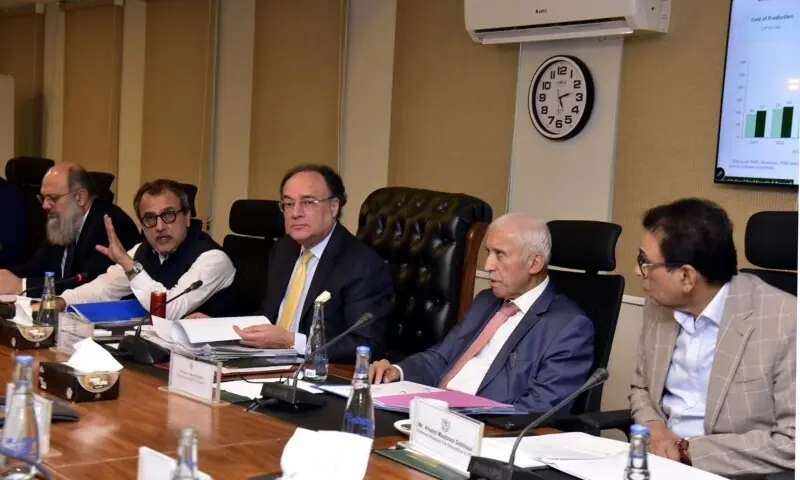
On Thursday, the matter came under discussion as Petroleum Minister Ali Pervaiz Malik met with the Sui Southern Gas Company’s (SSGC) board of directors.
“The existing system of gas subsidies via pricing slabs needs to be revisited,” the minister was quoted as saying in an official statement.
“He emphasised the need to transition to a single, fair gas price for all consumers, while vulnerable segments be protected through targeted social protection programmes.
asserted
segments → come → programmes
This transition would spur greater economic activity while quelling migration of customers to alternative fuels,” the statement said.
asserted
statement → spur → fuels
He directed the SSGC board to develop a comprehensive strategy and sustainable business model, with a special focus on controlling unaccounted-for gas (UFG), to transform the company into a financially viable organisation while keeping public service as its foremost priority.
asserted
He → direct → priority
The meeting, which he presided over, also reviewed the company’s performance, key achievements, operational challenges and future reform priorities.
asserted
he → preside → performance
Meanwhile, the SSGCL managing director briefed the minister on the company’s milestones, achievements and challenges.
asserted
director → brief → milestones
The management highlighted a significant improvement in the gas distribution system, with UFG reduced by approximately 57 per cent in volumetric terms.
asserted
UFG → highlight → terms
The meeting was informed that there was no gas loadshedding for K-Electric, industrial consumers and fertiliser plants, while domestic consumers were being provided gas three times a day.
asserted
consumers → inform → gas
Malik highlighted that gas prices had not been increased for the past year, while the accumulation of gas circular debt had nearly been halted, marking important progress towards stabilising the gas sector.
asserted
accumulation → highlight → sector
He said Ogra had determined a reduction in prescribed gas prices, but the government had absorbed the impact, resulting in a reduction of around Rs55 billion in gas circular debt.
asserted
government → say → debt
He urged the SSGC board to formulate a comprehensive business reform strategy focused on making the company self-sustaining, improving operational efficiency, reducing losses and gas theft, strengthening revenue recovery and ensuring better utilisation of resources.
asserted
company → urge → resources
Petroleum Secretary Hamed Yaqoob Sheikh, during the meeting, emphasised that the board operated independently in accordance with the spirit of the State-Owned Enterprises (SOE) Act.
asserted
board → emphasise → Act
He said the board should exercise its mandate and take all necessary measures to improve the efficiency and ensure the long-term sustainability of SSGC.
asserted
board → say → SSGC
The minister said the government was already working with the World Bank on comprehensive gas sector reforms, aimed at addressing structural challenges and creating a more efficient, sustainable and financially viable gas sector.
asserted
government → say → sector
Discussing the situation in Balochistan, the SSGC board welcomed the constitution of a political committee under Deputy Prime Minister and Foreign Minister Ishaq Dar to examine the province’s challenges, describing the initiative as a positive step towards addressing its longstanding issues.
asserted
board → discuss → issues
The minister directed that gas supply issues in Balochistan be addressed on a priority basis, along with technical challenges, infrastructure constraints and gas theft.
asserted
issues → direct → challenges
He stressed the need for sustainable solutions to improve gas availability and service delivery in the province.
asserted
He → stress → province
The minister added that public service must remain the top priority in all operational, financial and strategic decisions, while reforms should be pursued to ensure the company’s long-term sustainability.
asserted
reforms → add → sustainability
 The Aporia