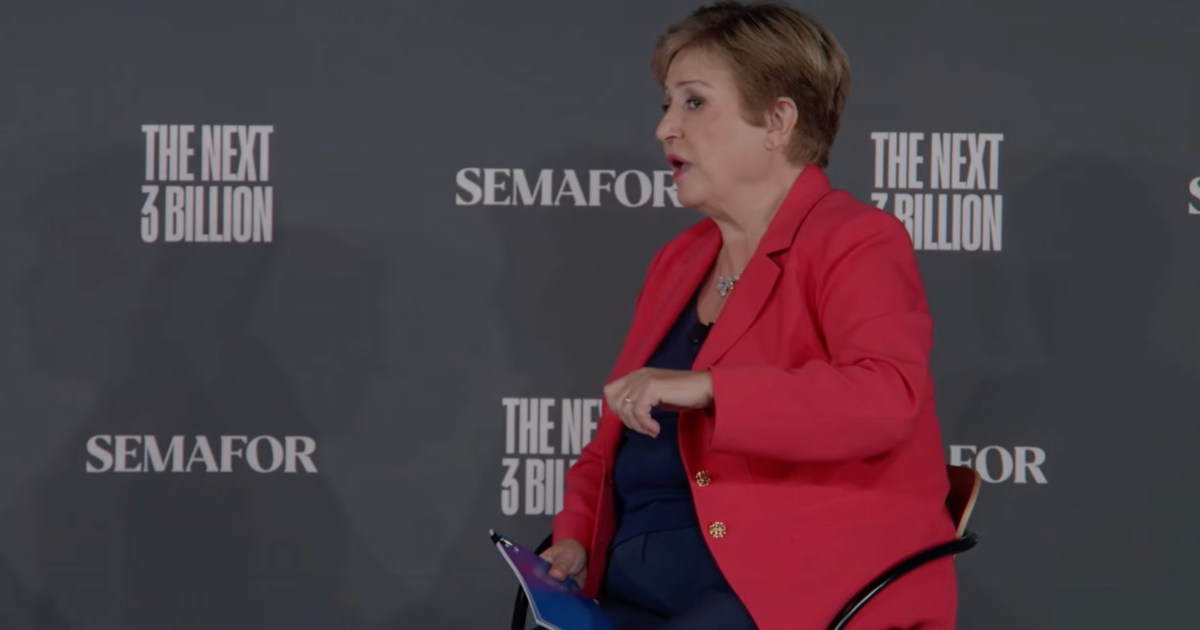
Photo via BBC News

IMF tells advanced economies to 'bring debt down' as borrowing costs rise

Read the original at BBC News ↗
Cite

Race, M., & Islam, F. (2026, September 22). IMF tells advanced economies to 'bring debt down' as borrowing costs rise. BBC News. https://www.bbc.co.uk/news/articles/cx305ymq4ldqo?at_medium=RSS&at_campaign=rss

Dated when The Aporia collected the article, usually within hours of publication. Check the original for its exact date and byline.

BBC News · collected 2026-09-22 · by Michael Race, Faisal Islam

Quick Summary

Kristalina Georgieva, head of the International Monetary Fund (IMF), has warned that advanced economies like the UK and US must reduce their debt levels due to rising government interest costs. She cited global economic shocks such as war-induced oil supply disruptions as driving factors behind increased borrowing costs and higher debt servicing expenses. In August alone, UK borrowing reached £18.3 billion ($24.4 billion), nearly 20% higher than the previous year, with debt interest at a record high since 1997. Georgieva emphasized that while external economic pressures are out of governments' control, they must prioritize fiscal consolidation and ensure central banks maintain price stability.
Written by AI on 2026-09-23, from this article's own text only (the story summary below draws on all the coverage).

AI analysis

Story summary

Kristalina Georgieva, head of the International Monetary Fund (IMF), has warned that advanced economies like the UK and US need to reduce their borrowing and debt levels due to rising government interest costs. She cited global economic shocks from wars disrupting oil supply as factors driving up inflation and borrowing costs. In August, UK government borrowing was £18.3bn ($24.4bn), a 20% increase over the previous year, surpassing official forecasts. Additionally, large tech companies competing for funds to invest in artificial intelligence (AI) development are contributing to higher bond yields. These factors are complicating preparations for UK Prime Minister Andy Burnham's upcoming Budget, where potential tax and spending policies are under speculation.

Written for “Global Debt Concerns” on 2026-11-18, grounded in this article and the 0 other(s) covering the same event.

Compared with similar articles

This article reads leans right and hedges 5% of its claims. Each row says how that neighbour differs.
ABC News (AU)
Leans left further left than this Hedges 5 of 48 claims Outlet record 67/100
“The articles discuss different aspects of economic conditions and policies without describing the same specific incident.”
Daily Mail
Hedges 4 of 38 claims Outlet record 70/100
“While both articles mention warnings from the IMF about debt levels in advanced economies, they describe different aspects and contexts of this broader issue.”
Semafor
Hedges 0 of 9 claims Outlet record 65/100
“The articles discuss related topics concerning inflation and borrowing costs but describe different aspects of IMF head Kristalina Georgieva's warnings without clearly referring to the exact same speech or interview.”

Story

Global Debt Concerns
Economy/Business · 1 article(s) covering the same event.
How this article was measured signals, leaning charts, publisher record, byline, topics and claims

Signals How these are calculated →

Claims extracted
20
sentences that state something as happening or true
Uncertain
5%
1 of 20 hedged ("reportedly", "may", "according to")
Leaning
Leans right
of the writing, not the subject · beta estimate
Publisher signals
65/100
BBC News's corrections and hedging, across everything collected from it. Not a measure of accuracy.
Outlets on this story
1
Economy/Business
Same framing elsewhere
1
articles that frame the event the way this one does
Analyzed 2026-09-23 · how these are computed

How this is being covered How these are calculated →

Article leaning vs. publisher reliability
Source leaning vs. consistency

Publisher

BBC News · 6152 article(s) · 9 correction(s) detected
Running correction rate · 9 correction(s)

Who wrote this

Michael Race
23 article(s) here · 1 carrying a prediction
Dan Coatsworth, head of markets at investment firm AJ Bell, says because Huang was also a key figure in "flying the flag" to drum up enthusiasm and investment for the wider AI industry, his departure posed a "real risk" that Nvidia could now decide to change its current strategy and rein in spending.
Huang had been expected to weather the storm following the revelation of an affair involving Alice Huang, alleged to be a Chinese spy.
This intertwining of companies means that the negative impact being felt by Nvidia, on the stock market for example, could perhaps have wider implications on other companies and the wider economy.
- Published Vinted and eBay could be included in the list of platforms set to be banned for children aged under 16, the culture secretary has said.
- Published The UK may have no involvement in the US-Iran war, but the country is feeling the full force of the conflict on its economy.
The Ukraine steel industry estimates steel exports to the EU could ultimately fall by about 50–60%.
- Published Not building a third runway at Heathrow Airport would be a "huge missed opportunity" for the UK, the boss of the country's busiest airport has warned.
The latest figures show borrowing - the difference between tax receipts and government spending - was £18.3bn ($24.4bn) in August, almost a fifth higher than the year before and higher than official forecasts.
- Published Investment banking giant JP Morgan has said it is struggling to predict how oil prices will be impacted by the US-Iran war, telling investors in a rare note that "we simply don't know how to model the endgame".
- Published US interest rates have been raised for the first time in more than three years and could be increased further in a bid to slow rising prices.
Also by Michael Race
Nothing else under this byline is closely related to this article, so these are simply their most recent.
All 23 articles by Michael Race →
Faisal Islam
21 article(s) here · 1 carrying a prediction
- Published The UK will have a "voice in the room" but no vote on European Union food policies as part of a so-called "Brexit reset" to reduce red tape, EU relations minister Hamish Falconer has told the BBC.
He was, I suggested to him, one of the few people who could walk into the White House to meet Trump, and a few days later meet President Xi Jinping in Beijing.
The Bank will officially confirm the calculation on Thursday.
The government claims the UK economy will eventually see £5.1bn worth of annual benefits.
It might be called the "micro Budget".
It follows a warning earlier this week from Heathrow's chief executive, who said that not building a third runway at the UK's busiest airport would be a "huge missed opportunity".
In the meantime it's a sportsman's bet where the roving eye of the bond markets will focus next.
While this is good news for the chancellor and the Treasury, it also points to the sort of Budget we will get in a fortnight's time.
Asked about the PM's comments, Lescure told the BBC: "British people decided, and that's obviously their 100% right, and if they're willing to come back, they will have to decide." "But what I can tell them is: come back, anytime."
- Published Artificial intelligence (AI) could trigger financial market shocks and the UK needs to be prepared for them, the governor of the Bank of England has warned.
Also by Faisal Islam
Nothing else under this byline is closely related to this article, so these are simply their most recent.
All 21 articles by Faisal Islam →

Topics

Georgieva IMF the International Monetary Fund the United Nations General Assembly

Subjects

Georgieva PERSON · 3× IMF ORG · 3× Andy Burnham PERSON · 1× Kristalina Georgieva PERSON · 1× the International Monetary Fund ORG · 1× the United Nations General Assembly ORG · 1×

Narrative

Concerns over inflation eating away at returns has sent the interest rates on bonds - known as yields - higher in recent months. But there are other factors pushing yields up, including increasing competition in the bond market from large tech companies looking to raise huge amounts of money to invest in artificial intelligence (AI) development.
framing: assertive · carried by 1 article(s) · first seen 2026-09-23
The latest figures show borrowing - the difference between tax receipts and government spending - was £18.3bn ($24.4bn) in August, almost a fifth higher than the year before and higher than official forecasts.

Claims (20 extracted, 1 hedged)

- Published The world's advanced economies including the UK and US need to cut borrowing and reduce debt levels following weeks of spiralling government interest costs, the head of the International Monetary Fund (IMF) has warned. asserted
head → publish → Fund
In an exclusive interview, Kristalina Georgieva said global economic shocks had been "pushing debt levels up like a staircase not to heaven" but that governments had taken "no action to contain that service cost". "[It's] time to take that action," she said, adding that "courage" was needed by politicians to take the necessary steps. asserted
courage → say → steps
The intervention comes as government borrowing costs have surged in response to wars disrupting the supply of oil, which has fuelled inflation. asserted
which → come → inflation
Higher global borrowing costs have hit the UK government in the run-up to UK Prime Minister Andy Burnham's first Budget next month, with speculation building over potential tax and spending policies. asserted
speculation → hit → policies
The latest figures show borrowing - the difference between tax receipts and government spending - was £18.3bn ($24.4bn) in August, almost a fifth higher than the year before and higher than official forecasts. asserted
borrowing → show → forecasts
Meanwhile debt interest for the month was the highest August figure since monthly records began in 1997. asserted
records → begin → 1997
Higher borrowing costs have also hit the US, the world's largest economy, which has seen its debt pile surpass $40tn. asserted
pile → hit → 40tn
The amount has doubled within the space of a decade, prompting concerns at home and abroad. asserted
amount → double → concerns
On the sidelines of the United Nations General Assembly, Georgieva said the IMF's message to advanced economies was that while there were economic factors occurring outside the control of governments, they did have command over domestic policies. asserted
they → say → policies
"There are these two things that must be done: bring debt levels down, put fiscal consolidation as a priority, and make sure that the central banks deliver on their mandate for price stability," she said. asserted
she → be → stability
"It is impossible to stress strongly enough how critical it is to get the courage to take the steps that are necessary. asserted
that → stress → steps
These are politically tough steps to take, but necessary steps to take." asserted
These → take → ?
Asked specifically about the UK's higher interest costs compared to other major economies, Georgieva said its position was "not very different" from others. asserted
position → ask → others
She pointed to "fairly consistent action" on lowering debt and praised planning and housing reforms, adding that advanced economies "don't have the cash" to boost growth and so had to rely on reforms to encourage the private sector to invest. asserted
economies → point → sector
AI could present 'financial stability risk' Governments around the world raise money by selling bonds - essentially an IOU - and in return pay interest to the investment funds that buy them. uncertain
that → present → them
Concerns over inflation eating away at returns has sent the interest rates on bonds - known as yields - higher in recent months. But there are other factors pushing yields up, including increasing competition in the bond market from large tech companies looking to raise huge amounts of money to invest in artificial intelligence (AI) development. asserted
inflation → eat → development
On AI, Georgieva referenced recent concerns about loss of safe control over such systems as a potential financial stability problem, alongside debt levels. asserted
Georgieva → reference → levels
"If we see more incidents when AI takes [on a] life of its own, then we can be faced with a significant financial stability risk," she said. asserted
she → see → risk
The IMF's managing director repeated the influential body's assessment that the global economy was affected by two forces "pushing in opposite directions" - the energy price shock and investment in AI. asserted
economy → repeat → AI
She said it was important for the low exports of oil and gas from the Gulf "to resume in a durable manner, for the energy supply shock to finally be in the rearview mirror". "That is a very significant step to normalisation," she said, but acknowledged it was yet to happen. asserted
it → say → normalisation

Give feedback · no sign-in needed

No sign-in needed for now. Your note is sent without a name, so it cannot be answered.

History Support