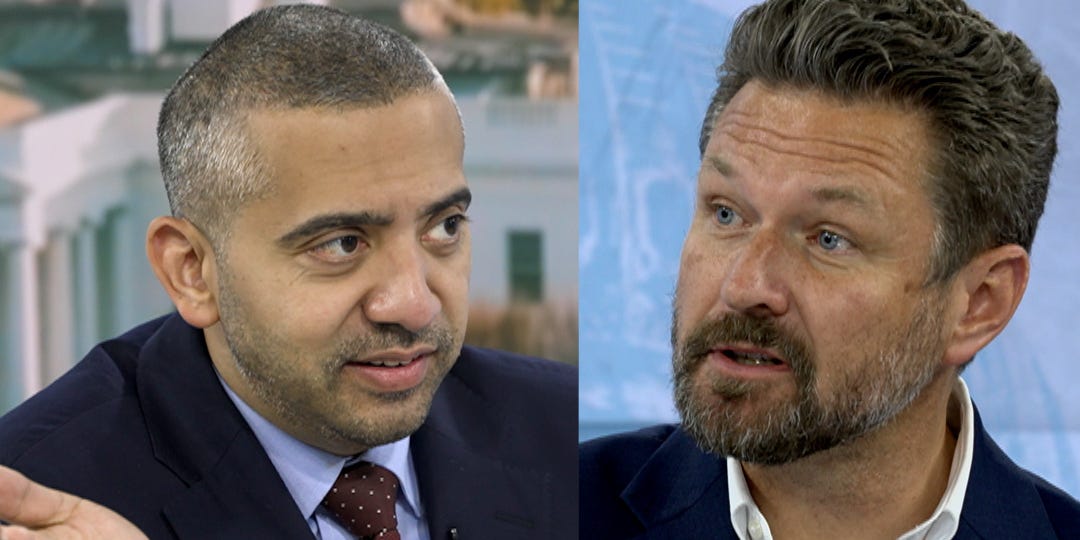
Photo via Zeteo

AGI, ASI, RSI? 9 Words and Acronyms You Need to Know to Understand the ‘AI Apocalypse’

Read the original at Zeteo ↗
Cite

Team Zeteo. (2026, September 22). AGI, ASI, RSI? 9 Words and Acronyms You Need to Know to Understand the ‘AI Apocalypse’. Zeteo. https://zeteo.com/p/agi-asi-rsi-superintelligence-meaning-artificial-intelligence-explainer

Dated when The Aporia collected the article, usually within hours of publication. Check the original for its exact date and byline.

Zeteo · collected 2026-09-22 · by Team Zeteo commentary

Quick Summary

This article provides definitions for key terms related to artificial intelligence (AI) to help readers understand discussions about potential risks and benefits, including AGI, ASI, RSI, and "alignment." AGI specifically refers to a theoretical AI system with human-level or superior capabilities across various domains. The article notes that while some experts view AGI as achievable in the near future—OpenAI CEO Sam Altman predicts it by year-end—others see it as more of a marketing term without clear practical implications yet.
Written by AI on 2026-09-23, from this article's own text only (the story summary below draws on all the coverage).

AI analysis

Story summary

In recent weeks, AI researchers and executives have warned that AI could kill all humans within 10 years, though not everyone agrees on the severity of this prediction, with some seeing it as marketing hype. Regardless of differing opinions, there is consensus that AI poses significant risks and will continue to transform daily life. To help navigate the complex terminology surrounding these risks and potential benefits, a guide outlines nine key terms: AGI (Artificial General Intelligence), which refers to systems capable of performing any intellectual task a human can; ASI (Artificial Superintelligence), denoting an AI surpassing human intelligence across all domains; RSI (Rapidly Self-Improving AI), where an AI rapidly evolves beyond initial capabilities; and "alignment," the goal of making AI actions beneficial to humans. These terms are often used without standardized definitions but provide a framework for understanding the evolving technology's impact.


Written for “Artificial Intelligence Terminology” on 2026-11-18, grounded in this article and the 0 other(s) covering the same event.

Compared with similar articles

This article reads leans right and hedges 7% of its claims. Each row says how that neighbour differs.
The Straits Times
Hedges 3 of 12 claims Outlet record 64/100
“The articles discuss different aspects of AI concerns and developments without reporting on a single, identical incident.”
NBC News
Leans left further left than this Hedges 17 of 61 claims Outlet record 78/100
“The articles discuss different aspects of AI risks and concerns without focusing on the exact same incident or time.”
Semafor
Hedges 0 of 4 claims Outlet record 65/100
“The articles discuss different aspects of AI without focusing on a single specific event.”
ABC News (AU)
Hedges 19 of 51 claims Outlet record 67/100
“The articles discuss different aspects of AI risks and concerns, with Article A focusing on general warnings about AI apocalypse and hype, while Article B specifically addresses biological threats from AI.”
Al Jazeera
Leans left further left than this Hedges 6 of 43 claims Outlet record 60/100
“Article A discusses general warnings and debates about AI risks, while Article B specifically mentions US and China's stances on AI development calls.”
The Straits Times
Leans strongly right further right than this Hedges 1 of 23 claims Outlet record 64/100
“The articles discuss AI-related topics but do not describe the same specific incident or occurrence.”
Daily Mail
Leans right Hedges 3 of 38 claims Outlet record 70/100
“The articles discuss different aspects of AI and do not describe the same specific incident.”

Story

Artificial Intelligence Terminology
Technology · 1 article(s) covering the same event.
How this article was measured signals, leaning charts, publisher record, byline, topics and claims

Signals How these are calculated →

Claims extracted
14
sentences that state something as happening or true
Uncertain
7%
1 of 14 hedged ("reportedly", "may", "according to")
Leaning
Leans right
expected in commentary, which argues a position · beta estimate
Publisher signals
not measured
these signals count newsroom corrections; Commentary has none to count
Outlets on this story
1
Technology
Same framing elsewhere
1
articles that frame the event the way this one does
Analyzed 2026-09-23 · how these are computed

How this is being covered How these are calculated →

Article leaning vs. publisher reliability
Source leaning vs. consistency

Publisher

Zeteo · 275 article(s) · 0 correction(s) detected
No corrections detected for this publisher. That may mean careful reporting, or simply that nothing has been checked.

Who wrote this

Team Zeteo
55 article(s) here · 1 carrying a prediction
He is shaking things up for House Democrats already, describing the United States as in “crisis,” denouncing the “oligarchs” and Democratic neoliberals, and warning that democracy may not survive the 2028 election if the Democrats don’t take action now.
If you would like to watch the full documentary, and support this type of journalism and the work we’re doing at Zeteo, please consider upgrading to a paid subscription.
These children will sadly not be the last to die due to Israel’s genocide of Gaza.
On CNN, Attorney General Todd Blanche suggested he would follow through with Trump’s orders and launch investigations into Democrats, claiming that since the election, some lawmakers “have done nothing but threaten everything that’s happening in this administration.”
Even a lame duck Trump will continue harming democracy, undermining the Constitution, and harming societies worldwide.
It’s too early to tell what, if any, meaningful impact Tuesday’s election in the U.S. will have on the U.S.-Israel relationship, but it’s clear much of America – and the world – is demanding Israel be held accountable for its actions.
You’ve probably heard about the big races – Abdul El-Sayed’s major win in Michigan, James Talarico in Texas, Keisha Lance Bottoms in Georgia – but there are a whole host of other major victories you may have missed that show not only how massive this blue tsunami was, but just how unsuccessful Trump’s anti-DEI campaign and racist policies have been.
The live stream featured an all-star roster of special guests, including Rep. Greg Casar, Mahmoud Khalil, Michigan State Rep. Alabas Farhat, former Rep. Andy Levin, United Auto Workers president Shawn Fain, Dearborn Mayor Abdullah Hammoud, and more.
We might go live as early as 8pm ET (5pm PST / 1am GMT) if results from other races start pouring in.
Will Trump’s warmongering, vile racism, and brazen corruption be punished?
Wire or desk byline, not an individual reporter.
Also by Team Zeteo
Nothing else under this byline is closely related to this article, so these are simply their most recent.
All 55 articles by Team Zeteo →

Topics

Anthropic ChatGPT Claude OpenAI

Subjects

Anthropic ORG · 1× Dario Amodei PERSON · 1× OpenAI ORG · 1× Sam Altman PERSON · 1×

Narrative

Regardless of where you are on the contentious issue, one thing is clear: AI poses enormous risks, and whether regulation or a slowdown happens or not, the technology itself isn’t going anywhere and will likely continue to change the way we live.
framing: assertive · carried by 1 article(s) · first seen 2026-09-23
The headlines are hard to miss: AI could kill all humans in 10 years, a growing number of AI researchers and executives have warned in recent weeks.

Claims (14 extracted, 1 hedged)

The headlines are hard to miss: AI could kill all humans in 10 years, a growing number of AI researchers and executives have warned in recent weeks. uncertain
number → miss → weeks
Not everyone believes it’s as dire as some are making it out to be, and instead see much of the hype as a marketing campaign designed to fill the pockets of Big AI. asserted
it → believe → AI
Regardless of where you are on the contentious issue, one thing is clear: AI poses enormous risks, and whether regulation or a slowdown happens or not, the technology itself isn’t going anywhere and will likely continue to change the way we live. asserted
we → pose → way
That’s why it’s important to understand the confusing word salad of phrases and acronyms researchers and experts often use to describe the fast-developing technology, its risks, and its potential benefits. asserted
researchers → ’ → technology
To help, we’ve put together a quick cheat sheet of nine of the most common confusing terms – from AGI to ASI to RSI to “alignment” – you should know. asserted
you → help → alignment
Many of these terms don’t have universally agreed-upon definitions and refer to theoretical concepts that some experts don’t even think are possible, but here’s how best to think about them: 1. Artificial General Intelligence (AGI) asserted
think → have → Intelligence
While popular AI applications like Claude or ChatGPT can be impressively capable with specific sets of tasks, artificial general intelligence (AGI) would match or exceed human capabilities across different areas. asserted
intelligence → match → areas
There is no single definition of AGI, but you can think of it as an AI system that can learn, solve problems, and generally operate much like – or better than – a human. asserted
that → be → human
People can have relationships with others and make their own decisions. asserted
People → have → decisions
Chatbots, while impressive, are only able to generate text that’s similar to what they’ve been trained on, based on a prompt. asserted
they → generate → prompt
A theoretical AGI model would have the same flexibility that humans have. asserted
humans → have → that
AGI remains a hypothetical term. asserted
AGI → remain → ?
But OpenAI CEO Sam Altman says his company will reach AGI by the end of the year. asserted
company → say → year
Anthropic CEO Dario Amodei, however, says AGI is just a “marketing term,” though he has admitted that we are on the verge of creating AI systems that are “better” than humans at most things. asserted
that → say → things
Give feedback · no sign-in needed

No sign-in needed for now. Your note is sent without a name, so it cannot be answered.

History Support