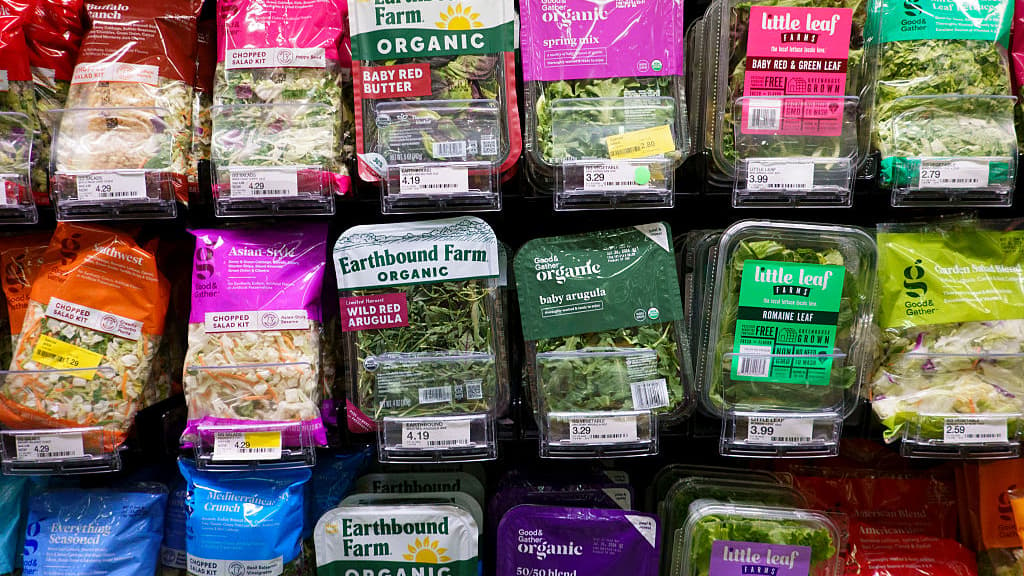
This summer, it’s been hard for consumers to know what to put in their grocery cart.
asserted
consumers → know → cart
Recalls have affected hundreds of products, including lettuce, which was linked to a Cyclospora outbreak; eggs and jalapenos that were connected with salmonella; and blueberries that were potentially contaminated with E. coli.
asserted
that → affect → coli
These incidents have left shoppers across the United States wondering whether this summer has been a particularly bad one for foodborne illnesses.
asserted
summer → leave → illnesses
Here’s what to know—and why consumers may be perceiving a greater number of outbreaks than usual, despite what the data shows.
uncertain
data → ’ → what
According to federal data, the number of food recalls regulated by the U.S. Food and Drug Administration (FDA) is relatively on par with an average year.
uncertain
number → accord → year
In the past decade, the U.S. has seen a range of 400-800 annual recalls.
asserted
U.S. → see → recalls
But what stands out in 2026 is the severity of some of the outbreaks caused by contaminated food this year.
asserted
stands → stand → food
“I don't know that I would necessarily say there are more outbreaks,” says Janet Hamilton, the executive director of the Council of State and Territorial Epidemiologists.
asserted
Hamilton → know → Epidemiologists
“However, what I would say is the scale and magnitude of outbreaks that we're facing right now are unprecedented.
asserted
we → say → that
It's like we're being eclipsed by the scale and magnitude of these outbreaks with the staffing levels that we have.”
asserted
we → eclipse → that
The summer’s Cyclospora outbreak linked to iceberg lettuce alone sickened more than 10,000 people, caused over 400 hospitalizations, and led to at least two deaths, according to the U.S. Centers for Disease Control and Prevention (CDC).
Epidemiologists believe it could be among the largest documented foodborne illness events in U.S. history.
uncertain
it → link → history
"We've never seen anything like that before,” Hamilton says.
asserted
Hamilton → see → that
The volume of food affected is higher than average
While the total number of recalls has been about average, USDA-regulated recalls affected more than 37 million pounds of food during the first half of 2026—the highest it has been in a decade.
asserted
it → affect → decade
At the same time, epidemiologist and former CDC adviser Katelyn Jetelina says that it’s very hard to tell just how bad this summer’s outbreaks have been—and our lack of federal data does not help.
“Our data is just not great in the United States,” she tells TIME.
asserted
she → say → TIME
“We’re patching things together to try to figure out what is reality versus concern and public perception, and it's hard to know where the line is.”
asserted
line → patch → concern
“That’s what's most frustrating for me as an epidemiologist as well as a mom,” she adds.
asserted
she → ’ → epidemiologist
There are seasonal factors, and surveillance has improved
asserted
surveillance → be → ?
It’s normal for foodborne illnesses to peak in the summer, since warmer temperatures help bacteria and other organisms multiply.
asserted
bacteria → ’ → summer
But this is a consistent seasonal threat, epidemiologists say, and not specific to 2026.
asserted
epidemiologists → say → 2026
There has also been an increase in media attention around food safety, which can make it seem like the magnitude of any given event is higher than it actually is.
asserted
it → make → event
This increased coverage is partially due to improved surveillance tools.
asserted
coverage → increase → tools
Laboratories are better equipped than ever to detect foodborne illnesses, track how bacteria multiply, and find links between patients.
asserted
bacteria → detect → patients
Because we have more information than ever on some of these bacteria, and we are able to process data faster than ever before, this means that the information can be quickly and easily shared with the population—which potentially makes it feel like the country is experiencing more outbreaks, when consumers are really just seeing more updates.
asserted
consumers → have → updates
Federal staffing shortages may be weakening the safety net
Experts say that while we are able to more quickly detect and identify food safety issues in past decades, health departments at the federal and state levels have experienced significant decreases in funding and staffing—potentially weakening food safety oversight.
uncertain
departments → weaken → oversight
It can be hard to tell how this is impacting outbreaks.
asserted
this → tell → outbreaks
One potential outcome is having less ability to monitor and control an existing outbreak, Hamilton says.
asserted
Hamilton → have → outbreak
“Health departments are mounting responses quickly, but when the outbreaks need additional sustained surge support, the system is quickly overwhelmed,” she says.
asserted
she → mount → support
“That leads to situations like what we have seen with Cyclospora.
asserted
we → lead → Cyclospora
This would have been a complicated outbreak to begin with, and then when you don't have the staffing to keep pace with the level of detailed interviews that you need, the ability to rapidly control the outbreak diminishes.”
asserted
ability → begin → outbreak
Hamilton and her colleagues at the Council of State and Territorial Epidemiologists conduct regular surveys to track staffing levels in state and territorial health departments, and their recent reports found that one-third of public health officials in state health departments have left their positions since the Trump Administration took control in 2025.
asserted
Administration → conduct → 2025
On the federal level, some of the staffing cuts were led by the Department of Government Efficiency.
asserted
some → lead → Efficiency
Federal cuts to the CDC and FDA also affect state and local health departments, since federal funds provide more than half of their total budgets, according to KFF.
uncertain
funds → affect → KFF
Hamilton says that public health officials are like a “protective shield” around the complicated food systems in our country.
asserted
officials → say → country
Workers look at data “carefully and thoughtfully,” interview people impacted by foodborne illness, and “tease apart” what foods might be contaminated.
uncertain
foods → look → illness
This work is harder with fewer staff members who are stretched increasingly thin.
asserted
who → stretch → members
Even advanced tracking and surveillance technology may not be able to counter the loss of knowledgeable human engagement amid these outbreaks.
uncertain
technology → counter → outbreaks
“Our food supply chains are complicated, and I don't know that people really appreciate the detailed work and the complexity that goes behind understanding where foods and ingredients come from and exactly how people are exposed,” she adds.
asserted
she → know → where
Jetelina adds that part of the role of public health officials is distinguishing “correlation from causation”—a consideration that applies directly to questions about whether and how staffing and funding cuts have affected responses to illness outbreaks this year.
asserted
cuts → add → outbreaks
Reduced oversight may have allowed some contamination events to go undetected or unaddressed, while staffing shortages may have delayed the collection and dissemination of information that could have helped officials contain outbreaks and reduce the risk to consumers.
uncertain
officials → allow → consumers
But without further investigation, it is difficult to determine exactly how the cuts affected the number of recalls, the speed of outbreak responses, or other key measures in 2026.
asserted
cuts → determine → 2026
…and 9 more, not listed.
 The Aporia