Toronto operagoers have been treated to a pair of mighty performances in two Verdi workhorses this year.
asserted
operagoers → treat → workhorses
First came Canadian Sarah Dufresne, who made a ravishing Canadian Opera Company (COC) debut as Gilda in “Rigoletto.”
asserted
who → come → Rigoletto
Now, Kathryn Lewek is delivering an equally impressive COC debut in the company’s latest revival of “La Traviata,” in which she plays the French courtesan Violetta Valéry, whose lavish lifestyle can’t shield her from a debilitating illness and heartbreak at the hands of her lover, the nobleman Alfredo.
asserted
lifestyle → deliver → lover
Lewek’s performance is one that, from her opening aria, grabs the audience by the collar and doesn’t let go until her last breath, one that manages to make the Four Seasons Centre for the Performing Arts feel like a private salon, as if we’re right there with Violetta, tracing her steps in her final, tragic weeks.
asserted
we → open → weeks
Throughout, Lewek demonstrates the breadth and ease of her technical ability.
asserted
Lewek → demonstrate → ability
Pianissimo passages are rendered with an ethereal shimmer, floating above the stage, lingering with haunting resonance.
asserted
passages → render → resonance
Particularly in the opera’s third act, after Violetta is convinced by Alfredo’s father, Giorgio, to end their relationship, Lewek marvellously, yet subtlety, conveys her character’s vulnerability.
asserted
Lewek → convince → vulnerability
But there’s power to Lewek’s Violetta as well.
asserted
Violetta → ’ → ?
And when she opens up, she reveals a robust, mellifluous sound, especially in her lower register.
asserted
she → open → register
It’s a performance, without question, that is the highlight of director Arin Arbus’ production, returning to the COC for the third time since it debuted in Toronto over a decade ago.
asserted
it → ’ → Toronto
But it’s too bad that Lewek is paired with a co-star who struggles to match her level.
asserted
who → ’ → level
Long Long, the Chinese tenor who was one of the saving graces in a calamitous COC production of “Faust” two years ago, delivered a surprisingly wobbly opening-night performance as Alfredo.
asserted
who → save → Alfredo
Though he possesses a bright, ardent voice, Long’s loose vibrato occasionally distorts the melodic line, pushing it sharp.
asserted
vibrato → possess → it
His acting also leaves much to be desired.
asserted
acting → leave → much
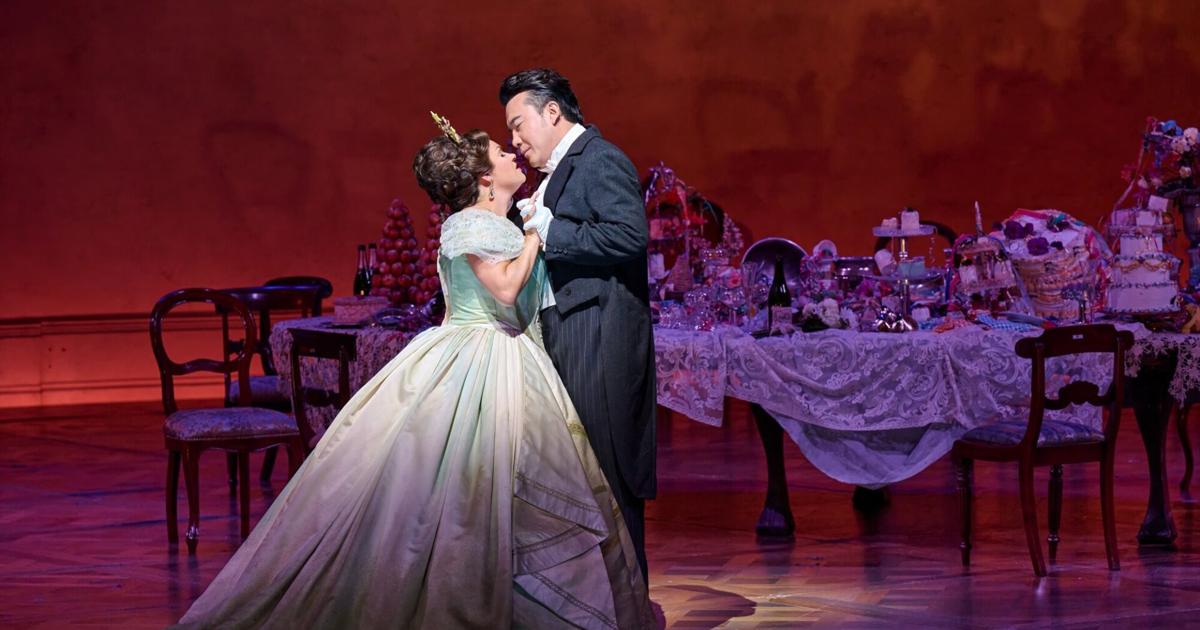
Arbus’ original staging, replicated here by revival director Mo Zhou, burns with passion, offering many intimate moments between Violetta and Alfredo.
asserted
staging → replicate → Violetta
But Long rarely conveys the stakes of their relationship.
asserted
Long → convey → relationship
His movement comes across as measured and unnatural, hands often dangling by his sides in clenched fists.
asserted
hands → come → fists
His Alfredo feels less like a rebel going against the rigid rules of French society than an awkward teenager stumbling through his first love.
asserted
Alfredo → feel → love
Lewek is better matched in her few scenes with Russell Braun as Giorgio, Alfredo’s father, who only wants the best for his son.
asserted
who → match → son
The Canadian baritone produces a warm sound matched with a stage presence that, captivatingly, teeters between sympathetic and threatening.
asserted
that → produce → sympathetic
Arbus’ production remains one of the gems in the COC’s repertoire.
asserted
production → remain → repertoire
And what it does best is capture the excess, but also the superficiality, of the world in Verdi’s “La Traviata.”
asserted
does → capture → Traviata
This is a world of colourful, even gaudy, decadence, where tables overflow with sweet treats and libations, and social gatherings are accompanied by music and dancers.
asserted
gatherings → overflow → music
(The opulent sets are by Riccardo Hernandez, while the period costumes are designed by Cait O’Connor.
asserted
costumes → design → O’Connor
But it’s also a world where all that can so quickly be stripped away.
asserted
that → ’ → ?
By the third act, when Lewek’s Violetta is resigned to her deathbed, Arbus’ production becomes eerily naked.
asserted
production → resign → deathbed
Gone are the resplendent sets, replaced by greying walls and austere lights (designed by Marcus Doshi) that cast tall, ghostly shadows.
asserted
that → go → shadows
Even the orchestra, led competently by visiting conductor Paolo Carignani, sounds more naked and exposed, with murmuring, isolated string passages accentuating how death, for Violetta, merely lurks around the corner.
asserted
death → lead → corner
“La Traviata” roughly translates from Italian into English as “the wayward woman.”
asserted
Traviata → translate → woman
But Arbus’ production is really more about the waywardness of the world — the illusion of social stratification, how social order can so easily slip into disorder.
asserted
order → slip → disorder
It’s a production that whips up a storm and at the eye of this hurricane is Lewek’s Violetta, the gale-force presence who gives this work its shape.
asserted
who → ’ → shape
 The Aporia