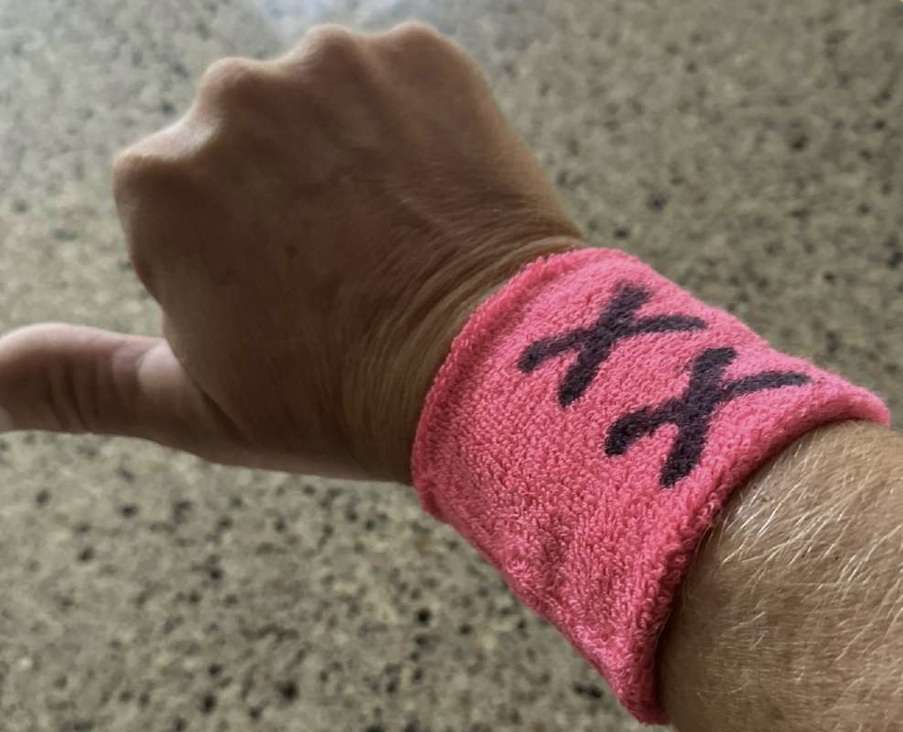
Some excerpts from the longish opinion today in Fellers v. Kelley, written by First Circuit Judge Sandra Lynch, joined by Judge Jeffrey and Howard:
On September 17, 2024, [plaintiffs] were instructed by Bow High School officials to remove pink "XX" wristbands they wore in protest while watching their daughters (in [one plaintiff's] case, granddaughter) play in a girls' soccer game against a team with one transgender athlete.
asserted
daughters → write → athlete
Further sanctions followed….
asserted
sanctions → follow → ?
[W]e conclude that appellants have established a likelihood of success as to their viewpoint discrimination claim arising from the sanctions imposed on them for their passive speech in wearing these wristbands….
uncertain
appellants → conclude → wristbands
The district court analyzed the school playing fields and adjacent parking lot, as appellants requested, under the mode of First Amendment law applicable to limited public fora as to impermissible viewpoint discrimination….
asserted
appellants → analyze → discrimination
The] appellee school district argues that this case must be analyzed more in the mode of Tinker v. Des Moines Independent Community School District (1969) … [and other cases that] recognize the particular interests inherent in the public elementary and high school settings, and the necessary discretion given to public school administrators in the difficult job of running public schools….
asserted
that → argue → schools
Neither of those two different classic modes of First Amendment analysis, urged on by these opposing parties, is a perfect fit for this public high school speech case, and we note that the Supreme Court has not addressed this precise question.
asserted
Court → urge → question
We need not and do not reach the complex question of which (or whether) either of these alternate modes is the appropriate First Amendment type of analytical model for the facts of record here.
asserted
either → need → record
We conclude that on these facts the differences in analysis would not affect the outcome here….
asserted
differences → conclude → outcome
The school's legitimate interest in regulating certain kinds of speech on the playing field sidelines … is not demonstrated by the evidence in this record.
asserted
interest → regulate → record
There is no evidence that appellants' protest caused a material disruption [which would be relevant under Tinker].
asserted
which → be → Tinker
There was no disruption until school officials chose to intervene, after which the referee suspended the game for approximately fifteen minutes and the school officials chose to impose restrictions on appellants' speech and impose sanctions.
asserted
officials → be → sanctions
The appellants did not stage any pregame demonstrations; did not march, shout, chant, or otherwise disrupt the game; and did not confront Tirrell or any other player.
asserted
appellants → stage → Tirrell
Instead, they waited until halftime before donning the "XX" wristbands in a passive, silent gesture of protest.
asserted
they → wait → protest
There is also no evidence of harassment, given there is no evidence in the record that any player actually saw the wristbands.
asserted
player → be → wristbands
The lack of any evidence demonstrating harassment also defeats the school district's argument that it had an affirmative duty under Title IX to protect students from the speech in which appellants engaged….
asserted
appellants → demonstrate → which
While it is true that appellants chose to protest at the September 17 game because of Tirrell being a player, the record does not contain evidence of appellants engaging in harassment before or during the game.
asserted
appellants → choose → game
To the contrary, appellants did not shout, chant, make threats, or aggressively gesture at Tirrell to communicate their views against her participation.
asserted
appellants → shout → participation
Nor is there evidence that Tirrell or any other player even saw the wristbands or "subjectively perceived the environment to be hostile or abusive."
asserted
environment → see → wristbands
Principal Fisk did note the challenges that transgender students face generally.
asserted
students → note → that
But Fisk did not ever explain how appellants' display of the "XX" symbol constituted sufficiently severe or pervasive conduct to qualify as harassment under Title IX.
asserted
display → explain → IX
And to the extent the district court concluded that the silent wearing of "XX" wristbands on the sidelines of a school soccer field, without more, always amounts to harassing speech, we disagree.
asserted
we → conclude → speech
The school district responds that it may make "predictive judgment[s]" to proactively prohibit conduct that it believes will eventually lead to an actionable Title IX claim…..
uncertain
it → respond → claim
We agree with the general proposition.
asserted
We → agree → proposition
But the argument fails on the facts of this record….
asserted
argument → fail → record
We need not decide in this appeal whether and under what circumstances passive speech, on other facts, consisting of displaying the "XX" symbol on school property during school events could be reasonably thought to be harassing.
uncertain
speech → need → events
But appellants' silent display of the "XX" symbol at the September 17 game fell short of harassment and disruption, and we conclude that the district court erred in holding that the school's interest in prevention of harassment justified the prohibition.
asserted
interest → fall → prohibition
While it is a closer issue, we conclude that the school district likely was not justified in sanctioning the appellants for their passive speech based on its concerns derived from the earlier exchanges with the appellants and other parents.
asserted
district → conclude → appellants
None of appellants' reported discussions, including their possible different methods of protest reported to Bow High School officials by other parents, led to any attempt to "heckle and intimidate" Tirrell.
asserted
None → report → Tirrell
It is true that Fellers initially attempted to convince his daughter to get the Bow High School players to wear the wristbands, but his daughter informed him that "she could not get full support from the team and was afraid that it would divide them."
uncertain
it → attempt → them
Fellers's Facebook post made the night before the game encouraged spectators "to protect the integrity and safety of female athletics" and "come out to support our XX Lady Falcons and show your solidarity with our girls' team."
asserted
post → make → team
But the record shows only that the appellants and perhaps others of similar views engaged in a passive protest and only started the protest at halftime.
asserted
appellants → show → halftime
While the school district may make predictive judgments about whether disruption may occur and "need not be certain of its forecast," it cannot use those projections to immediately suppress a passive, silent protest, that did not impair any of the legitimate school administration interests recognized by the Supreme Court.
uncertain
that → make → Court
This brings us to the school officials' other stated reasons for sanctioning appellants.
asserted
This → bring → appellants
Superintendent Kelley stated that the "XX" symbol conveyed an "exclusionary" message about gender.
asserted
symbol → state → gender
Principal Fisk, who ordered appellants to remove the wristbands, described the symbol both as "hateful" and as "anti-trans."
asserted
who → order → anti
As to these justifications for the sanctions imposed, the record evidence demonstrates the likelihood that the school district imposed sanctions on the appellants' wearing of the wristbands because it disagreed with the protest message conveyed….
asserted
it → impose → message
Although the leading Supreme Court case on viewpoint discrimination in academic limited public fora, involved colleges and not high schools, and involved a limited public forum, both significant differences, Rosenberger's anguage about viewpoint discrimination is pertinent.
asserted
anguage → lead → discrimination
"The government must abstain from regulating speech when the specific motivating ideology or the opinion or perspective of the speaker is the rationale for the restriction.
asserted
ideology → abstain → restriction
The characteristics of the school as a place of learning reinforce that administrators cannot favor one side of a debate involving parental speech on an issue of prominent public concern, and which, in those parents' views, concerned the safety of their children.
asserted
which → reinforce → children
As the Supreme Court stated in a case involving a high school football game, "learning how to tolerate diverse expressive activities has always been 'part of learning how to live in a pluralistic society.'"
asserted
learning → state → society
…and 7 more, not listed.
 The Aporia