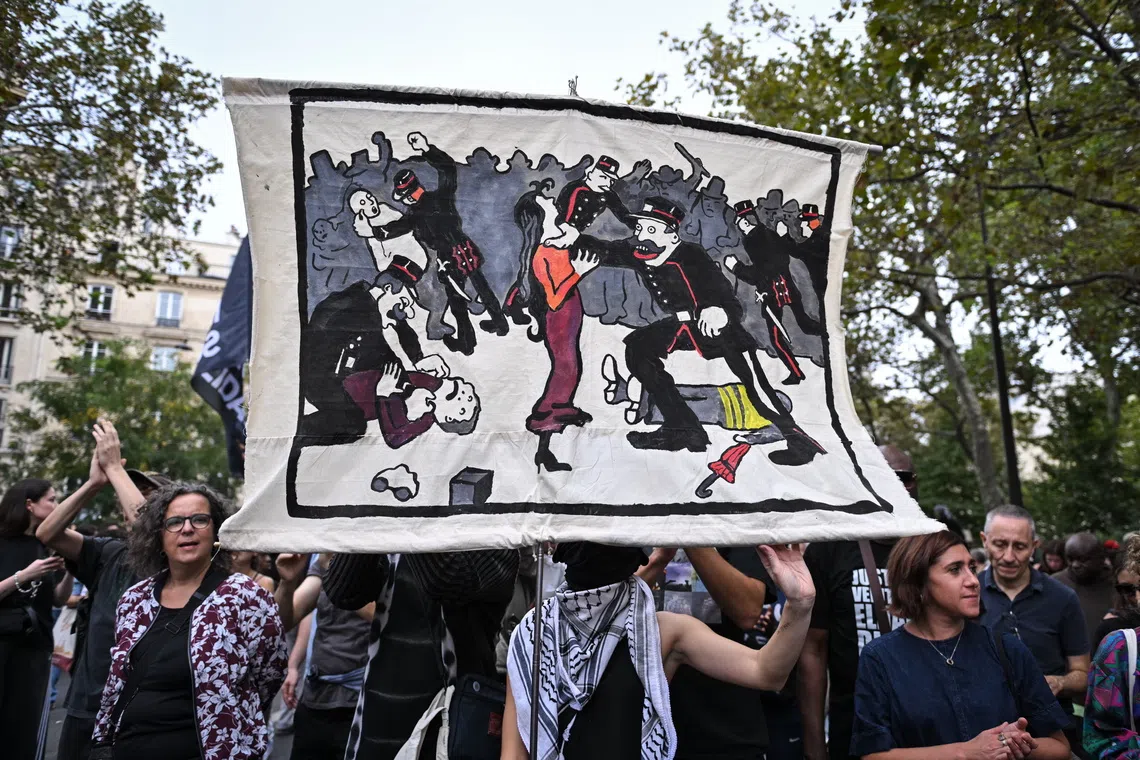
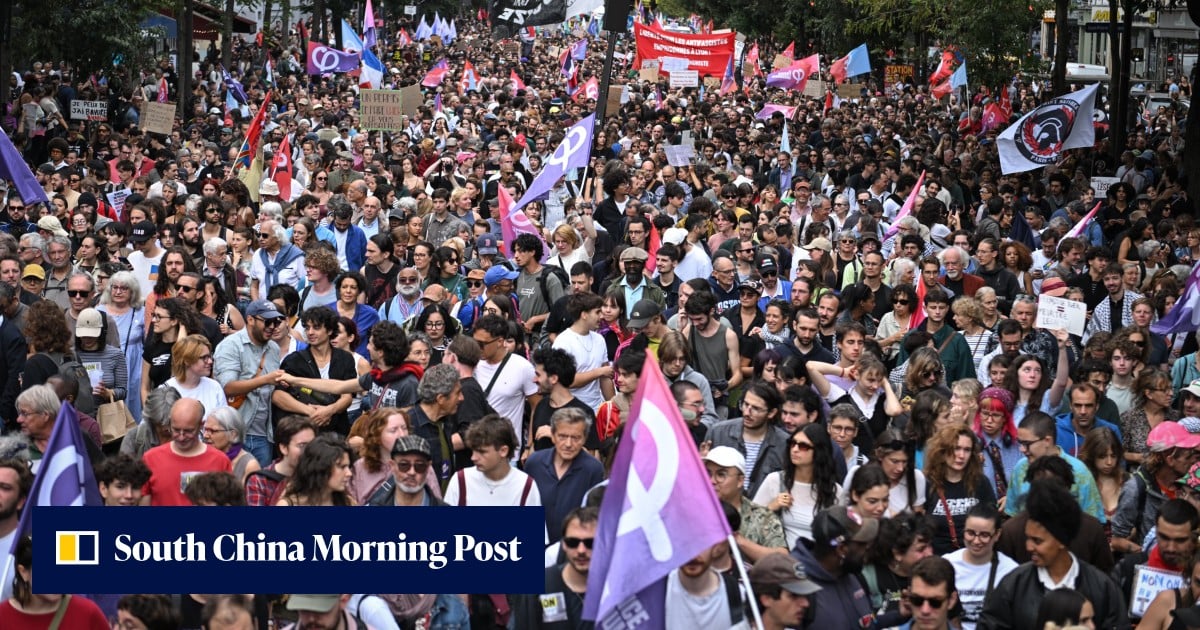
France was rocked by protests on Sunday against proposed legislation that would grant additional protections to law enforcement officials using firearms in the line of duty.
asserted
that → rock → duty
The new law, which critics say will grant police officers a “licence to kill”, comes amid mounting allegations of police brutality in recent years, particularly against immigrant communities in the banlieues – outlying suburbs – of Paris and other major cities.
asserted
critics → say → Paris
Recommended Stories
list of 3 items- list 1 of 3Russia seizes assets of French firms, summons UK envoy over Ukraine support
- list 2 of 3Lebanon security talks in Paris to focus on post-UNIFIL alternatives
- list 3 of 3Macron and Aoun discuss efforts to back Lebanon’s army, end Israeli attacks
asserted
3Macron → seize → attacks
So what is the new law, why is it controversial and where have protests taken place?
asserted
protests → take → place
Where are protests taking place and what are they about?
Thousands of people marched in France over the weekend against the proposed law which would grant armed police and gendarmes the presumption of self-defence if they use their weapons while carrying out their duties.
asserted
they → take → duties
This means that complainants against police brutality would have to prove that a police officer was not acting in self-defence.
asserted
officer → mean → defence
A petition against the bill lodged by Issam El Khalfaoui, whose son was shot dead by a police officer in 2021, on the website of the National Assembly, gathered 730,000 signatures earlier in the year, but a parliamentary law committee dismissed it in July.
asserted
committee → lodge → July
Thousands of people marched in the French capital Paris over the weekend while many other protests were organised in cities across France.
asserted
protests → march → France
Police said about 8,200 people demonstrated in the southern French cities of Lyon and Toulouse alone.
asserted
people → say → Lyon
Protests were also held in Marseille, southern France, and Rennes, in the country’s northwest, where officials said eight people were arrested and three police officers were injured when projectiles were thrown at them.
asserted
projectiles → hold → them
Left-wing politicians, rights groups including Amnesty International, France’s magistrates’ union and the country’s League of Human Rights also participated in the protests.
asserted
groups → include → protests
What is the new police law coming in?
asserted
law → come → ?
Draft bill 691 aims to establish a presumption of legitimate self-defence or of legality for law enforcement officials when they use their firearms in the line of duty.
asserted
they → aim → duty
In other words, the proposition would mean that officers who killed someone in a shooting incident would be presumed to have acted within the limits of the law, unless there was proof to the contrary.
asserted
who → mean → contrary
The text says the presumption of self-defence “may be rebutted if the judicial investigation demonstrates that the use of weapons was manifestly disproportionate or contrary to the principle of absolute necessity established by law”.
uncertain
use → say → law
Deputies in the National Assembly approved the bill in July.
asserted
Deputies → approve → July
A vote on the proposed legislation will now take place in the Senate, the upper house of the French parliament.
asserted
vote → propose → parliament
Why is this new law being brought in?
asserted
law → bring → ?
A longstanding demand of France’s far-right National Rally party, the legislation was proposed by Member of Parliament Eric Pauget, from France’s right-wing Les Republicains (LR) party.
asserted
legislation → propose → party
Proponents of the law, including French Interior Minister Laurent Nunez, say it is an important legal measure, required to protect police officers working in dangerous conditions, particularly when tackling organised crime.
asserted
it → include → crime
What have the responses to the proposed law been?
asserted
responses → propose → law
Nunez told the French parliament in July that “it does not lead to penal irresponsibility – at any moment, if the circumstances are reunited, any prosecutor can reverse this presumption”.
asserted
prosecutor → tell → presumption
But critics say the measure amounts to a “licence to kill”.
asserted
measure → say → licence
Mathilde Panot, president of the hard-left France Unbowed (LFI) party, condemned the bill, saying “the police kill already”.
asserted
police → leave → bill
Addressing crowds in Paris during Sunday’s protest, she said, “In the Republic there can be no organised police impunity.
asserted
she → address → Republic
In the Republic, there cannot be a category of citizens who have the right of life or death over other citizens.”
asserted
who → have → citizens
Pouria Amirshahi, a left-wing lawmaker representing French residents overseas, also condemned the bill.
asserted
Amirshahi → represent → bill
“There will be more deaths – if you authorise someone to use their firearm with the idea that they won’t be accountable, then they will just shoot,” said Amirshahi.
asserted
Amirshahi → authorise → idea
“This law grants police impunity.”
asserted
law → grant → impunity
Amnesty International’s Cedric Picard, who took part in the Marseille protest, said, “We are afraid police violence would only grow with this law.”
Why is this new law controversial?
The United Nations has condemned the proposed law, saying it could “legitimise and normalise” violence against civilians.
uncertain
it → take → civilians
“The duty to investigate every potentially unlawful killing rests with the State,” said Morris Tidball-Binz, United Nations special rapporteur on extrajudicial, summary or arbitrary executions.
asserted
Binz → investigate → executions
“It cannot be displaced, in law or in practice, by requiring victims or their families to rebut a legal presumption that the use of potentially lethal force was lawful before the facts have been independently established.”
asserted
facts → displace → force
Tidball-Binz said that if the proposed legislation is adopted, it would violate Principle 9 of the UN Basic Principles on the Use of Force and Firearms by Law Enforcement Officials, which mandates strict limits on the use of lethal force.
asserted
which → say → force
Marie-Laure Geoffray, also of Amnesty International, echoed Tidball-Binz’s statement in July, saying that the law would slow down investigations into police violence, as the burden of proof would fall on the victims or their families rather than on the police.
asserted
burden → echo → police
Critics have warned the new law could trigger a rise in fatal shootings and a sharp decline in public trust in the police.
uncertain
law → warn → police
Do other countries have this law?
asserted
countries → have → law
Pauget, the MP who put the bill forward, said Italy’s anti-protest law is similar in nature.
asserted
law → put → nature
Proposed by Italian Prime Minister Giorgia Meloni’s far-right wing government and adopted in June 2025, the law introduced harsher penalties for protest-related offences, including property damage and sit-ins deemed disruptive, and granted broader powers to law enforcement officers.
It also allowed intelligence agents to commit certain “crimes” for national security purposes without facing prosecution.
asserted
agents → propose → prosecution
That law similarly prompted widespread demonstrations across Italy, with human rights organisations accusing the government of criminalising dissent, limiting civil liberties and restricting the right to protest.
asserted
organisations → prompt → right
When has the French police been accused of brutality?
asserted
police → accuse → brutality
…and 18 more, not listed.
 The Aporia