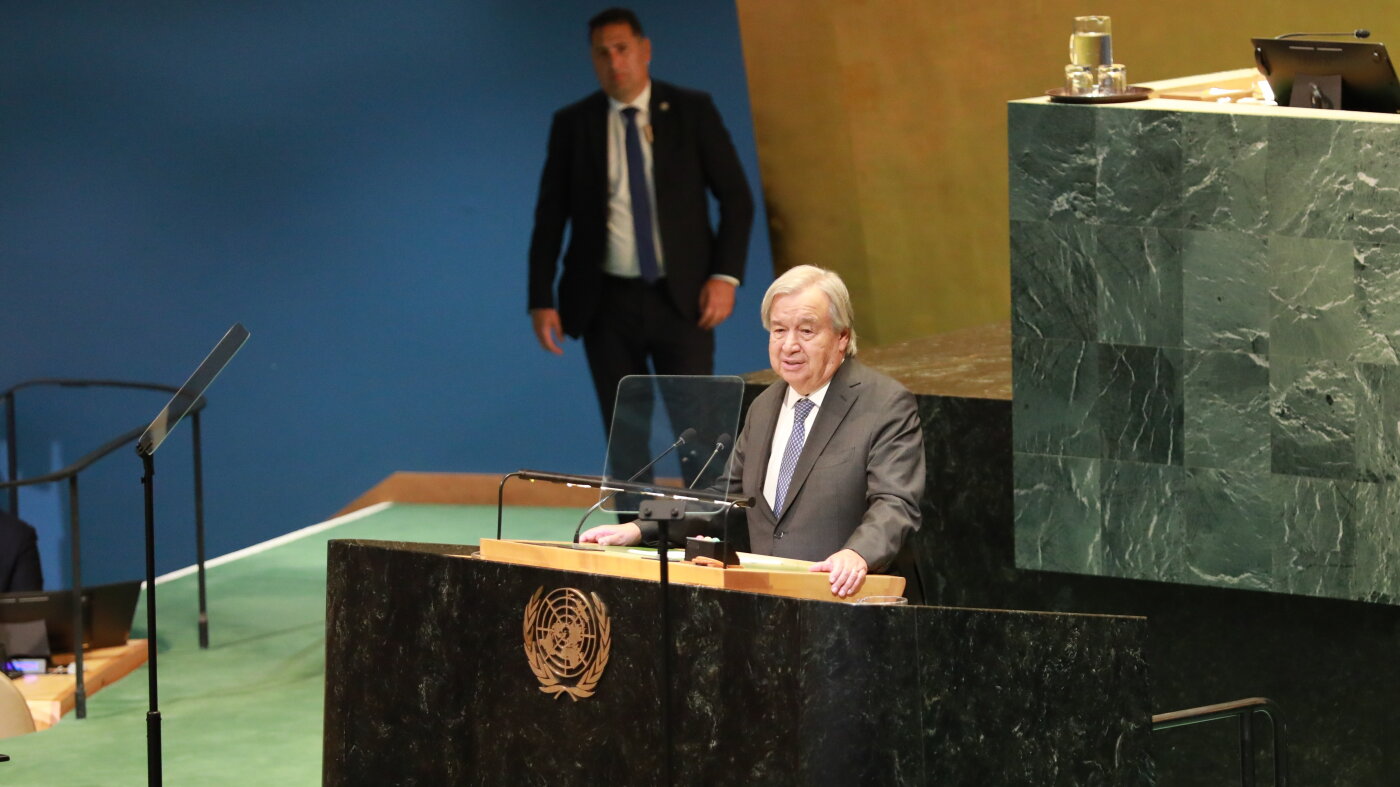
UN chief Antonio Guterres on Tuesday (September 22, 2026) delivered a powerful clarion call to global leaders to reform the UN Security Council to ensure that it reflects today’s world and has the legitimacy to deal with current geopolitical challenges.
asserted
it → deliver → challenges
This is the final high-level UN General Assembly week for Secretary General Guterres, whose second five-year tenure as head of the United Nations ends in December 2026.
asserted
tenure → end → December
“We must also reform the Security Council so that it reflects today’s world with the legitimacy and effectiveness that today’s challenges demand,” Mr. Guterres told world leaders in his address to the opening of the General Debate at the 81st session of the General Assembly.
asserted
Guterres → reform → Assembly
Mr. Guterres, delivering his last address to the high-level UNGA debate as UN Chief, said the Security Council was designed in the aftermath of World War II.
asserted
Council → deliver → II
“But the world has fundamentally changed since then.
asserted
world → change → ?
A change that is far from reflected in the Security Council.”
asserted
that → reflect → Council
He said the “most stunning example” of this is Africa.
asserted
example → say → this
“When the UN was founded, most of Africa was still under colonial rule.
asserted
most → found → rule
Today, Africa still has no permanent seat on the Council.
asserted
Africa → have → Council
This must change,” he said, to applause from the leaders in the UNGA hall.
asserted
he → change → hall
After ending his nearly 35-minute and final address, Mr. Guterres received a standing ovation from world leaders, Foreign Ministers, Ambassadors and diplomats and senior UN officials as he exited the podium.
“…Our institutions and systems of global governance continue to reflect the power realities and interests of a largely bygone age.
asserted
institutions → end → age
That is the defining challenge before us.
asserted
That → define → us
At the very moment when humanity faces an unprecedented convergence of threats, our mechanisms for collective action are under growing strain,” he said.
asserted
he → face → strain
The call by Mr. Guterres to reform the 15-nation body was among the strongest by him as the powerful UN organ remains deeply divided and polarised, failing to stop conflicts and fulfil its responsibilities of maintaining international peace and security.
asserted
organ → reform → peace
With sharp divisions among its five permanent, veto-wielding members — China, France, Russia, the U.K. and the U.S. — the Council has remained ineffective as conflicts rage from Gaza to Russia.
asserted
conflicts → wield → Russia
India has been at the forefront of years-long efforts to reform the Security Council, including expansion in both its permanent and non-permanent categories, saying the 15-nation Council, founded in 1945, is not fit for purpose in the 21st Century and does not reflect contemporary geopolitical realities.
asserted
Council → reform → realities
Delhi has consistently underscored that it rightly deserves a permanent seat at the horse-shoe table.
asserted
it → underscore → table
India is vying for a non-permanent seat at the UN Security Council for the 2028–29 term, elections for which will be held in June next year.
asserted
elections → vie → June
As he addressed world leaders gathered in the iconic UNGA hall, Guterres voiced concern over deepened geopolitical divides, intensified inequalities and frayed trust.
asserted
Guterres → address → divides
Mr. Guterres said that at a time when new centres of economic, political and technological influence have emerged, and humans are increasingly handing over power to machines, “our institutions and systems of global governance continue to reflect the power realities and interests of a largely bygone age."
“That is the defining challenge before us.
asserted
That → say → us
At the very moment when humanity faces an unprecedented convergence of threats, our mechanisms for collective action are under growing strain,” he said.
asserted
he → face → strain
The Security Council is paralysed, but the UN is not broken, says Guterres
Mr. Guterres emphasised that “we are clearly moving towards a multipolar world.
asserted
we → paralyse → world
And that movement is irreversible,” but cautioned that there are different ways that multipolarity can take shape.
asserted
multipolarity → caution → shape
In many respects, that is the trajectory we are on today,” he said.
asserted
he → say → respects
He also showed the international community the possibility of another path that goes towards networked multipolarity.
asserted
that → show → multipolarity
A world in which multiple centres of influence coexist within a common framework of international law and shared rules,” he said.
asserted
he → coexist → law
Mr. Guterres said such a world could help avoid hegemonic tendencies and what he described as the "Great Fracture: The division of the world into two rival blocs with separate economic, technological and security systems."
uncertain
he → say → systems
“A networked world recognises that no power can solve today’s challenges alone.
asserted
power → recognise → challenges
Of course, competition will remain a permanent feature of international relations.
asserted
competition → remain → relations
But competition does not mean confrontation,” he said.
asserted
he → mean → confrontation
Noting that healthy competition can drive innovation, strengthen resilience, and expand opportunity, Mr. Guterres said building such a future begins with a recognition, especially by superpowers that their power isn’t so super.
asserted
power → note → superpowers
"Their power has limits.
asserted
power → have → limits
The events of recent years have made that unmistakably clear.
asserted
that → make → years
Military power alone cannot secure peace.
asserted
power → secure → peace
Economic power alone cannot command stability.
asserted
power → command → stability
And technological power alone cannot guarantee security.
asserted
power → guarantee → security
“A networked multipolar world can create the conditions for more balanced and representative global problem-solving.
asserted
world → create → solving
But it requires a multilateral system centred in the UN that is balanced and representative.
asserted
that → require → UN
Strong, effective institutions that reflect the realities and the progressively changing relative weight of countries and economies in today’s world – not the power arrangements of 80 years ago,” he said.
asserted
he → reflect → world
 The Aporia