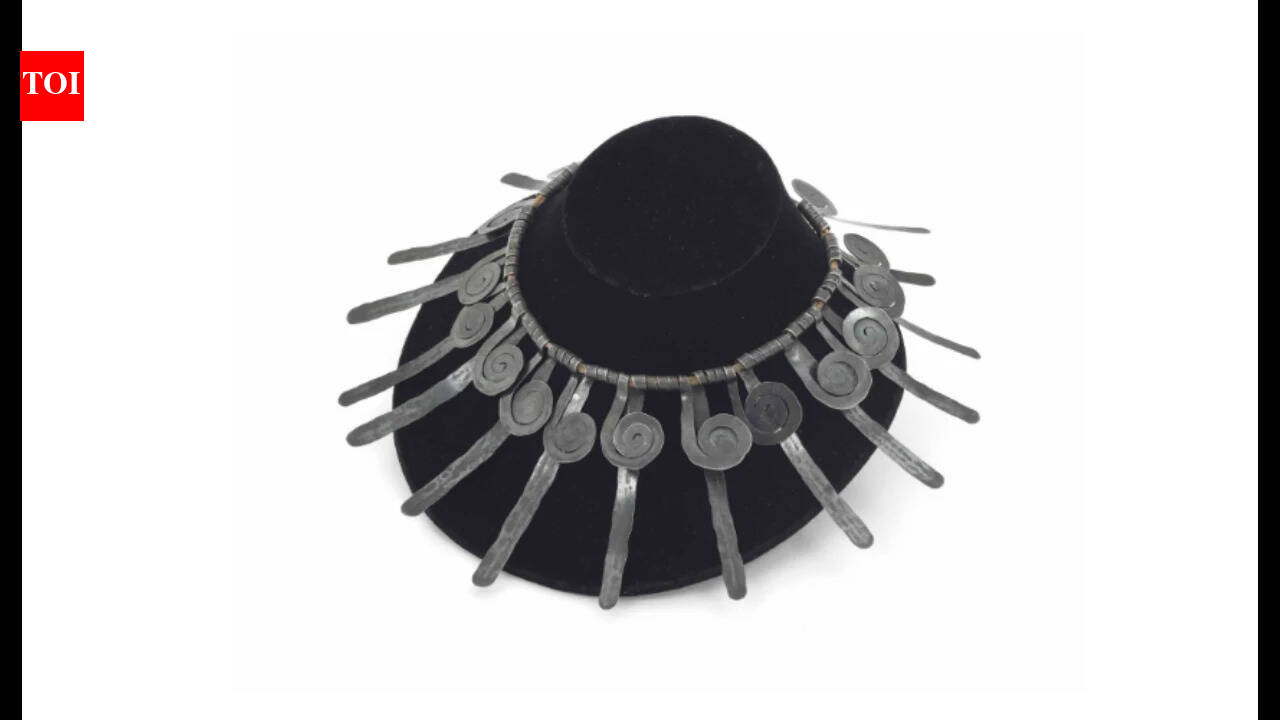
A woman, named Norma Ifill from Philadelphia, paid just $15 for an unusual necklace at a Brooklyn flea market, wore it for years without knowing its origin, and only later learned it was a work by Alexander Calder, according to a report by The Sun.
uncertain
it → name → Sun
The forgotten piece, a silver wire and cord necklace made around 1940, was consigned to Christie’s and sold in the auction house’s First Open sale of Post-War and Contemporary Art in 2013 for $267,750, including buyer’s premium.
asserted
piece → forget → premium
Christie’s results show the necklace, catalogued as “Untitled (Necklace),” achieved the high end of its $200,000 to $300,000 estimate, turning a thrift-store find into one of the standout stories of the sale.
asserted
necklace → show → sale
How a flea-market find becomes museum-quality art
The necklace’s journey began at a Brooklyn flea market, where the seller picked it up for $15 simply because she liked the way it looked.
asserted
it → become → way
For years it remained a personal accessory, worn without any thought of its potential value or pedigree.
asserted
it → remain → value
Years later, when Ifill visited an Alexander Calder jewellery exhibition at the Philadelphia Museum of Art and had it viewed by jewellery experts, they confirmed to her that it was indeed a long-lost piece by Calder, as per HuffPost.
asserted
it → visit → HuffPost
Only later did she discover that the piece was not a generic vintage item but a work by Alexander Calder, the American artist best known for his mobiles and stabiles but also a prolific creator of wearable art.
asserted
piece → discover → art
“I can’t believe I had a Calder necklace all this time and had no idea...
asserted
I → believe → idea
I wore it about four-five times max and every time I wore it, people always admired it," Ifill had told Bloomberg earlier.
asserted
Ifill → wear → Bloomberg
Calder began making jewellery in the 1920s and 1930s, often crafting pieces from wire, sheet metal and found objects.
asserted
Calder → begin → wire
He made many of these works as gifts for friends, fellow artists and dancers, and they circulated informally through social circles rather than through galleries.
asserted
they → make → galleries
Over time, some of these necklaces, bracelets and brooches have been recognised as legitimate extensions of his sculptural practice, with the same playful sense of line, balance and movement that defines his larger works.
asserted
that → recognise → works
The Christie’s sale and where the necklace fit
asserted
necklace → fit → sale
The necklace appeared in Christie’s First Open sale of Post-War and Contemporary Art, a two-day auction in New York held on September 26 and 27, 2013.
asserted
necklace → appear → September
The sale was designed to bring together works by established names and emerging artists at accessible price points, with many lots estimated in the tens or low hundreds of thousands of dollars.
asserted
lots → design → dollars
In total, 281 of 399 lots offered were sold, generating $13.67 million and an 84 percent sell-through rate by value.
asserted
lots → offer → value
Lot 107 in the sale was described as “Alexander Calder (1898–1976), Untitled (Necklace), silver wire and cord, executed circa 1940.”
asserted
Lot → describe → 1940
It carried a pre-sale estimate of $200,000 to $300,000.
asserted
It → carry → 300,000
When the hammer fell, the final price, including buyer’s premium, was $267,750, placing it among the top results for jewellery and small-scale works at the auction.
asserted
price → fall → auction
The buyer was recorded as European Trade, suggesting the piece was acquired by a dealer or gallery acting on behalf of a collector.
asserted
piece → record → collector
Why Calder’s jewellery matters
Calder’s jewellery has long fascinated scholars and collectors because it blurs the line between functional object and sculpture.
asserted
it → matter → object
He often made pieces by hand, bending and twisting wire with pliers in ways that echo the construction of his mobiles.
asserted
that → make → mobiles
Many of the necklaces are abstract, relying on loops, spirals and open forms that move with the wearer’s body.
asserted
that → rely → body
In that sense, they are kinetic sculptures in miniature, designed to be experienced in motion rather than viewed statically on a pedestal.
asserted
they → design → pedestal
Art historians see these works as part of Calder’s broader experimentation with line and space.
asserted
historians → see → line
Just as his large-scale mobiles respond to air currents in a gallery, his necklaces respond to the movements of the person wearing them.
asserted
necklaces → respond → them
That connection between art and everyday life was central to Calder’s practice and helps explain why his jewellery has gained recognition and value in the secondary market, even though it was originally made outside the traditional gallery system.
asserted
it → help → system
From personal adornment to auction headline
For the original flea-market buyer, the necklace’s transformation from $15 accessory to six-figure artwork is a reminder of how much knowledge and context can change the meaning of an object.
asserted
knowledge → change → object
Worn for years as a simple piece of jewellery, it carried no special status until its attribution was confirmed.
asserted
attribution → wear → status
Once identified as a Calder, it moved from the realm of personal style into the world of post-war and contemporary art, where provenance and authorship drive value.
asserted
provenance → identify → value
The story also highlights how auction houses like Christie’s have become key players in shaping the market for artists’ jewellery.
asserted
houses → highlight → jewellery
By including the necklace in a major Post-War and Contemporary Art sale alongside paintings, photographs and sculptures by names like Andreas Gursky, Keith Haring and Kerry James Marshall, the auction house positioned it as a serious work of art rather than a decorative curiosity.
asserted
house → include → art
The strong result, near the middle of the estimate range, suggests that collectors are willing to pay significant sums for authenticated examples of Calder’s wearable art.
uncertain
collectors → suggest → art
What the sale says about the market
asserted
says → say → market
The First Open sale results, as summarised by Christie’s specialist Saara Pritchard, showed strong demand for both rising stars and established figures.
asserted
results → summarise → stars
Works by artists such as Tauba Auerbach and Oscar Murillo sold above their estimates, while rare vintage pieces by Alfred Jensen, Alexander Calder and Howard Hodgkin attracted competitive bidding.
asserted
pieces → sell → bidding
The overall total of $13.67 million was the highest ever achieved for a First Open sale of Post-War and Contemporary Art at Christie’s in New York at that time.
asserted
total → achieve → time
Within that context, the Calder necklace stood out not only for its price but for its narrative.
asserted
necklace → stand → narrative
A flea-market find that turned into a $267,750 sale is the kind of story that captures public attention and reinforces the idea that important works can still surface in unexpected places.
asserted
works → turn → places
For dealers, collectors and curators, it is a reminder to look closely at objects that might seem ordinary at first glance, especially when they bear the hallmarks of an artist known for working across media.
uncertain
they → look → media
…and 6 more, not listed.
 The Aporia