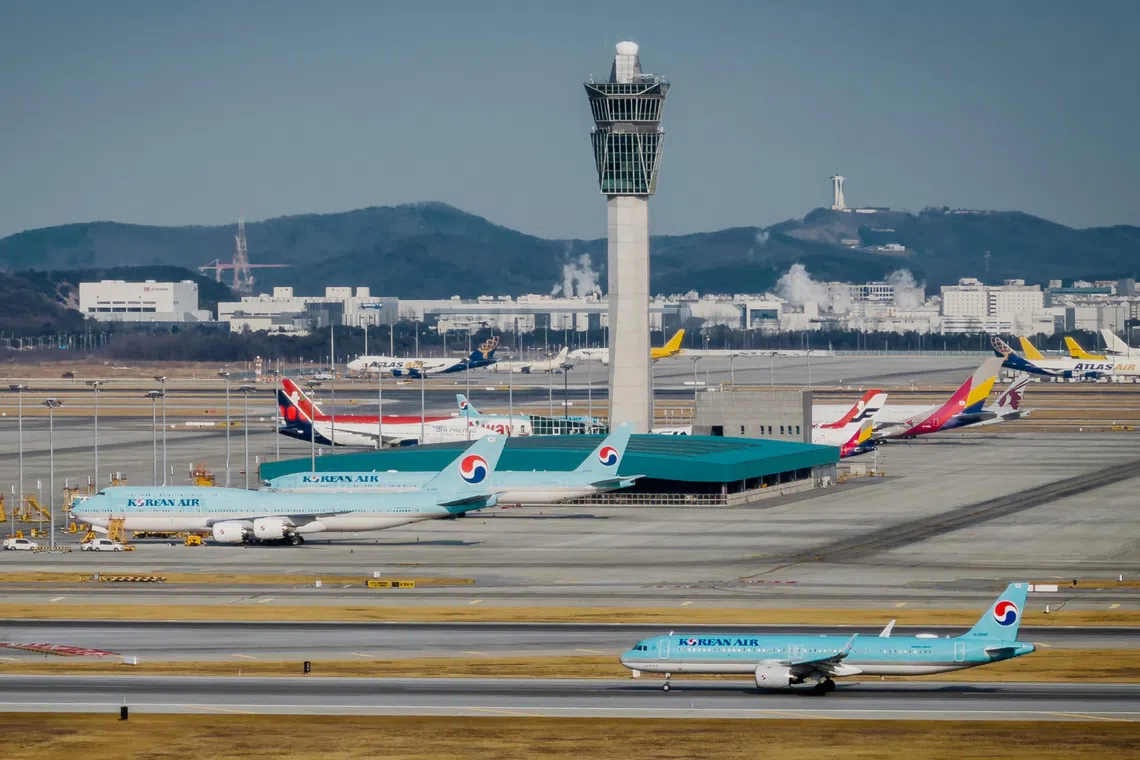
Experiencing turbulence: Gulf air hubs weather wartime downturn
AI generated
PARIS –
asserted
hubs → experience → downturn
After six months of war in the Middle East, the Gulf’s major aviation hubs are navigating turbulence as a hefty portion of their lucrative transit traffic opts for other airports such as Istanbul.
asserted
portion → navigate → Istanbul
Between April and June, business for Middle Eastern airlines – measured by passenger kilometres – was down 30 per cent, with that figure down close to 50 per cent on routes to Europe, according to the International Air Transport Association (IATA).
uncertain
business → measure → Association
In Dubai, the number of flight seats scheduled was down 15 per cent year on year in August, the biggest drop among the world’s top 10 airports, aviation data specialist OAG said, though the United Arab Emirates hub remained the world’s leading international airport by that measure.
asserted
hub → schedule → measure
The shock to the Gulf is significant because the region has made connecting travel a linchpin of its economic strategy.
asserted
travel → make → strategy
As recently as 2025, nearly one in six connecting passengers worldwide passed through the Middle East.
asserted
passengers → connect → East
These travellers represented nearly half of all traffic through Dubai and the UAE capital Abu Dhabi, and almost three-quarters of traffic through the Qatari capital Doha.
asserted
travellers → represent → capital
Since the outbreak of war on Feb 28, airspace restrictions over Iran and Iraq have taken a toll.
asserted
restrictions → take → toll
Risk-averse European carriers have cut services to the region, making Turkish Airlines “the big winner”, according to Paul Chiambaretto, an air transport specialist at France’s Montpellier Business School.
uncertain
Airlines → cut → School
With Russian airspace also off limits to many Western airlines, Istanbul’s strategic location has made it a desirable alternative to Gulf hubs, placing it at the “global centre of gravity for air transport”, Chiambaretto said.
asserted
Chiambaretto → make → transport
Istanbul is able to connect Europe to Asia with only a slight detour, he added.
asserted
he → connect → detour
Turkish Airlines’ customer base is up 5 per cent since the start of the conflict, with a decrease in capacity on Middle East flights offset by a 6 per cent bump on routes to Europe and a 16 per cent rise for East Asia.
asserted
decrease → offset → Asia
The national carrier has been “expanding strongly for several years, offers a very good product and relies on a modern airport”, Chiambaretto said.
asserted
Chiambaretto → expand → airport
In July, Istanbul’s main airport even overtook London Heathrow with more than eight million travellers.
asserted
airport → overtake → travellers
‘Structural’ change
The question is whether passengers will return to the Gulf once the situation stabilises.
asserted
situation → return → Gulf
Early in July, IATA was still describing the diversion of traffic as likely a temporary phenomenon.
asserted
IATA → describe → phenomenon
But the longer the conflict lasts, the greater the risk that these new aviation habits will become entrenched.
asserted
habits → last → ?
“This crisis, which initially seemed purely cyclical, is starting to become increasingly structural,” warned Chiambaretto.
asserted
Chiambaretto → seem → ?
The Gulf airlines are trying to regain ground.
asserted
airlines → try → ground
Early in August, Emirates said it had restored 92 per cent of capacity that had been planned before the war, while Qatar Airways claimed in mid-June to have brought back 85 per cent of its network.
asserted
Airways → say → network
UAE carrier Etihad was holding up even better: In August, it was the only one of the three major Gulf carriers to increase its capacity year on year, doing so by 9 per cent.
asserted
it → hold → cent
In the longer term, the Gulf hubs and their reliance on connecting flights are also under threat from the arrival of a new generation of aircraft capable of flying farther.
asserted
hubs → connect → aircraft
Single-aisle jets such as the Airbus A321XLR can now fly 11 hours carrying 200 passengers.
asserted
jets → fly → passengers
They can make direct routes between secondary cities profitable without passing through a hub, such as a route announced by United Airlines on Aug 25 from Washington to the French city of Toulouse, which will begin in April 2027.
asserted
which → make → April
Ultra-long-haul flights are also bypassing stopovers.
asserted
flights → bypass → stopovers
Australian airline Qantas plans to launch at the end of next year a 22-hour non-stop flight between Sydney and London using specially configured Airbus A350s.
asserted
Qantas → plan → A350s
 The Aporia