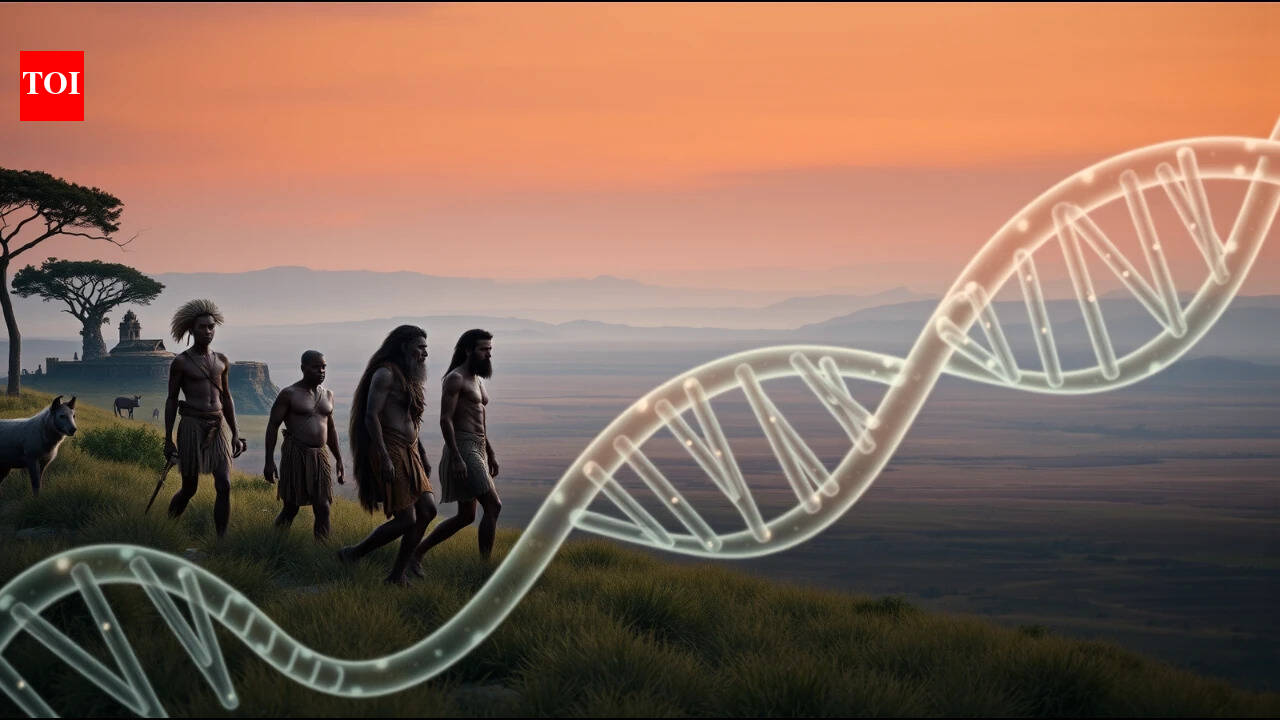
Modern humans already carry small amounts of Neanderthal and Denisovan DNA, evidence that our ancestors interbred with other human groups tens of thousands of years ago.
asserted
ancestors → carry → groups
Both lineages are known from ancient remains, including fossils from which scientists have successfully recovered DNA.
asserted
scientists → know → DNA
Now, researchers at the University of California, Berkeley have identified genetic signatures from 2 additional ancient human lineages whose DNA has never been recovered directly from a fossil.
asserted
DNA → identify → fossil
One appears to have split from the lineage leading to modern humans around 800,000 years ago before eventually interbreeding with an ancestral human population in Africa.
asserted
One → appear → Africa
The other is far older, splitting from the human lineage roughly 1.8 million years ago before its descendants passed genetic material into Denisovans, who later transmitted a small portion of it to modern humans.
asserted
who → split → humans
The findings suggest that ancient human evolution involved repeated encounters and exchanges between populations that have left almost no physical trace behind.
asserted
that → suggest → trace
How TRACE found ancient DNA without a fossil genome
asserted
TRACE → find → genome
According to UC Berkeley's own press release, the findings come from a technique called TRACE, short for TRacking Archaic Contributions via ARG Estimation, developed by a team led by Berkeley associate professor Priya Moorjani.
uncertain
findings → accord → Moorjani
Instead of requiring DNA from ancient bones, TRACE examines genomes from living people and uses an ancestral recombination graph to reconstruct how different sections of their DNA are related through generations.
asserted
sections → require → generations
Because DNA inherited from an ancient population can retain unusually deep ancestry, researchers can identify genomic regions that appear to have originated from populations whose physical remains have never yielded recoverable DNA.
asserted
remains → inherit → DNA
Berkeley graduate student Yulin Zhang, one of the study's first authors, said the method allowed the team to identify specific sections of modern genomes carrying ancestry from the previously unknown lineage.
asserted
team → say → lineage
Why researchers think one ghost lineage contributed DNA to all modern humans
The study, published in Science as
Recovering signatures of archaic hominin introgression using ancestral recombination graphs, identified ancestry from the first ghost lineage in both African and non-African populations.
asserted
study → think → populations
That distribution suggests the interbreeding event occurred before the population ancestral to present-day non-Africans left Africa.
uncertain
population → suggest → Africa
The researchers estimate that this lineage separated from the lineage leading to modern humans roughly 800,000 years ago, although the interbreeding itself occurred much later.
asserted
interbreeding → estimate → humans
Individuals today appear to carry roughly 0.5 to 1 per cent ancestry from this population, according to the Berkeley team.
uncertain
Individuals → appear → team
The result is particularly significant because there is no sequenced ancient genome that researchers can point to and say, "this is the source."
asserted
this → be → that
Instead, its existence has been reconstructed entirely from patterns preserved in the DNA of people living today.
asserted
existence → reconstruct → people
How Denisovans became the bridge between modern humans and an even older lineage
The second discovery came from a different genetic trail.
asserted
discovery → become → trail
Researchers examined genomes from populations in Oceania, where Denisovan ancestry is particularly high, and looked more closely at DNA segments inherited from Denisovans.
asserted
ancestry → examine → Denisovans
Within those segments, they detected evidence of ancestry from an even older population that had separated from the modern human lineage roughly 1.8 million years ago.
asserted
that → detect → lineage
The researchers estimate that this super-archaic population interbred with Denisovans more than 200,000 years ago.
asserted
population → estimate → Denisovans
Later, when Denisovans encountered and interbred with Homo sapiens, a small amount of that much older genetic material entered the modern human gene pool as well.
asserted
amount → encounter → pool
The result is effectively a chain of inheritance spanning several ancient populations: an unknown lineage contributed DNA to Denisovans, Denisovans passed some of it to modern humans, and researchers can now detect the signal despite having no directly sequenced genome from the original population.
asserted
researchers → span → population
What the hidden lineages reveal about the human family tree
The researchers cannot yet say exactly which ancient human populations these genetic signatures represent.
asserted
signatures → hide → populations
Their estimated divergence times overlap with several known groups from the Middle Pleistocene and earlier, but genetic evidence alone is not enough to assign either ghost lineage confidently to a particular fossil species.
asserted
evidence → estimate → species
What the findings do show is that the human family tree was considerably more interconnected than a simple sequence of populations replacing one another.
asserted
tree → show → one
Ancient groups repeatedly moved, encountered one another and exchanged genes, sometimes passing DNA through several populations before it eventually reached people alive today.
asserted
it → move → people
The researchers also found that some of the inherited ancient genetic segments occur in parts of the genome involved in biological functions including immunity and metabolism.
asserted
some → find → immunity
Such regions can be especially important during adaptation because genetic variants introduced through interbreeding may provide useful traits in changing environments.
uncertain
variants → introduce → environments
The broader picture emerging from TRACE is therefore not of isolated human lineages disappearing without a trace, but of ancient populations leaving genetic signatures that can remain detectable hundreds of thousands or even millions of years after the populations themselves have vanished.
asserted
populations → emerge → years
 The Aporia