That is 0 articles you have read today.
The Aporia is free and carries no advertising, so readers are the only
thing paying for it. If you are getting this much out of it, a small
donation is what keeps it independent.
Daily limit reached
You have read 0 articles today.
That is more than the 15 a day The Aporia gives away,
and well past what it can carry on nothing. Your allowance resets at
midnight.
There is no advertising here and nothing about you is sold, so readers
are the only thing paying for it. If the site is worth this much of
your day, it is worth a few dollars.
Everything else stays open: the
maps, the
directory and
search do
not count against this, and neither does re-opening something you have
already read today.
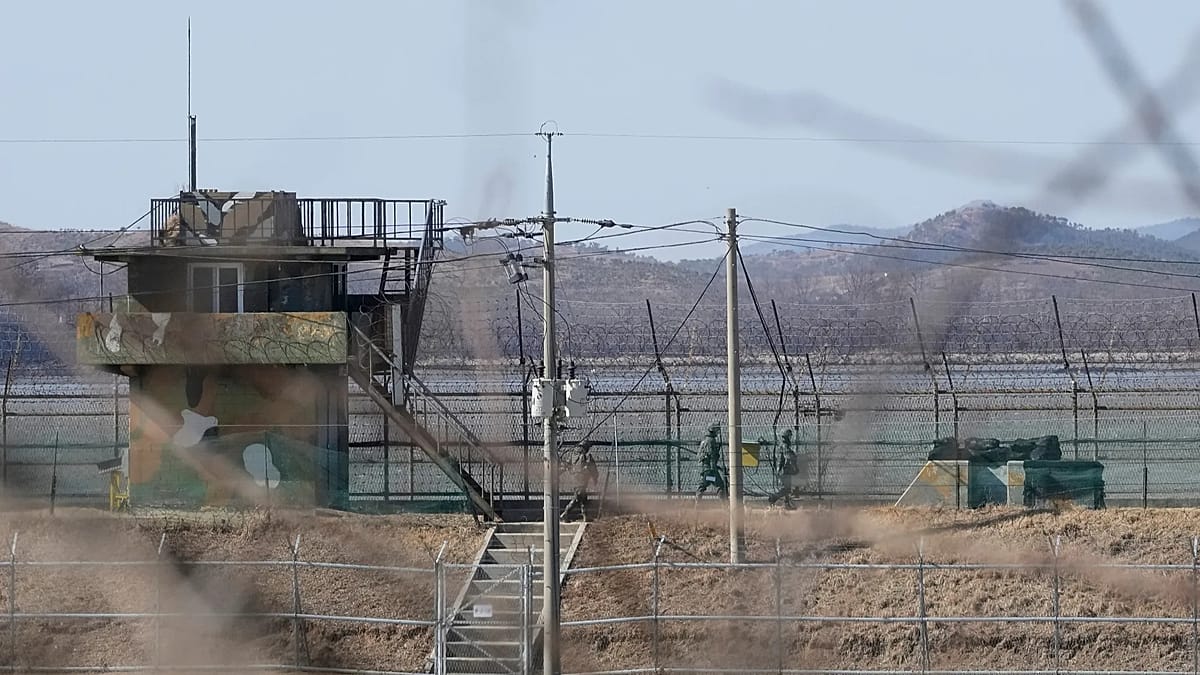
Three South Korean military officers were injured in an explosion near the heavily mined Demilitarized Zone (DMZ) on Monday, according to Seoul's Joint Chiefs of Staff. Two officers were evacuated by helicopter and one was transported by road before being airlifted; it is unclear if the blast was caused by a North or South Korean mine or another explosive device. The DMZ, which stretches 248 kilometers and remains highly fortified with an estimated 800,000 mines from both sides, continues to be a source of tension between North and South Korea.
Written locally by qwen2.5:14b on 2026-09-21,
using this article's own text rather than the other coverage of the
same event (that is the story summary below).
Story summary
On September 21, 2026, a suspected landmine blast injured three South Korean soldiers during an operation in the western sector of the Demilitarized Zone (DMZ) that separates North and South Korea. The incident occurred near the Military Demarcation Line within the DMZ, one of the world’s most heavily fortified and mined frontiers. Two soldiers were airlifted by helicopter, while a third was initially transported by road before being evacuated to a military hospital in Seoul.
The DMZ is 248 kilometers long and four kilometers wide, with an estimated two million mines scattered within it and nearby areas. The cause of the explosion remains unclear, though it has raised concerns about increased North Korean activity along the border as relations between the two nations continue to deteriorate. Since 2024, North Korea’s leader Kim Jong-un has designated South Korea as his country's principal enemy, prompting efforts to strengthen border defenses and fortifications.
Written for “DMZ Explosion Injures Soldiers” on 2026-10-05,
grounded in this article and the 5 other(s) covering the same event.
The Demilitarised Zone (DMZ) is a 248 km buffer zone separating North and South Korea and is one of the world’s most heavily fortified borders.
asserted
Zone → separate → borders
Three South Korean military officers were injured in an explosion during an operation near the heavily mined border with North Korea, Seoul's military said on Monday.
asserted
military → injure → Monday
The incident occurred south of the Military Demarcation Line inside the Demilitarised Zone (DMZ), one of the world's most heavily fortified and mined frontiers.
asserted
incident → occur → frontiers
Two of the injured officers were evacuated by helicopter, while a third was due to be transported by road before being airlifted, the Joint Chiefs of Staff (JCS) said.
asserted
Chiefs → injure → Staff
It was not immediately clear whether the explosion was caused by a North Korean mine, a South Korean mine or another explosive device.
asserted
explosion → cause → mine
The three officers "were injured by an explosion of unknown cause while conducting an operation at a location south of the MDL," the JCS said in a statement.
asserted
JCS → injure → statement
The military did not immediately provide details on the severity of their injuries.
asserted
military → provide → injuries
The DMZ is a 248-kilometre (154-mile) long and roughly four-kilometre (2.5-mile) wide buffer zone that has divided the Korean Peninsula since the 1953 armistice that halted the Korean War.
asserted
that → divide → War
While the zone itself is officially demilitarised, its northern and southern boundaries are among the world's most heavily fortified frontiers and remain littered with landmines.
asserted
boundaries → demilitarise → landmines
Around 800,000 mines are estimated to be buried around the area, according to military data cited by Yonhap news agency, many dating to the Korean War although mine-laying has continued in recent years.
uncertain
laying → estimate → years
Since 2024, after North Korean leader Kim Jong-un designated South Korea as his country's "principal enemy," Pyongyang's military has laid mines and built anti-tank barriers along the border as part of efforts to permanently seal off the frontier.
asserted
military → designate → frontier
South Korea's military has previously said several North Korean soldiers were killed or wounded in accidental mine explosions during those works.
asserted
soldiers → say → works
Landmine incidents have previously heightened tensions between the two Koreas.
asserted
incidents → heighten → Koreas
In 2015, two South Korean soldiers were seriously wounded when a landmine exploded on the southern side of the DMZ, with one losing both legs.
asserted
one → wound → legs
Seoul concluded that North Korean troops had crossed the MDL to plant the mines, an accusation Pyongyang denied.
asserted
Pyongyang → conclude → mines
The incident prompted South Korea to resume anti-North Korea loudspeaker broadcasts along the border.
asserted
incident → prompt → border
The latest incident comes as South Korean President Lee Jae-myung has repeatedly called for unconditional dialogue with the North, overtures that have so far gone unanswered by Pyongyang.
asserted
that → come → Pyongyang
 The Aporia